



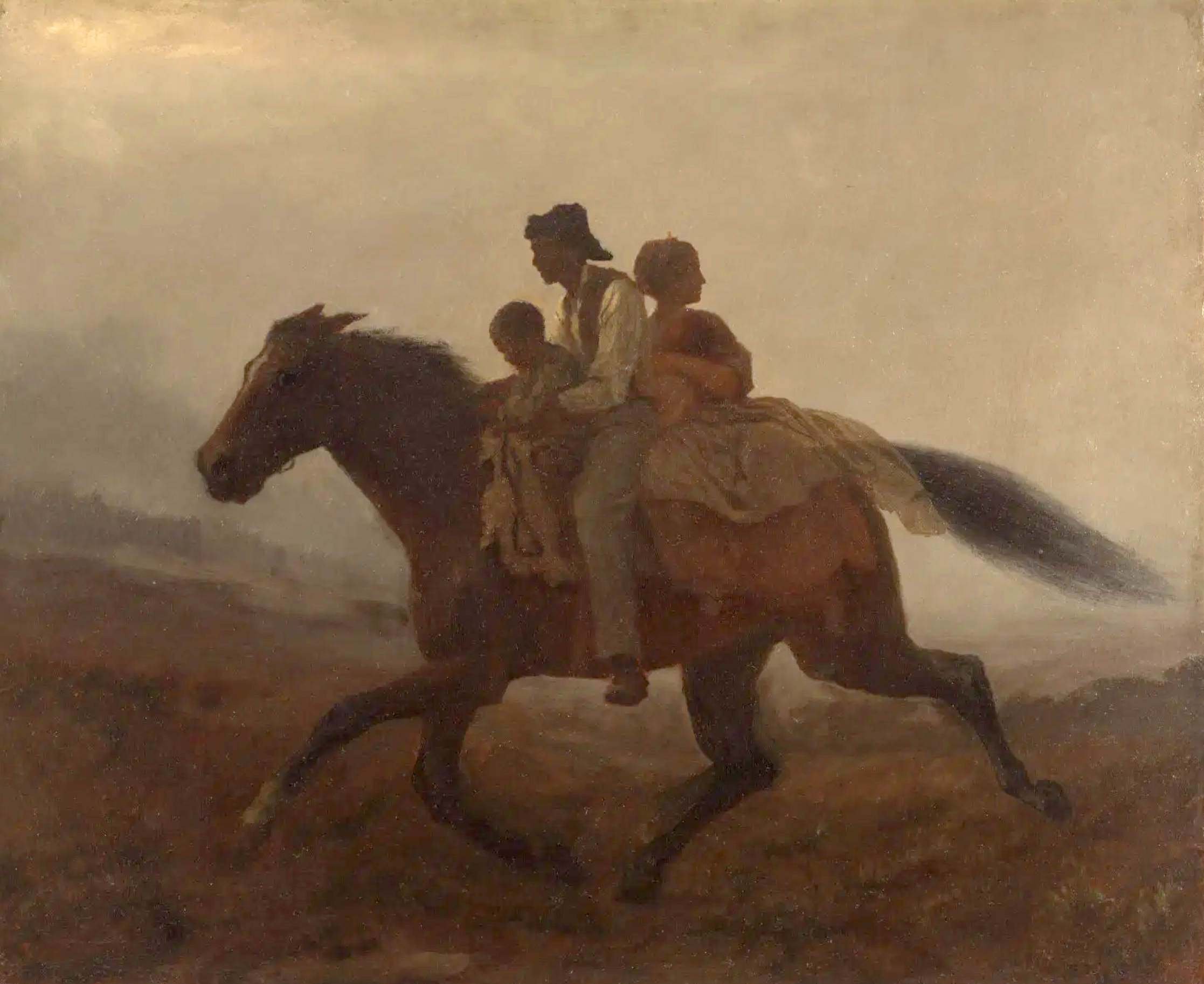
History is littered with unintended consequences. The Fugitive Slave Law of 1850 is a prime example. Envisioned by Congress as a way to ease tensions between the North and South over the brutally painful issue of slavery, the law served only to inflame regional resentments.
Many northerners were outraged that the law compelled them, under threat of a prison sentence or stiff fine, to work in support of slavery. Specifically, the law required state and local officials to assist the federal marshals who were tasked with capturing and returning people who had escaped slavery. Ordinary citizens could also be charged with a crime if they appeared to “knowingly and willingly obstruct, hinder, or prevent” the seizure of formerly enslaved people.
Just how badly Congress miscalculated when it passed the law became clear in Vermont, where the state government instituted its own new statute that made the federal law virtually impossible to enforce. In doing so, Vermont lawmakers argued that abiding by the Fugitive Slave Law would violate both the state and federal constitutions.
The Fugitive Slave Law was part of a series of measures that together became known as the Compromise of 1850. The laws were an attempt to balance the interests of the free and slave states in resolving issues arising from the Mexican-American War. Victory had brought vast new territories under American control, so Congress needed to decide whether any new states being created would allow slavery.
Hammered out by Whig Sen. Henry Clay of Kentucky and Vermont-born Democratic Sen. Stephen Douglas, who represented Illinois, the compromise admitted California as a free state and banned the slave trade in Washington, D.C. In return, Congress declared that settlers in Utah and New Mexico could decide whether those territories would permit slavery. In late September, Congress also passed the Fugitive Slave Law, which constituted a major strengthening of existing laws.
The Burlington Free Press responded to the Fugitive Slave Law with an extraordinary editorial. Ostensibly writing to formerly enslaved people who were seeking freedom, the newspaper declared: “We think a good deal more of the Slave who has the spirit to attempt to assert his ‘inalienable right’ to personal liberty, than we do of the white man who would deprive him of that right.”
“KEEP OUT OF THE CITIES,” the Free Press advised. “Morality and Humanity are dead among City officials. Where men congregate together in great herds, the vicious and inhuman altogether predominate over the just and humane.” Cities breed greed, the editorial argued, and their populations “care very little about freedom.”
Instead, the Free Press suggested Vermont as a destination: “Go into the uncontaminated COUNTRY. Seek our quiet Villages, where the Mountains and the Valleys and the Streams and the Air, are the Evangelists of Freedom. Go into an atmosphere that Slave-Catchers cannot breathe and live — where Habeas Corpus and Trial by Jury are substantial realities, and will not be surrendered till the Constitution authoritatively demands the sacrifice. Don’t stop among the many, but among the few. Come to Vermont….”
The Free Press editor was building on Vermont’s reputation as an opponent of slavery. In 1777, the state had become the first state to ban slavery in its Constitution. That prohibition, however, came with a significant asterisk — it did not apply to males under the age of 21 or females under 18. Also, there was no enforcement mechanism, so incidents of people being enslaved in Vermont continued into at least the first decade of the 1800s. In 1835, mobs in Rutland and Montpelier disrupted antislavery speeches by a touring minister. Vermont’s record was hardly unblemished.
But much had changed in Vermont during the decade and a half leading up to 1850. Antislavery speakers and writers had persuaded some Vermonters to change their views. More importantly, the war with Mexico offered tangible proof that, left unchecked, slavery would likely spread. The massive territories that came with the American victory threatened to bring perhaps five new slave states into the Union. Some Vermonters tolerated slavery where it had already taken root, but they were deeply uncomfortable with allowing it to grow.
In the weeks after the Fugitive Slave Law’s passage, Vermonters gathered at meetings around the state to denounce it. The Brandon Post listed six meetings in Rutland County alone (Brandon, Rutland, Wallingford, Castleton, Poultney and Benson).
The Friends of Liberty of Chittenden and Addison counties advertised an “Indignation Meeting” to be held in North Ferrisburgh to protest the law, which had made Vermont a “Slave Hunting ground and our citizens Human Blood Hounds.”
The Burlington Courier published an article headlined “How To Oppose the Fugitive Slave Law,” which argued against violence, rebellion and mob rule, “(a)nd yet we mean resolutely to oppose the (law), and to use all our influence to prevent its execution.”
While arguing for the law’s repeal, the St. Albans Messenger tried to calm people’s passions. “We hope that Vermont will express none of this fanatical law-breaking disposition which is too manifest in many places out of the state,” it wrote. “Ultraism and fanaticism of every kind is now glutting itself on the excitement in reference to this bill.” The newspaper urged Vermonters not to “imitate this worst feature of southern manners, and resort to nullification and anarchy.”
Vermont Gov. Charles Kilborn Williams, an ardent abolitionist who once declared that any law supporting slavery was “unchristian” and “violates the right of nature,” helped push a bill through the state Legislature that made the Fugitive Slave Law effectively unenforceable in Vermont.
The statute became known as the Habeas Corpus Law, after the legal procedure under which courts review whether a person is being detained or imprisoned legally. Under the new law, Vermont state’s attorneys of each county had to bring any alleged fugitive before a judge. If the judge failed to release the accused, the defendant had the right to a trial by jury, with the state covering the costs. Given public sympathies, Vermont juries would have inevitably ruled against the enslavers.
The law put Vermont at the forefront of the fight. No other state passed a new personal liberty law between 1850 and 1853, though some Northern states followed suit after that time.
Vermont’s law faced harsh criticism. Editors of the Daily National Intelligencer, a newspaper in Washington, D.C., that advocated gradual emancipation, wrote: “We are mortified and astonished that such an enactment should not only have received the concurrence of the Legislature, but the sanction of the Governor.”
President Millard Fillmore was outraged with Williams and the Vermont Legislature. “(T)he president and the entire Cabinet are very much exasperated at the course of proceedings in the Vermont legislature,” reported the Memphis Daily Eagle, “and … they determined to enforce the fugitive slave law in Vermont, should a case arise there, if it required the whole military force of the United States to do it.”
Opponents of the Vermont law criticized the state for engaging in “nullification,” the claim that individual states have the right to ignore federal laws they believe are unconstitutional. Two decades earlier, South Carolina lawmakers had famously attempted to nullify federal tariffs they said promoted Northern interests over Southern ones.
Supporters of the Vermont law, however, argued that the state statute was more constitutional than the federal one because habeas corpus and its guarantee of due process are enshrined in both the U.S. and Vermont constitutions.
The Natchez Democrat newspaper in Mississippi saw things differently. “This law is clearly and palpably unconstitutional, and ought to be and will be kicked out of every court in Vermont, unless the person sitting upon the bench is either a knave or a fool,” the paper opined. The newspaper said the law had been “smuggled through” the Vermont Legislature late in the session, when many lawmakers were absent “and the rest (charity would suppose) were drunk.”

In Memphis, Tennessee, the Daily Eagle saw Vermont’s effective blocking of federal law as dangerous. “A government that is not able to enforce its own laws is in reality no government at all. It is a shallow humbug, a misty form, a legal mockery; and should be done away with as speedily as possible,” the paper argued.
The editor of the Georgia Journal and Messenger informed readers that “the acts of the Vermont Legislature will be everywhere regarded in the South as a dangerous aggression.” Still, despite what the writer termed Vermont’s “treasonable propensities,” he wasn’t concerned. “Happily the State is so utterly insignificant in numbers, wealth, and influence that her efforts to sever the bonds which hold us together need excite no other feeling than that of contempt.”
The Argus of Albany, New York, however, saw Vermont’s action as a dangerous escalation of tensions. “Vermont has begun the work — South Carolina may follow,” the paper wrote. “What state will next step into the arena, and nullify another part of the constitution? If this work is to go on, where will the end be? What will become of the constitution or law, or of the Union itself?”
Indeed, a decade later, South Carolina took the ultimate step of nullification when it became the first state to secede from the Union.
Correction: An earlier version of this story misstated the effects of the Compromise of 1850 on slavery in Washington, D.C.

