


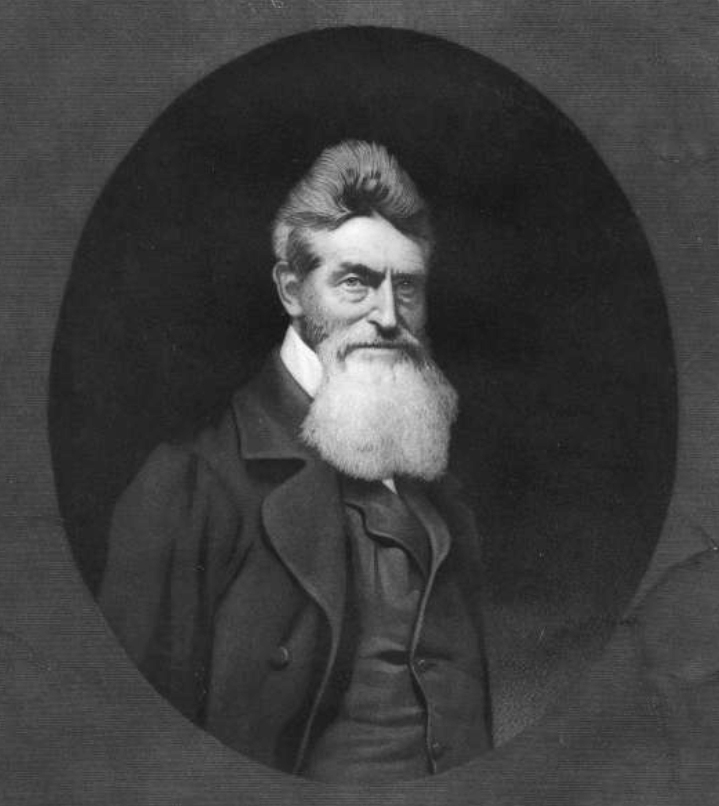
Joshua Young had a train to catch. Aboard it was his hero, the violent abolitionist John Brown, or his body at least. Brown had been executed days earlier, on Dec. 2, 1859, by the State of Virginia, and now his casket was headed home for burial in upstate New York.
Young shared Brown’s hatred of slavery and both favored scorched-earth tactics to defeat it. But whereas Brown had fought with weapons, Young used words.
As minister of Burlington’s Congregational Unitarian Church, Young attacked slavery from the pulpit. His sermons drew admirers but made enemies among the church’s more conservative members, some of whom owned mills that relied on Southern cotton picked by enslaved people.
Young was deeply saddened by Brown’s death. Brown had believed he was God’s agent, sent to destroy slavery. He and his followers, including five of his sons, had made headlines across America by brutalizing slave owners in the Kansas Territory during fighting over whether the region would be admitted to the Union as a free or slave state. They had gone so far as to murder in the name of abolition, slaughtering five slavery supporters. The killings had turned countless admirers against Brown but not Young.
The 37-year-old minister was still with him when Brown was hanged for seizing the federal arsenal at Harper’s Ferry, Virginia, in the misguided belief he would lead a slave rebellion with the arms he seized.
Lucius Bigelow, a friend and fellow abolitionist, stopped Young on a Burlington street and asked if he would like to attend Brown’s funeral, which would be held the next day in Elba, New York, in the Adirondacks. Though Young had never met Brown, he agreed to catch the afternoon train with Bigelow.
Young rushed home to tell his wife. She asked if it was wise to attend the funeral of such a controversial man. “It may not be wise, but I am going anyway,” he told her.
It was typical Young. Since arriving in Burlington in 1852 to lead his church (for which the city’s Church Street is named), he had often listened to his heart more than his head. But he understood the risks of following his convictions.
As the new minister, he sermonized that opponents of slavery had been “branded as fanatics, thrown out of office, dismissed from their parishes, politically proscribed, socially ostracized … not in the South, but in the North — in New England, in Massachusetts. God forbid that I should say in Vermont!”
At the time, Vermonters were not uniformly opposed to slavery, as we might like to believe. In the 1830s, a visiting abolitionist, the Rev. Samuel J. May, was run out of Montpelier by an angry mob. In Young’s own church, a sign had hung in the corner of the balcony that read “for colored people.” The congregation was willing to have Black people worship with them, but not in the same pews. In a show of changing views, the sign was taken down in 1845.
But some parishioners were rankled by Young’s unrestrained support of abolition, and by rumors his Willard Street home was part of the Underground Railroad.
While attending a Unitarian meeting in Boston in 1854, Young learned that a Black man who fled slavery had been jailed in the city under the Fugitive Slave Act and sent back south. Returning to Burlington, Young delivered a scathing sermon against the act, which he called “wicked and infamous — a dark deed of sin — and act of treachery.”
He said he intended to “fulfill a vow I then and there laid upon my soul, to plead the cause of the slave — the cause of human rights and liberty, with renewed zeal; to give whatever of talent God has bestowed on me, and whatever of influence I am permitted to exert, to the agitation and discussion of this evil, wrong, crime against man, sin against God — American Slavery.”
In 1858, some members of his congregation were angered when his name was listed among supporters of an anti-slavery convention in Rutland. Young backed out, saying the event was attracting too many followers of free love, spiritualism and other fringe beliefs. While the decision might have pleased some parishioners, it angered local abolitionists. Young offered to resign over the controversy, but his congregation rejected the idea by a vote of 40-2.
Young and Bigelow caught their train south to Vergennes, planning to meet Brown’s funeral cortege. They arrived to bad news: The procession was a day ahead of them. Brown’s widow and the others had spent the night before at the Bardwell House in Rutland, and at about that time would have been arriving at the family homestead in North Elba.
The men rushed by carriage to Panton to catch the ferry across Lake Champlain. This was the same ferry Brown had used to travel to Vergennes to buy supplies for his farm and the one that just hours earlier had conveyed his body across the lake toward his home.
A nor’easter blew in, pelting Young and Bigelow with rain and snow. The ferry wasn’t going anywhere until the weather cleared, the ferry operator announced. Although the men argued with the ferry operator for two hours, he remained unmoved.

But then suddenly the storm passed. The moon shining brightly, the men sailed across Lake Champlain. Arriving on the New York side after midnight, Young and Bigelow, drenched by now, knocked at a nearby farmhouse where they saw a light, and persuaded the farmer to drive them by wagon to the Browns’ home. They arrived early the next morning.
Entering the house, they found it crowded with family, friends, admirers and formerly enslaved people living in the area, who, Young said, “had personally known and admired the man who had gone forth from them a simple shepherd and now was brought back dead with a fame gone out into all the world.”
Wendell Phillips, a leading Boston abolitionist, stepped from the crowd and spoke quietly with Young.
“It would give Mrs. Brown and the other widows great satisfaction if you would perform the usual service of a clergyman on this occasion,” Phillips told him. For all Brown’s fame, or perhaps because of his notoriety, Young was the only clergyman present.
The service inside the farmhouse began at 1 p.m. After hymns, prayers and a eulogy by Phillips, the pallbearers brought the casket outside, placed it on a table, and opened it so mourners could take a last look at their hero.
“It was almost as natural as life,” Young would later write. “There was a flush on the face, resulting probably from the peculiar mode of his death, and nothing of the pallor that is usual when life is extinct.”
Consoling Brown’s widow, Mary, at graveside, Young recited the words of St. Paul: “I have fought the good fight, I have finished the course, I have kept the faith …”
Young later said of that day, “It was a scene of unutterable emotion, of touching pathos. … It was the old, old story of the prophet’s fate, ‘Truth forever on the scaffold, wrong forever on the throne.’ ”
Word of his role in the funeral reached to Burlington about the same time he did. The Burlington Sentinel expressed outrage that Young had quoted St. Paul in reference to Brown.
The paper wrote: “Was it to sanction publicly (Brown’s) murders that the Reverend Joshua donned his sacerdotal robes, left his Master’s flock, periled his valuable life by traveling night and day through one of the most tedious storms incident to this northern climate, and united with the infidel (Phillips) in casting pearls before swine and singing praises to the memory of a Felon, over his grave, made premature by his murders?”
Worse for Young, perhaps, were the snubs. At the next week’s Sunday services, Young noticed changes in his congregation. Some new faces had appeared in the crowd, but some familiar ones were missing. He sensed “a certain unmistakable indication that things were different.”
He learned what had happened the next day.
“Six of the wealthiest families of my parish had taken an oath and gone over to a neighboring church, not a few, of the class that follow in the train of the rich, were equally disaffected. On all sides the arrows of public rebuke began to fly. On the street I observed that old friends seeing me coming, suddenly remembered that they had forgotten something and turned back, or, crossing over passed by on the other side.”
His congregation, for the most part, had tolerated his abolitionist views, but presiding over the funeral of a murderer was too much.

Young withstood the slights for years — he still had admirers among the city’s abolitionists. But by 1862, the congregation decided it was time for a new minister. At a meeting of the church’s men, two-thirds voted that they were “not content” with Young. He immediately tendered his resignation and this time it was accepted.
(One intriguing but unproven theory suggests that Young was driven out by mill owners who were allegedly smuggling in Southern cotton during the Civil War. The mill owners feared, the theory goes, that Young would learn of the smuggling and expose them.)
Young left the Burlington church in March 1863 for a friendlier congregation in Massachusetts.
Recalling how the city had turned against him after the funeral, Young wrote, “I left Burlington a respected and beloved pastor. I returned to find myself in disgrace, an exile in the place of my residence, and little better than a social outcast. Honorable men there were who suggested that it would be a spectacle not for tears, to see me dangling at the end of a rope from the highest tree on the common, swinging and twisting in the wind.”
So just as John Brown had martyred himself for the cause of freedom, Young had sacrificed his career in Vermont for John Brown.

