

This commentary is by Héctor J. Vila of New Haven, an associate professor of writing and rhetoric at Middlebury College.

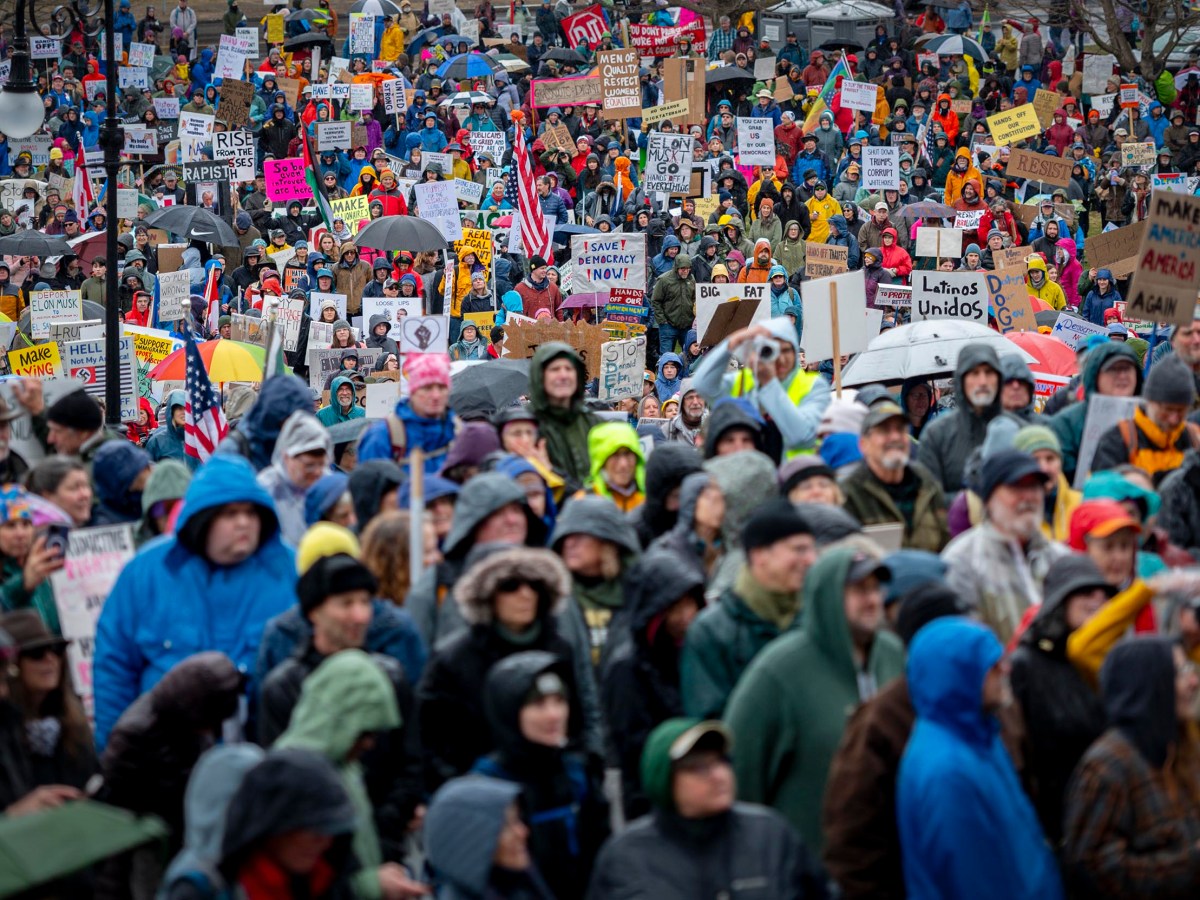
On a gray, overcast day in mid-April in Burlington, Vermont, I found myself among a crowd of fellow citizens protesting the Trump administration. We held signs: “I DESERVE AN EDUCATION,” “NATURE NOT DESTROY,” “DEFEND DEMOCRACY NOW.” My favorite: “IKEA HAS BETTER CABINETS.” We chanted, keeping rhythm with pounding drums: “MUSK HAS GOT TO GO.”
On April 5, 2025, the “Hands Off!” protests against the Trump administration took place across the United States — over 1,200 rallies nationwide. The largest gathering was in Washington, D.C., where over 100,000 people assembled on the National Mall. These protests demonstrated public dissent against the administration’s policies, including budget cuts, tariffs and the influence of Elon Musk’s Department of Government Efficiency, or DOGE.
But as we marched up Church Street, I was somewhere else. I was having an out-of-body experience, seemingly in two places at once: my past and present coming together. On March 24, 2018, I was in another protest in Buenos Aires, Argentina.
As I moved through the Burlington crowd, I felt myself walking between worlds, one foot on Church Street and another on the streets of Buenos Aires seven years earlier. This disorienting confluence mirrored the very nature of the “Hands Off!” movement itself — a modern demonstration anchored in centuries of American dissent tradition, historically linked to every protest from Boston Harbor to the Women’s March of 2017.
As an Argentine, a U.S. citizen and an academic who has spent over four decades teaching in the United States, I have witnessed my share of political upheavals. From the military juntas of my youth to the current political theatrics in both my homeland and my adopted country, history repeats itself with new actors and a modern twist.
Americans, like Argentines, are not shy about demonstrating. These protests have shaped the social, political and cultural landscape of both nations, reflecting the power of collective action in pursuit of justice and equity.
In the United States, Trump’s rise has polarized the nation through executive overreach and attacks on democratic institutions. His economic policies have left many Americans disenfranchised — a stark reminder of the autocratic tendencies I witnessed in Argentina during military rule.
Meanwhile, in Argentina, President Javier Milei has embarked on a radical economic experiment with drastic spending cuts and anti-establishment rhetoric. High inflation and financial crises stretch the social fabric to its limit.
Adding to this complex tapestry are international influences like Steve Bannon, who has found a kindred spirit in Milei, and Elon Musk, who admires Milei’s economic policies and has been gifted a chainsaw by him — a symbol of Milei’s aggressive cutting approach to governance.
The parallels between the political climates of the United States and Argentina are striking, and the potential for increased autocratic governance concerns me. Democracy is fragile, requiring constant vigilance.
Yet, amidst these turbulent times, I am reminded of James Baldwin’s words in The Fire Next Time: “If we—and now I mean the relatively conscious whites and the relatively conscious blacks, who must, like lovers, insist on, or create, the consciousness of the others—do not falter in our duty now, we may be able, handful that we are, to end the racial nightmare, and achieve our country, and change the history of the world.”
While Baldwin advocates for love and grace, the current administration’s policies foster division. Budget cuts to education, environmental deregulation, and DOGE all suggest governance prioritizing efficiency over human connection. Where Baldwin sees commitment to justice as essential for democracy, the administration has provoked resistance from citizens demanding education, environmental protection and democratic safeguards.
If we fail to embrace Baldwin’s vision and Trump’s policies continue, the future holds increasing polarization and democratic erosion. Without love — defined as radical recognition of shared humanity — societies fracture. Policies prioritizing efficiency over equity accelerate wealth disparities. Environmental degradation creates health crises affecting marginalized communities. Democratic institutions weaken as norms are replaced by authoritarian approaches.
The widespread protests represent not just opposition to specific policies but a desperate defense of democracy itself. Without Baldwin’s prescription of love as a political force, America risks becoming ungovernable, with civic discourse replaced by competing monologues and democratic participation reduced to performative resistance.
In this sense, we are Argentines: two nations, separated by language and wealth, with citizens advocating for equal justice. Somos todos Argentinos at this moment.

