


Vermont State University tried to do a lot in the last 12 months: revamp its hybrid academic offerings, cater to a wider variety of students and keep all five of its campuses operational.
But as the state university completed its first year late last month, some worried that in all the budget balancing, people have been left behind. The plan for consolidation, dictated in large part by state mandates, is under pressure from several angles.
Faculty position losses skewed heavily toward the liberal arts, leaving some programs cut and many surviving departments wondering whether they will ultimately survive the transition. Students said they returned last fall to campuses that felt vacant and saw staff members they had relied upon laid off.
In September 2021, the trustees of the Vermont State Colleges System voted unanimously to create a single institution that combined Castleton University, Northern Vermont University and Vermont Technical College.
The 2023-2024 academic year saw this plan put into place for the first time. Five main campuses — Castleton, Lyndon, Johnson, Williston and Randolph — and more than 5,000 students were united under one institution and one set of academic offerings.
Controversy and uncertainty have made leadership continuity a problem over the last two years. Faculty and staff unions voted “no confidence” in the administration in February 2023, and student government associations across the university followed suit that November.
The resignation of state university president Parwinder Grewal in April 2023 followed an unpopular set of recommendations that included closing physical libraries. Mike Smith served as interim president until that November. Two weeks later, current president David Bergh took the reins — though he, too, is described as “interim.”
The new university has started to do — out of necessity — what the state mandated three years ago: cut $5 million a year from its budget for five years and keep all five main campuses open.
It’s a show of commitment that the state has rewarded in its budget for the 2025 fiscal year, softening its mandate to $3.5 million in cuts per year for the remaining two years of the agreement.
Rep. Marc Mihaly, D-Calais, serves on both the House Appropriations Committee and the board of the Vermont State Colleges System. He is also a former dean and president of Vermont Law School, now called Vermont Law and Graduate School.
“I’ve actually been very impressed so far by the leadership, particularly at the top,” he said of the state university’s transition.
Mihaly also said that VTSU is not alone in its predicament. “The traditional model of education … is in trouble,” he said, “in a world which is largely not government-financed.”
Despite an uptick in state support since 2020, Vermont still ranked 49th out of 50 for higher education appropriations per full-time student in 2023, according to the State Higher Education Executive Officers Association. To reach the mean for this metric, those appropriations would have to nearly double.
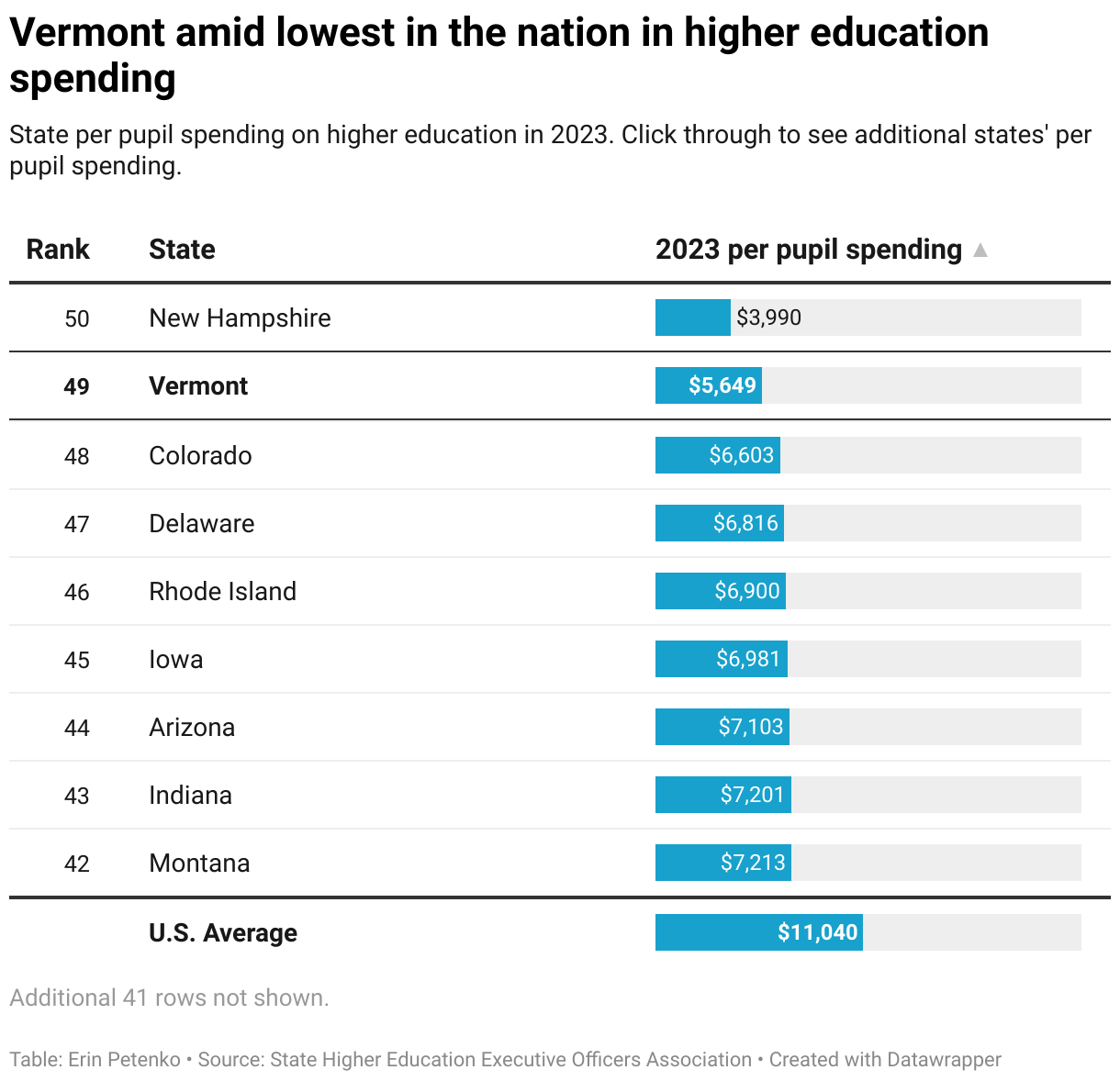
Nonetheless, legislators have been “very firm” in their requirement that all five main campuses stay open, according to Sarah Truckle, the state university’s vice president of business operations.
In part, she said, it’s a measure that reflects a commitment to the goal of providing a local campus to as many students as possible.
Over half of the VTSU student body is comprised of first-generation college attendees, and over half are students returning to education later in life, as opposed to entering directly from high school. Many of them work or have families.
It’s “no secret,” said Maurice Ouimet, vice president for admissions and enrollment, that “we are Vermont’s public higher education access system.”
The university’s website indicates that roughly 72% of its students are in-state, meaning the university likely served around 3,780 Vermont students in fall 2023. By contrast, less than a quarter of the University of Vermont’s student body — just under 2,500 in 2023 — is drawn from Vermont. Just 1.5% of UVM’s undergraduates are over 25, according to a 2022 report.

Rather than consolidate departments to specific locations, the university plans to continue to keep them dispersed across the campuses to best serve students who are less able to relocate, according to Nolan Atkins, provost and vice president for academic affairs.
Each location houses a subset of curricula, many of which have the ability to reach students both in person and virtually. For studying literature and writing, the Castleton, Lyndon and Johnson campuses are all options for in-person learning with some virtual components. For a Bachelor of Science in nursing, one would necessarily be based on the Castleton campus.
The administration emphasized that the campuses aren’t five iterations of the same institutional offerings. “Unique attributes will continue to attract students to be residential students at those locations,” said Ouimet.
But to some extent, the university has struggled with enrollment. Last year’s institutional changeover saw a drop of just under 14% in the incoming first-year class, Ouimet said. There was also an overall dip of just under 6% across the university, from 5,554 in a fall 2022 headcount to 5,251 in fall 2023, according to university spokesperson Katherine Levasseur.
Levasseur declined to provide projected enrollment numbers for VTSU this fall, saying “we enroll all the way up to when classes start.” She confirmed via email that fall enrollment numbers are currently up 7% over last year.
Spread too thin? Five campuses, one curriculum.
Some faculty say that, in practice, consolidation into one dispersed set of academic offerings has meant that many academic areas have experienced debilitating cuts.
According to Linda Olson, a former sociology professor at Castleton, the cuts made to the university’s academic workforce have been “damaging to our ability to continue to operate.”
She accepted a retirement buyout offer last semester. It’s difficult, she said, but she’s more concerned about the health of the academic programs she’s leaving behind.
Under Mike Smith, the university announced its “Optimization 2.0” plan last October. The administration expected, according to a later report, only one layoff and some 17 buyouts among faculty. The plan detailed strategies to limit losses in many areas of study through consolidation, programming changes or discontinuation.
Smith left the organization the day after filing the report.
In “Optimization 2.0,” Olson’s sociology department was marked for “major modifications” due to its “negative net position” and “low enrollment.”
The section noted that social sciences’ enrollment issues were “exacerbated by multiple-campus offerings.” Psychology’s optimization recommendations also bore this addendum.
Sometimes, cuts have come in the form of attrition not reflected in the layoff and buyout reports. Just in Olson’s department at Castleton, she says, “we’ve essentially gone from, like, five full-time faculty to two” through unreplaced retirements.
Olson said faculty members have attempted to communicate their views on the consolidation process through existing avenues of shared governance, but their recommendations have often been paid little attention.
“The (reception to the) input of the faculty and staff has been largely performative,” she said.
Isaac Eddy, a former theater professor, was on a committee that attempted to address the future of performing arts on campus. He submitted a proposal last year defending the importance of specific aspects of the Johnson campus’ performing arts program to the local community.

In particular, he argued, theater courses must be in person rather than virtual.
When “Optimization 2.0” was circulated, Eddy’s “Performance, Arts and Technology” program was marked “discontinue.” Without warning, in an all-faculty memo, his career evaporated.
“It felt like a real disconnect,” he said. “Like we were speaking two different languages.”
There were 18 to 20 students in Eddy’s program when its dissolution was announced. Of those, a few graduated and nine remain enrolled, he said in a text message. The rest transferred to finish their degrees.
Eddy said he never received conclusive word from the administration about whether he might be offered a position at Castleton, where the Theater Arts program will continue. Feeling that he had no other choice, he accepted a retirement buyout at 45.
“I just was left in the dark,” he said. “I have a family here … I had been teaching and living in Johnson for eight years.”
Sometimes, he said, he wonders whether he could have saved the program if he was less insistent on teaching it in person. In trying to be uncompromising about the quality of his teaching, he worries he might have accelerated its end.
Eddy and Olson say they feel that fields like theirs that fall into the traditional “liberal arts” are in particularly acute danger at VTSU.
“I do think that humanities has been harder hit in all of this,” Olson said.
According to the university’s own reports on faculty position losses, 17 of the 29 faculty positions that have gone unreplaced since 2022 have been in the humanities or social sciences. Nine were in STEM fields, and technical degree programs accounted for just 3.
“Is it a liberal arts education if there’s no performing arts on your campus?” asked Eddy. “I’m not really sure.”
According to Nolan Atkins, the university’s provost and vice president for academic affairs, “a strong liberal arts foundation is essential for any VTSU grad to be successful in the workforce.”
The fact that some programs are being strengthened while others are cut, he said, is not entirely within the administration’s control.
“We have not intentionally steered money away from the liberal arts,” Atkins said.
The university received over $600,000 in federal grant money last November to develop its hybrid learning format, which the university has termed “Face-to-Face Plus.”
The Vermont Legislature set aside $3.8 million for tuition coverage in 2024 for students preparing for what it considers “critical occupations,” such as nursing or mental health counseling. The fund applies to both in- and out-of-state institutions.
The university also announced last fall that over $6 million in federal funding was granted to double the capacity of its nursing program.
The total operating budget of VTSU will be just shy of $135 million for the 2025 fiscal year, according to Levasseur.
Bergh, the university’s interim president, said that funding must to some extent correspond to the popularity of individual programs. “Students,” he stated, “are voting with their feet.”
“We’re always going to have a pendulum,” he said, which may be “swinging back toward the need for … students in the humanities.”
But Eddy said he thinks the liberal arts can’t wait that long. Without a willingness to reverse-engineer student interest, he said, programs like his won’t survive.
“We can’t hire full-time faculty because the student enrollment is so low, but the student enrollment is so low because we don’t have enough full-time faculty,” he said.

Olson agrees. “We’ve been focusing too much on cutting to sustainability,” she said, “which is not a sustainable proposal.”
Rep. Mihaly said he understands that the balance between people and funding is hard to strike. Though he supports the university’s trajectory, he acknowledges that the belt can only be tightened so far.
“You can’t ultimately cut your way into success,” he reflected.
The empty building problem
As a child, Zib Miller lived so close to Johnson State College that he’d sometimes swing by to swim in the pool or just hang out on campus. Now that it’s Vermont State University, Johnson campus, the atmosphere has changed.
“There would be people around,” he remembered of that earlier period. “It actually looked like a college campus.”
Now, as a rising junior there, he said it feels empty. Two of the five residence halls were closed entirely in the 2023-2024 academic year. Next year, an additional one will be shut down.
On the weekends, he said, people often go home rather than stay on the vacant campus.
“You’ll walk through the quad on a Friday afternoon and there’s absolutely no one else on the quad,” he said.
Miller, previously a student in Isaac Eddy’s now-defunct performance program, has decided to graduate early from the university with an associate’s degree, rather than complete the remaining years for a bachelor’s degree.
According to Truckle, who oversees business operations, VTSU’s campuses are roughly 30% overbuilt. The university’s data, however, indicates that less than half of the university’s available beds were in use in fall 2023.
When one removes the Castleton campus from the equation, the occupancy level falls to less than 37%.
Bergh said he’s uncertain whether the newly flexible hybrid curriculum will diminish the incentive for students to live and learn on campus.
“We can't be all things to all people,” he acknowledged. “As long as we're positioned to be flexible and responsive, I think we'll be in good shape.”
Last year, the university sold a section of its land in Lyndon to the Vermont National Guard, which plans to build a new readiness center right near campus.
Bergh sees the potential for more sales like this. “These facilities might be repurposed in ways that … meet some of the needs of the communities and regions that they're situated in,” he said.
Much of the unused infrastructure is residential. “Vermont has very pronounced housing needs right now,” acknowledged Bergh.
A report last year from Chittenden County Homeless Alliance estimated that 3,300 people statewide were experiencing homelessness, with 137 counted as unsheltered. Last fall, 1,625 beds were vacant at VTSU.
Bergh added that given the proximity of the empty residential buildings to active dormitories, there is a danger of “compromising that (student) experience” by introducing a new residential population.
Students say that, in many ways, their experience is already being compromised.
Cohen Repaci, a rising junior at the Johnson campus, said that many student clubs are evaporating or getting “downsized.” They said that there’s “just not enough interest” among the small community of students to maintain continuous leadership of extracurricular activities.
According to Repaci and Eddy, the outing club and the choral ensemble, among other groups, have fallen by the wayside.
Social patterns, Repaci stated, are deeply constricted. “You see the same five people,” they said, “every single day.”
Rapaci is envious in some ways of the students at the Castleton campus.
“They have a lot more students,” they said, “they’re really well-funded in their sports, their education programs.”
“It’s a little unfair,” they concluded. “We’re still students here.”
“Impossible”: the role of support staff
Amy Miller, a former coordinator of activism, advocacy and nonviolence education at the Castleton campus, said that there isn’t just a shortage of students living at VTSU’s far-flung campuses. There is also a lack of staffing in crucial areas.
Miller left her position in late January, citing a lack of job security. She said she’d watched a number of her colleagues get let go over the previous two years.
Before the consolidation, Miller had a full-time advocacy position that included sexual assault prevention and education in Castleton, working alongside the Title IX office.
This past semester, she said, the position was vacant. Although Jamia Damzy, the dean of students at VTSU, confirmed that Miller’s position will be replaced, it will now have a statewide responsibility — all five residential campuses and over 5,000 students.
“That's impossible,” said Miller of this coverage change. “It won't be prevention; it'll be only intervention.”
She said it’s not just a volume problem. Working with sexual assault survivors requires intimate familiarity not just with the student body and campus, but with the surrounding community and off-campus resources. In other words, it can’t be as effective in a virtual space, especially serving so many locations simultaneously.
“It's like fluff to tell parents that we have a person in that position,” she said.
Last fall, when she went to a board meeting to complain about the first round of cuts, Miller said, staff members were shut down. They were told certain topics of concern were off-limits, as well as various individual words, like “president.”

In the middle of her comments, Miller said, she was continually interrupted by reminders that she had strayed from these verbal bounds. “It was extremely frustrating,” she recalled. In the end, she stopped trying to talk and simply sent her complaints via email.
Damzy said that cuts have been challenging throughout her staff. Four onsite dean positions were cut last fall, centralizing staff leadership even further.
When asked if she was confident the replacement for Miller’s position would provide sufficient coverage, Damzy said she couldn’t be sure.
“We'll have to continue to figure out what works best for our community,” she said.
Zackary Durr, president of the university’s class of 2025, emphasized the importance of in-person student support. “We need face-to-face interaction,” he said, “rather than (meeting) virtually.”
Durr was on the student government association last fall when it voted no confidence in the university’s administration. Much of his reasoning surrounded staff cuts.
Alongside the academic austerity measures recommended by Optimization 2.0 last fall, several rounds of layoffs and reorganization resulted in the loss of 33 staff positions.
“That cut a bunch of really important positions on our campus … (in particular) the associate dean of students,” he said. The loss of that onsite support at Castleton, he remembered, was tangible.
Durr does feel that things have stabilized in this last semester under new leadership.
President Bergh, he said, has been “very transparent with the faculty, the staff and the students.” Durr said he’s grateful for that. As a student leader, he hasn’t always felt heard.
Bergh’s tenure saw the student governments from each campus create a new constitution, which Durr hopes will allow for greater collaboration and contact between the geographically separate student bodies.
Billie Neathawk, a library coordinator at Castleton and the staff union chair, said that much of the staff still feels overwhelmed.
She began working in the library 26 years ago as a young mother. It was supposed to be a temporary, part-time gig. But, she said, “I loved the way that people were treated … we were respected.”
Since the merger, she said, “we have not felt that at all.” It feels, she said, like someone has been making cuts based on a spreadsheet.
Neathawk was told she had been laid off in February 2023, before the decision was abruptly rescinded following Parwinder Grewal’s exit.
Even so, her library staff has shrunk from 14 to four during her time there, Neathawk said, and that’s par for the course. “Everybody in every department is doing two or three jobs,” she said.
“They do have a hard job,” she said of the central administration, but at the beginning of Bergh’s tenure, she said, “all confidence and trust in leadership (was) gone.”
“It's important for them to build that back,” she said.
