

The Legislature is moving quickly to advance this year’s Budget Adjustment Act to the governor’s desk, amid growing concerns from housing advocates over changes being made to the state’s emergency motel housing program.
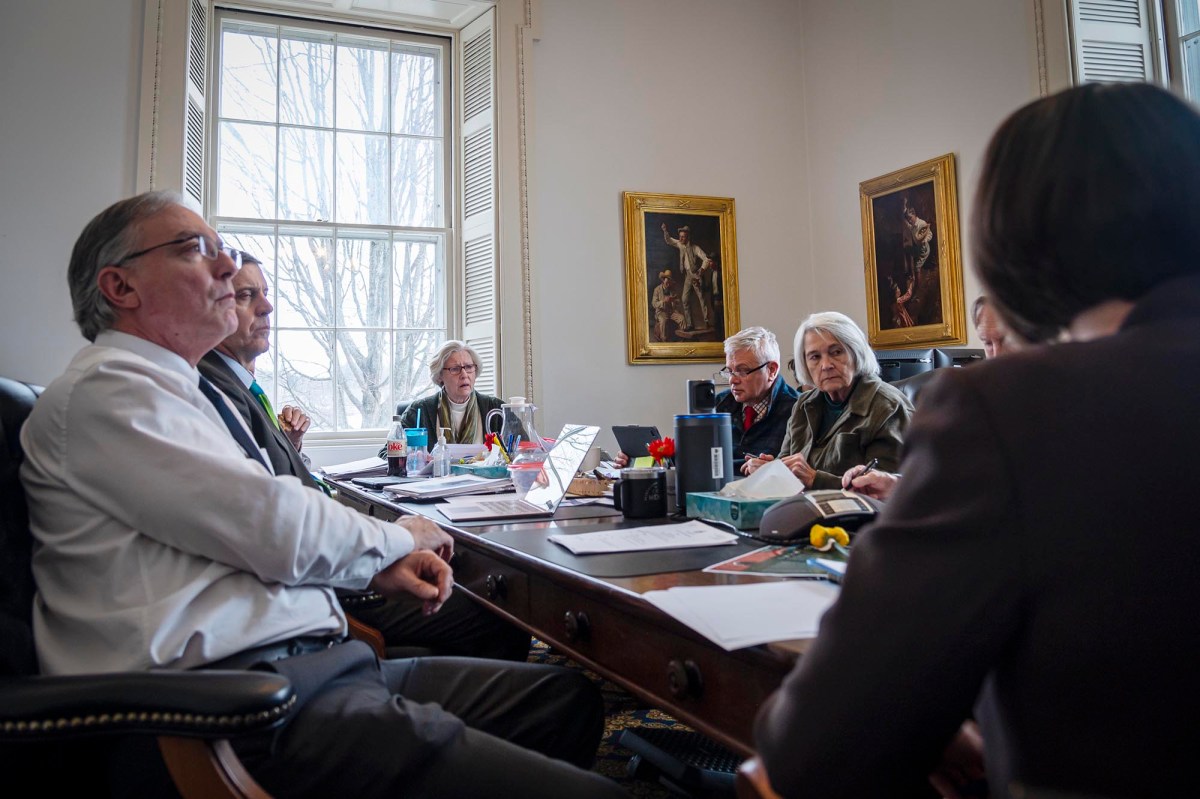
A conference committee of three state senators and three representatives have been hammering out for weeks discrepancies between the Senate and House versions of the spending package, which balances the state budget for the current fiscal year ending June 30. Late Tuesday night, the six appointees signed off on an agreement that, for the most part, conforms with the Senate’s version of the package, as passed earlier this month.
“I would say they followed the Senate version, which was more palatable from my perspective,” Republican Gov. Phil Scott told reporters at a Wednesday press conference, shortly before the Senate voted to concur with the committee’s negotiated package.
“I haven’t looked at every detail of the BAA and what they came up with,” Scott continued. “But for the most part… there’s no poison pills in there that we can see, and I’ll probably sign it if there aren’t.”
With the Senate’s expedient approval of H.839 on Wednesday, the House is expected to take up the bill Friday. If they concur with the conference committee’s version, the bill can head to Scott’s desk for his signature.
At issue between the House and Senate versions of the package was the future of the state’s pandemic-era motel emergency housing program. The conference committee abided by the Senate’s proposed language for the program, under which the state Agency of Human Services will begin instituting time limits for program participants entering the program due to adverse weather. The state’s most vulnerable people experiencing homelessness — pregnant people, families, people with disabilities and the elderly — will be eligible for shelter through June 30, under the bill.

There is another major change coming to the program: Effective this Friday, the state will cap participating motels’ nightly occupancy rate at $80 per night. Rate caps for the program have been hotly debated for months, with proponents saying that motels have been able to name their own price, and the state forced to foot an inflated bill.
But the cap has its detractors, too. As the BAA nears the finish line, housing advocates fear that owners of hotels and motels participating in the program won’t be amenable to the sudden rate cuts and will simply pull out of the program altogether. The folks caught in the crosshairs, they say, would be those housed there, who could be forced out onto the streets, into a homeless shelter (if they can find an empty bed) or into a new motel that agrees to the cuts, however far away that alternative motel may be.
According to a memo written by the Chittenden County Homeless Alliance and obtained by VTDigger, the alliance conducted a phone survey of 11 of 12 participating motels in Chittenden County. One motel did not respond, the alliance wrote to budget leaders on Monday.
Of the 11 motels surveyed, seven said that they would pull out of the program if a $75 nightly cap were implemented Friday, according to the alliance. As a result, the alliance predicted, 225 families would lose their shelter — just in Chittenden County.
In a Tuesday email to members of the conference committee, Sarah Russell, co-chair of the alliance, called the cap “unreasonable — especially for more urban areas like Chittenden County.”
At his Wednesday afternoon press conference, Scott played down those concerns. He said that many motel owners “didn’t quite believe” the cap would ever come to fruition, but “now it’s a reality.” The Agency of Human Services has made “tremendous gains” in negotiating the rate caps with hotel and motel owners in the past 24 to 48 hours, Scott said, and that the agency does not foresee a mass exodus of motel occupants come Friday.
“Most of the hotel (and) motel owners have, I think, taken advantage of the program and actually profited quite significantly by this program, because some of them were charging anywhere from $100 to $150 a night and filling their hotels,” Scott said. “So those days are over.”
If program participants are indeed kicked out by their motels on Friday, Scott said the administration has “contingency plans,” but he declined to elaborate to reporters what they are.
Also of note in the budget adjustment is a “life raft” for municipalities devastated by last summer’s catastrophic floods.
Legislators have stated from the start of the legislative session that the budget adjustment marked their first and fastest opportunity to deliver state aid to needy communities trying to rebuild. In total, the BAA includes $30 million in match funds required to leverage aid from the Federal Emergency Management Agency, plus another $23.5 million in general funds, dedicated to municipalities “impacted by the July 2023 flooding event.”

But that descriptor — “the July 2023 flooding event” — raised alarm bells for Sen. Ruth Hardy, D-Addison, on Wednesday. For many communities in Addison and Rutland counties, she told her colleagues during a Senate caucus of the whole, the real devastation came in the second wave of flooding, which hit in August. She queried Sen. Jane Kitchel, D-Caledonia: Would those communities be precluded from these state dollars because they were hit weeks later?
Kitchel, who chairs the Senate Appropriations Committee, pointed to a breakdown of estimated allotments slated to go to municipalities. Middlebury was slated to receive $141,000 — a sum which paled in comparison to those allocated to communities slammed in July’s round of flooding, like Barre and Montpelier.
“If (the Joint Fiscal Office’s) calculation is not including the August damage, that would make their grant much smaller,” Hardy replied. “($141,000) seems quite small considering the amount of damage.”
Maybe so, Kitchel said, but that language defining the flood passed in both the House and Senate version of the bill, and was not up for debate in the conference committee.
“That’s unfortunate,” Hardy replied.
