

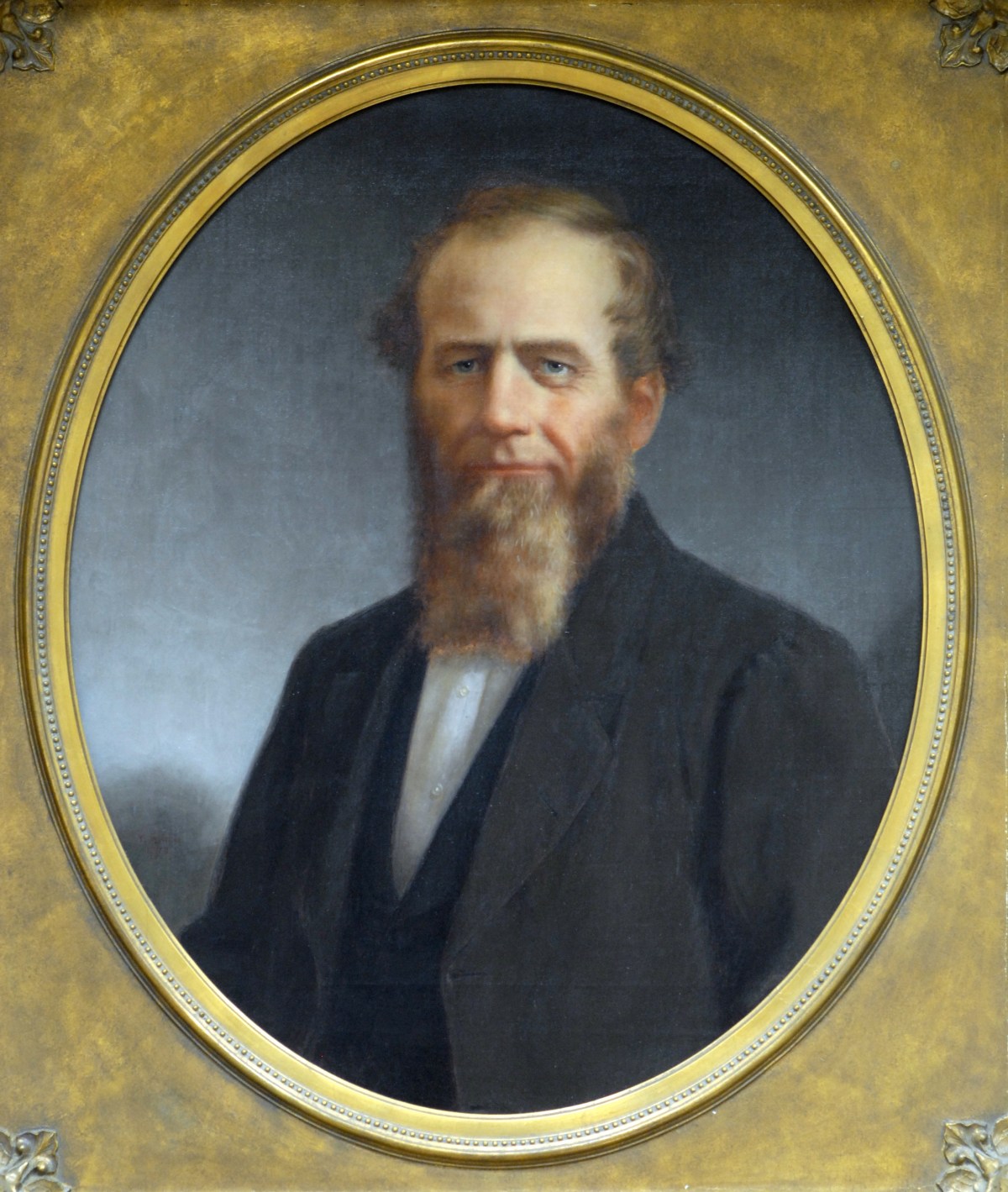
The water that engulfed Montpelier has dried up and in the aftermath of July’s floods, state buildings are slowly reopening. But only a few months ago, basements of those buildings were not only filled with water, but also with floating furniture, documents, and even a historic painting.
The oil painting in question is by Thomas Waterman Wood, a nationally renowned portrait painter and Montpelierite who died in 1903. It is a portrait of longtime state librarian Charles Reed that hung in the reading room of the state library. The painting was apparently put into storage in the basement of the Pavilion Building after being taken down off a wall at the former state library, according to David Schutz, Vermont’s state curator.
Schutz discovered the damaged painting after the flood water was pumped out of the basement, and the art piece and its gilded frame immediately went to conservators to work on the restoration, he said.
“I’ve seen photographs, and it’s in miraculous shape,” Schutz said, noting that it was still unclear what the costs related to the damaged items will be.
According to the state curator, works of art are normally kept in a storage area on Baldwin Street, out of the flood plain.
After the flood in 1992, Schutz built platforms in the Pavilion’s basement for the items in storage that elevated them above any previous flood levels, but this time around that was not enough.
“We knew it was in a flood plain. We knew that during the 1992 flood, as much as a foot of water came into the basement, which is what alarmed the Vermont Historical Society, so they relocated to Barre with their collections,” Schutz said.
Much of what was stored in the basements of the affected state buildings included office furniture and supplies, and a lot of it was not saved. The focus, according to Schutz, was on old furniture such as medicine cabinets that came out of the old state hospital, some of which went through two disasters.
The files that were stored in basements, such as in the state Department of Buildings and General Services, are being restored through a special process that includes freeze-drying documents, according to Eric Pembroke, Vermont’s director of planning and property management.
The state is still in the process of compiling an inventory list of all the items that were damaged or lost, but according to Kate Eberle, the communication coordinator at Building and General Services, there seem to be no essential documents or files that have gone missing.
According to Schutz, the items that were identified to be rescued are all in restorable conditions.
The bulk of the damage was done to mechanical and electrical systems that were stored in the basements of the damaged state buildings.
“If you look at a lot of the buildings that were constructed around the state or around the country, that is typically a space, attics or basements, where mechanical systems are typically built out,” Pembroke said.
As flood risk increases in Vermont, the state officials want to move all mechanical systems out of basements. They discussed plans for that in October at a joint legislative committee meeting about rebuilding the capitol complex.
“Elevating the mechanicals, I do think that is something FEMA will pay for this time around,” Chief Recovery Officer Douglas Farnham said at the meeting.
Right now, the rescued items will be stored in a warehouse in Barre until a more long-term storage option is decided upon.
“If we no longer going to have access to basements, such as (the Pavilion) had, we now have a dilemma on our hands of trying to figure out where decent storage, ideally climate controlled storage, ought to be located,” Schutz said.
