

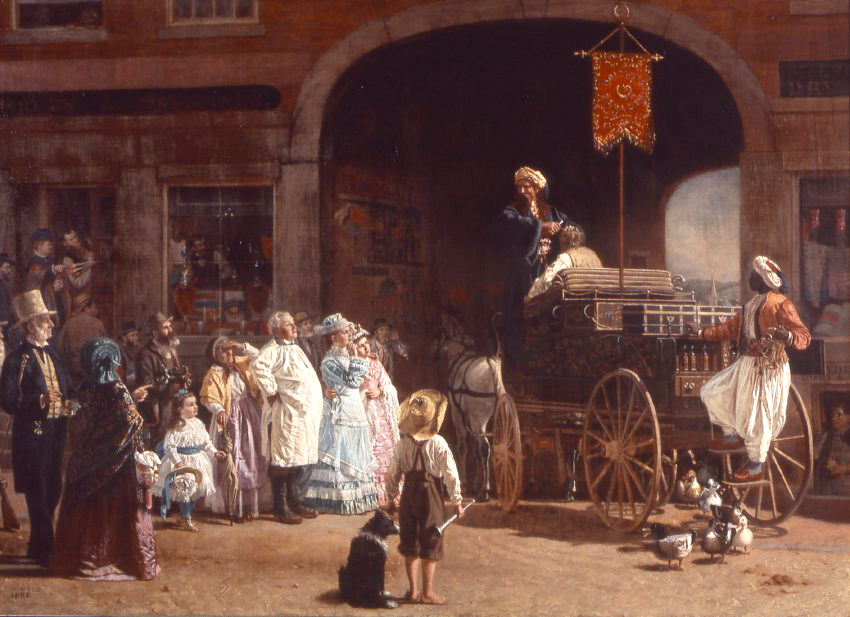
If you don’t live in Montpelier, you’ve probably never heard of Thomas Waterman Wood. Frankly, even if you do live there, you still might not have heard of him. And even if you have, you might not know who he was.
But during his life, the Montpelier native was among the most respected painters in America.
Since his death in 1903, however, he has largely slipped into obscurity. Actually, that would be back into obscurity. Wood didn’t come from a wealthy family or a family of artists — his father was a cabinetmaker — and little suggested he would become an important chronicler of life in the 19th century.
Local history, or perhaps legend, has it that as a boy he was inspired to try painting by an itinerant artist passing through Montpelier. This would have been during the 1830s. The painter didn’t offer Wood lessons. His contribution to history was leaving behind a few jars of paint that Wood decided to play around with.
The connection the young boy made with paint that day would eventually lead him to study art, go into business as a portrait painter, branch out into producing genre paintings (depictions of everyday life) and get himself elected president of the prestigious National Academy of Design in New York.

Having tried painting landscapes, he quickly gravitated to painting people. His friend Charles Paine, son of a Vermont governor, wrote that in 1844 Wood, then 21, “first exposed his shingle as a portrait painter” in a room at the Paine family hotel in Northfield.
His father, John, opposed Thomas’ choice of career, presumably fearing his son would never make a decent living. Perhaps that’s why Wood started painting portraits. Unlike with landscape painting, as a portraitist his works would usually be sold before he started them.
Wood’s earliest known oil portrait is of fellow Montpelierite Daniel Thompson. A lawyer and newspaperman, Thompson wrote the classic adventure novel “The Green Mountain Boys” in 1839. Wood depicts Thompson as stern-faced and imposing, as hard-edged as Camel’s Hump, which appears in the background. The painting, probably dating from the mid-1840s, is an excellent effort by an untrained artist. The work hangs in the library of the Vermont Historical Society in Barre.
Athenwood, a summer home
At about this time, Wood decided to travel to Boston to train with a prominent portrait painter named Chester Harding. Though Wood would go on to spend many winters in Boston, most of his early portrait commissions came from Vermont. Perhaps it was that his skills were in shorter supply in his home state, or that friends wanted to help him get started. He painted portraits of family friends, including his friend’s father, Gov. Charles Paine.
But to get by, he also gave singing lessons and borrowed money from his uncles. With family help, Wood bought land along the Northfield Road (today’s Route 12) and began building a house for himself and his bride-to-be, Minerva Robinson, in 1850.
Wood was clearly smitten; he described Minerva as “a most beautiful soul in a most beautiful face; filled with knowledge of all philosophy, history and romance, which had been distilled by her reflections to adorn her conversation and instruct her listeners.”
Wood named their house Athenwood. It was a play on his wife’s new name, being a combination of their family name and Athena, the Greek goddess of wisdom, known to the Romans as Minerva. Tellingly, Athenwood, which still stands, was built as a summer home. Wood knew he couldn’t fulfill his ambitions in his small hometown.
Remarkable for the era

The couple made the first of many moves for Wood’s career, this one to the New York City area. By 1858, they were living in Baltimore, where Wood completed a pair of unusual genre paintings depicting a newspaper hawker and a woman holding a basket of food.
What made the paintings remarkable, besides Wood’s beautiful rendering of them, is that he chose Black Americans as models and portrayed them sympathetically. At a time when slavery was still legal, this simple act of acknowledging Blacks as fully human bordered on revolutionary.
People were used to seeing Blacks reduced in art to racist stereotypes, partly as a way to try to justify slavery. As such, some people found the paintings shocking. Wood shook off the criticism and regularly painted both free and enslaved Blacks.
The paintings of the hawker and the woman with a basket brought Wood his first patron for his genre paintings. John Christian Brune, a wealthy sugar refiner, bought the pair. Encouraged, Wood submitted one of the works, “Moses, the Baltimore News Vendor,” to the National Academy in New York for its important annual exhibition. To his relief, the academy accepted the painting.
After the exhibition, the academy failed to return the painting to Baltimore. It had been sold to Robert Stuart, a leading art collector. The problem was that Brune had already purchased it. Perhaps academy officials didn’t realize the painting was already spoken for. Or perhaps Wood got greedy and accepted the second offer, because it was higher than Brune had paid.
Wood returned Brune’s money, but Brune sued Stuart for the painting and eventually won it back.
While the dispute raged, Wood took a well-timed overseas trip to immerse himself in the European art scene. After returning, the Woods lived for a time in Tennessee, though they returned regularly to Vermont. Wood divided his efforts between portraits and genre pieces, as he would for the rest of his life.
Honoring everyday life
In 1861, at the start of the Civil War, he painted a scene of Blacks, probably enslaved people, working in a cornfield. Some of the workers pause to look toward a boy who offers them water. The boy, who is kneeling, seems to be honoring the workers with his gesture.

And in 1867, Wood celebrated the outcome of the war in his painting “American Citizens (to the Polls).” The work shows a cross-section of American society standing outside a polling place, featuring a Yankee alongside more recent immigrants, an Irishman, a Dutch man, and, representing the newest full-fledged members of society, a Black man.
Wood was a thoroughly modern painter, depicting his times as they were changing. He also painted less politically charged works of daily life in rural America, vignettes such as a girl preparing to jump from a haymow or a boy gathering eggs. The scenes might seem overly sentimental today, but they fit the feeling of the times.
By honoring everyday life, Wood was a forerunner of another Vermont-based painter, Norman Rockwell.
One of Wood’s more famous works is “The Village Post Office,” which he painted in 1873. The painting depicts a post office in Williamstown, Vermont. As he did for many of his genre paintings, Wood used friends for models. He painted one of his uncles as the postmaster, while an assortment of Montpelier residents stood in for the customers. He even modeled the dog in the painting after a local hound.
By the time he reached middle age, Wood had earned a national reputation. In 1878, members of the National Academy of Design honored him by voting to allow Wood to join their ranks. He would top that 12 years later by becoming the academy’s president.
Despite his national success, Wood never forgot his hometown. In 1895, he hosted the official opening of the T.W. Wood Gallery, which still exists in Montpelier, though in a different location. He donated a large assortment of his canvases, as well as works by other artists, to form the basis of a cultural institution for the state capital.
Such dignitaries as Vermont’s venerable U.S. Sen. Justin Smith Morrill, a U.S. Supreme Court justice and the president of the University of Vermont attended the event.
When it came his turn to speak, Wood said, “This is my native place, and while I am in one sense a transient person here, still I have resided more years among you than the majority of your year-round inhabitants, and when I have been absent in body, my heart has been dwelling in this lovely valley about the firesides of my old-time friends.”

