


State lawmakers surveying the damage wrought to Vermont’s housing stock in July’s floods visited Barre City on Tuesday for a special off-session hearing. As is typical of these sorts of field visits, local dignitaries, including the Granite City’s mayor and manager, guided visitors from one red-tagged property to another in the municipality’s hard-hit north end.
Among the group: Rep. Peter Anthony, D-Barre City, who might have served as guide as well as subject of the tour. The devastated neighborhood that his Statehouse colleagues were walking through was his own — and his own home, which he and his wife purchased in the late 1970s, had been rendered uninhabitable.
This summer’s storms have caused widespread destruction, and already, more than 4,700 Vermonters have applied for federal assistance. The floodwaters never reached the Statehouse itself — despite wrecking much of the capital’s downtown — but a few lawmakers who will return to the Golden Dome in January will have first-hand experience of the flood’s impact and aftermath.
At least five lawmakers in the 150-member House of Representatives sustained damage to their home, business, or farm, according to the House Speaker’s office. The most acutely impacted were likely Anthony and Rep. Kelly Pajala, I-Londonderry, both of whom have been displaced from their homes. (The 30-member upper chamber appears to have been spared from any substantial impacts, according to the Senate President Pro Tempore’s office.)

Anthony and his wife, Marsha Kincheloe, are no strangers to flooding. Indeed, during the more than four decades they had lived in their home on Scampini Square, their property, which abuts the Stevens Branch of the Winooski, had flooded five times — including twice in 2011. They had two sump-pumps going in the basement and after Tropical Storm Irene, FEMA had reimbursed the cost of moving their circuit breaker out of the basement and to the first floor.
And so when the couple read the forecast on Monday morning, Anthony moved his motorcycle to higher ground and hoped for the best. “We were prepared to ride it out,” he said.
But by about 3 p.m., he said, water had already reached the second step leading up to the home’s front porch, and it was “pretty clear that my pumps would not keep up.” He and his wife packed up what they could and headed for higher ground, taking refuge at the home of Tommy Walz, who had once served alongside Anthony in Montpelier. The floodwaters remained so stubbornly high that it wasn’t until Wednesday that they could return to inspect the damage.
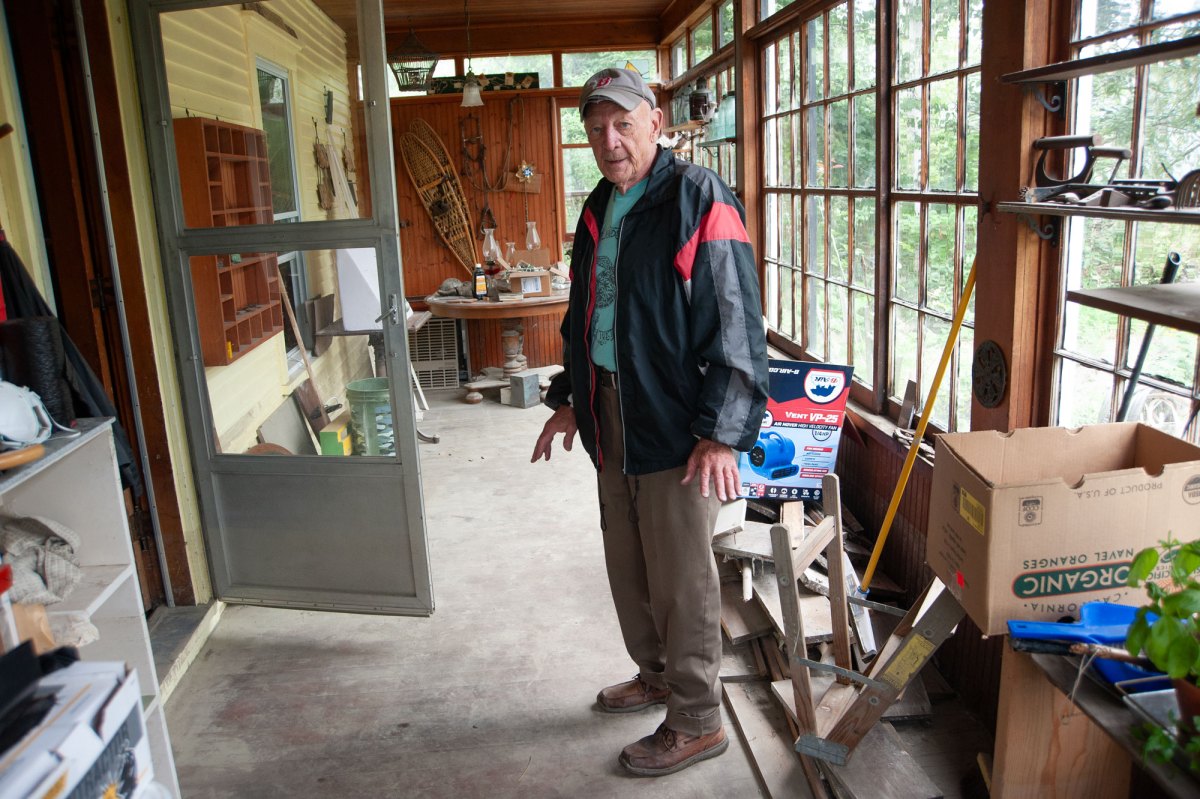
Prior floods had inundated the yard and basement. But the water rose far higher this time, and came up several feet into their first floor. Their home uninhabitable — perhaps permanently so — Anthony stayed for weeks with Walz before finding an apartment to rent downtown.
He and Kincheloe moved in last week. But long term, he said he’s still not sure what they’ll do. Because he accepted FEMA’s help during Irene to move his electrical system and didn’t subsequently get flood insurance — the premiums were unaffordable — he’s ineligible for federal help for home repairs now. He’s also unsure if it would make sense to rebuild, knowing all too well the growing risks involved.
He may look into the state’s buyout program, he said. After prior floods, including Irene, he said, he and his wife could always recover. But he worries that’s no longer the case.
“The best information is that that’s a much riskier area now than it was 13 years ago,” he said.
Vermonters wrestling with whether to rebuild their lives where they were when floodwaters came will face the most difficult housing market in a generation, and have few options about where to relocate.
Pajala, whose first-floor apartment in South Londonderry was completely inundated, has first-hand experience being on the short end of Vermont’s red-hot market. After a prior landlord sold the condo she and her two sons were living in, the family spent months living in a camper and couch-surfing until finding their current apartment a little less than two years ago.
Pajala is staying at the house of a friend who is on vacation. For now, she plans to return to the apartment once her landlord completes the necessary repairs, which should be soon. She isn’t naive about the risks (and is getting pricey flood insurance) but she sees few alternatives.
“We are planning on going back into that apartment, but I’m doing that with an eye to it not being potentially the best long-term option,” she said. “Because it’s still on the river and it will still flood again at some point in the future.”
As for the work ahead when she returns to Montpelier, Pajala said it’s been frequently on her mind. She’s been wondering about recent efforts to encourage denser, cheaper development in downtown areas, which are often in floodplains, while some municipalities keep higher-elevation areas undeveloped or carved up into larger and more expensive lots. She’s sympathetic to the desire to limit sprawl, she said, but Vermont should build affordable and low-income housing outside of harm’s way.
“I hope that from the state standpoint, we look at where there might be other areas where we can move some development to — which I know is a scary thought for a lot of places,” she said.
Anthony, for his part, asked whether Vermont will be willing to depart “from our mantra of local control” and instead take a wider view when planning for the state’s future.
“The folks who live in the river valleys, which are many of the older settlements, obviously — Springfield, Ludlow, Bellows Falls, Brattleboro, Barre, Montpelier, you name it, all the way up through the watersheds — they’re the ones who bear the brunt of the decisions that are made in upland areas.”
