

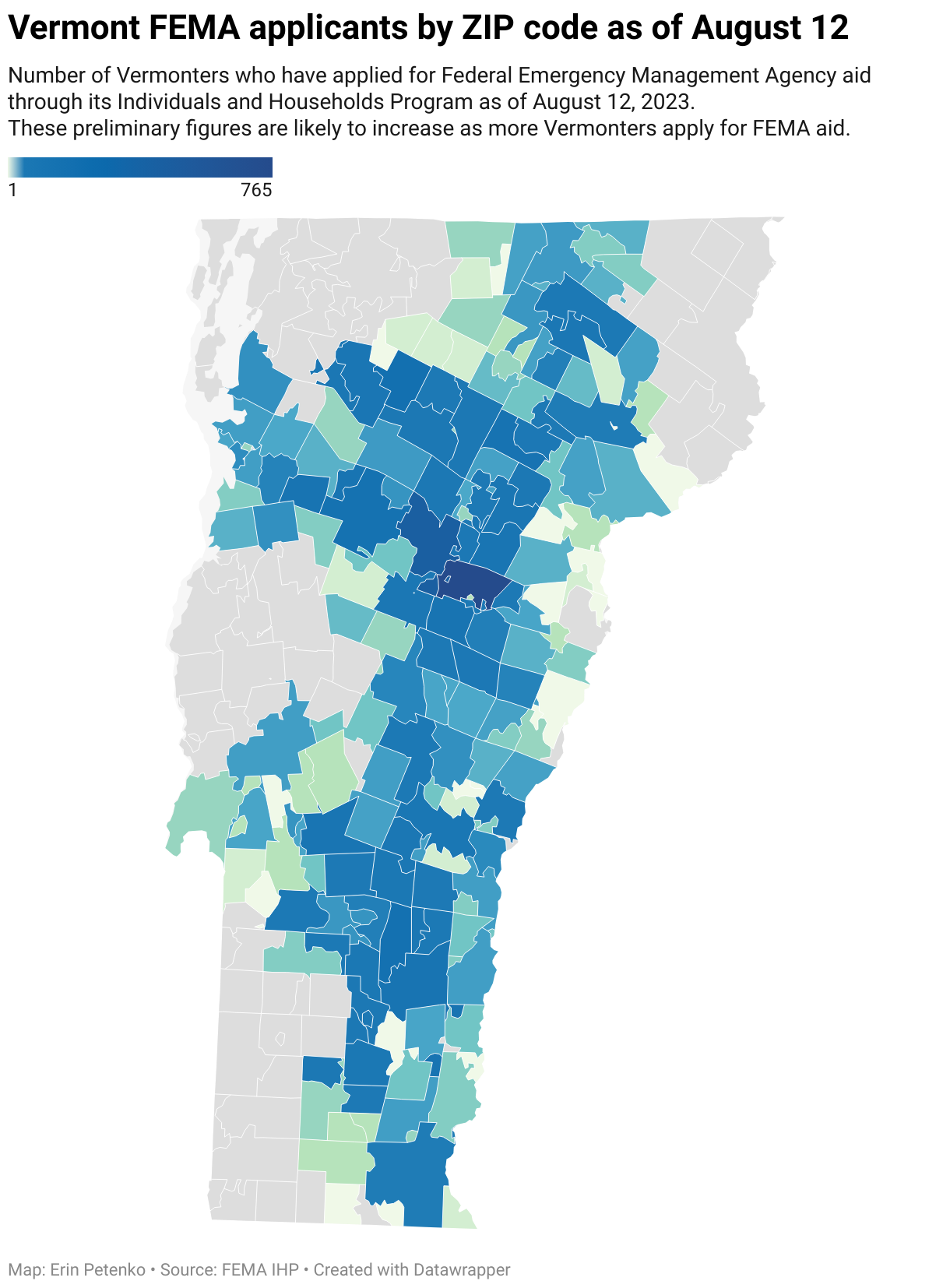
More than 4,700 Vermonters have applied for federal aid in the wake of this summer’s flooding, according to data published by the Federal Emergency Management Agency.
FEMA has already given out roughly $12.7 million in aid to 2,300 applicants through its Individuals and Households Program since Vermont was walloped with catastrophic flooding last month. That leaves an additional 2,400 people who were either denied or are awaiting a determination from the agency.
The recently updated FEMA data provides the first in-depth view of which Vermonters were affected by the natural disaster — including how the floods may have damaged their homes or upended their lives in other ways.
These figures are likely to increase as Vermonters continue to apply for the program. They only represent damage to certain regions of the state because only nine of Vermont’s 14 counties have so far been included in the federal disaster declaration.
Addison County, which experienced additional flooding in August, is not yet eligible for aid through FEMA’s Individuals and Households Program. State data makes clear that many residents experienced significant damage. According to Vermont Emergency Management, the state received 412 flooding-related reports to the 211 hotline from Addison County between July 26 and Aug. 8, in the vicinity of the later flooding, compared to 123 reports between July 12 and July 26.
The applications FEMA has received so far are heavily concentrated in Washington County, both in terms of total applications and on a per-capita basis. Windsor County ranked second in total applications, but on a per capita basis the smaller Lamoille County came in second.

Within Washington County, Barre had the most applicants, with about 600 reports of housing damage within the city alone. Barre officials have expressed concern that the flooding disproportionately impacted the city’s affordable housing stock.
The flooding also appears to have disproportionately impacted those with young families. About a third of FEMA applicants reported that their household included someone under age 18, compared to a quarter of Vermont households overall, according to Census data.
The most common reason Vermonters applied for FEMA aid was for damage to their home, with nearly three-quarters of applicants saying they’d had some level of damage to their house, apartment or other dwelling.
Additional challenges were reflected in the data, too. About 695 applicants reported food needs, 508 reported shelter needs, 180 reported damage to their car or other automobile and 670 reported utility outages, according to the data.
Only a small minority of applicants reaching out to FEMA had flood insurance, which provides a higher level of coverage than federal aid. According to the data, 10% of homeowners and 2% of renters who applied for assistance had flood insurance.
As of Aug. 12, FEMA had inspected 3,045 dwellings in Vermont to assess damage as part of eligibility requirements for some types of aid. It determined that about three-quarters of those housing units were indeed damaged by the floods, with a median amount of $1,444 in damage per inspection.
That’s a total of more than $17 million in flood damage just among the properties that have been inspected thus far.
But FEMA does not cover every dollar of damage recorded to a property. Because of limits to the amount of aid a household can receive and other restrictions, it has so far distributed $12.7 million through the Individuals and Households Program, which includes aid for home repairs, rental assistance for displaced homeowners and renters, and some aid for other needs in the wake of natural disasters.
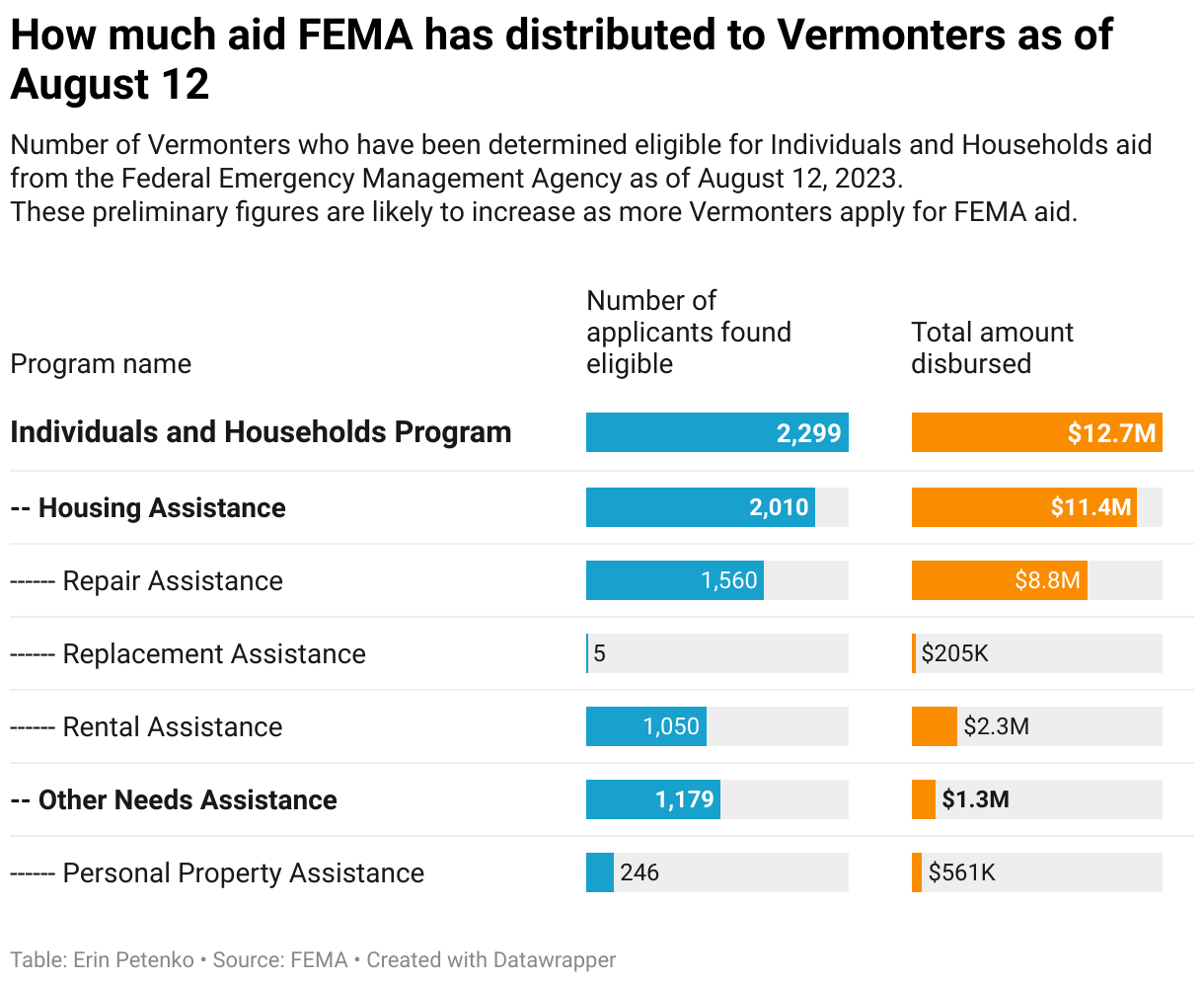
Some applicants can also be referred to the federal Small Business Administration for a loan, even if they are individuals and not business owners, according to the FEMA website. The data shows that 168 Vermont applicants to the Individuals and Households Program have been referred to the SBA so far.
According to FEMA’s website, individuals must apply for an SBA loan and be denied, or partially approved, in order to qualify for certain types of FEMA aid.
In a press release issued August 15, FEMA reported that $8.9 million in SBA loans had been distributed in Vermont so far. That includes loans not just to individuals, but businesses and nonprofits as well.
FEMA said in the release that it had paid $6.2 million in claims to National Flood Insurance Program policyholders.
The FEMA data also shows that at least 500 applicants have been rejected for federal aid for a variety of reasons, including insufficient damage to their home or for not responding to contact attempts by the agency.
Tracey Shirley, a FEMA spokesperson, said via email that the aid program would run through Jan. 14, 2025, during which FEMA would continue to process applications and distribute funds on a rolling basis. The amount an applicant can receive can “grow over time dependent on verified loss,” she wrote.
Vermonters can apply for FEMA aid via the agency’s website, through the FEMA mobile app, by phone or in person at a Disaster Recovery Center.
Correction: An earlier version of this story incorrectly stated which counties were ineligible for aid through FEMA’s Individuals and Households Program.
