

This commentary is by Mary Rose Dougherty of Waterbury, editor of The Mountain Troubadour. With Becky Widschwenter she offers embodied poetry community workshops to schools, mental health providers, and senior centers.

A housing crisis in Vermont and across the country. A pandemic that’s exacerbated it. Wetland creatures who aren’t excepted from a housing predicament of our making.
Perhaps that’s one reason in this post-pandemic time, when gifts of tremendous and formidable beauty arrive to astound us, it’s especially important to pause and receive them.
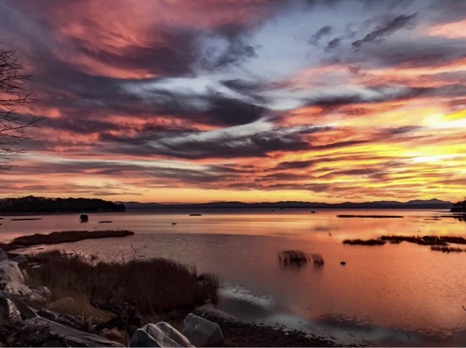
Take for example, Carol Kiewit Leinwohl’s photograph of Thayer’s Bay in Colchester gracing the cover of this year’s The Mountain Troubadour. Since keeping records 30 years ago, the Vermont Natural Resources Council estimates state-regulated wetland loss at about 20 acres annually. Worldwide, 100,000 acres have been lost, according to The Nature Conservancy.
In Vermont such loss is measured through absence of important nesting habitat for migratory birds and waterfowl — some like the Canada goose, wood duck, great blue heron, muskrat, beaver, snapping turtle and even the bullfrog — who, like some humans, have nowhere else to go to thrive.
Other critters, like the black bear — known to some as only as a backyard birdfeeder nuisance — moose, deer, wood frogs and marsh hawks need wetlands for life-cycle growth and for feeding, breeding and wintering.
Meanwhile, in the broader world, ecological opponents and supporters skirmish. Landowners learn to accommodate beavers on their property. A recent U.S. Supreme Court decision clips the Environmental Protection Agency’s authority to regulate our wetlands and associated waterways and follows a Supreme Court decision to curtail EPA’s rules against pollution and climate change. As if to counter, after a 400-year absence, beavers are set to return this winter to Nene Valley, South Australia.
Offered Leinwohl’s made photograph, I couldn’t help but find myself dreaming deep into the image, captivated by its orangy glow. Capturing every hue and tint of orange in the color thesaurus, offset by spans of gray cloud stretching across the sky, this image sounds Rainer Maria Rilke’s call to open ourselves: “Let everything happen to you/Beauty and terror/just keep going/No feeling is final.”
The pandemic gave us a peripeteia, a reversal of narrative, that disturbs the climate change narrative. How will we respond?
Poets’ work must be toward a reciprocity of filling a space with spirit and meaning that allows space to evoke feeling and memory in our imagination, as Gaston Bachelard so eloquently wrote in Poetics of Space (1958). To deepen our ecopoetics in this age of ecoanxiety, Bachelard offered topoanalysis, an archeological, albeit psychological, dig at the sites of our intimate lives. He envisioned not a literal house of rooms and spaces, but dreamed, imagined, remembered places, an intimacy with the core of inner experience.
This year’s Troubadour offers voices reflecting an ecopoetics speaking to such an essential sensibility, one with power to “build … a house in the mouths of deities so I can feel what it is to be holy,” as Robyn Joy says in her poem “dream house”. In “Park Boys,” Kristine Korman illustrates how new realities birth change. Our love for the planet must be pervasive, says the speaker in Cindy Hill’s “My Love is a Stone Marten”: “I see my love in everything,/even the sudden burst of heavy, bitter rain.”
Whether we’re ready for changes we’ve imposed on the planet, they’re arriving. My quest is for the kind of poet-psyche that brings our best versions of ourselves for our home, asking, “Where do gone things go?” as in Alice Wolf Gillborn’s playful “Who Ate the Goldfish?” Outside of the poem, the question resonates in the loss of home to our wetland friends.
Questions that beg us not to separate our lived lives from our enjoyment in nature, as in Erika Nichols-Frazer’s poem “Left Behind”: “What is a thing when it becomes something else?/Rewritten, called fact?” Perhaps we’ll mirror her avowal: “I do not slow down” with an uptick in the attention we pay to our world.
For it’s “our wild places so carefully cultivated/holding this sweet conservation/between us” as Ann Fisher says in “Protected Places.”
To find joy, as Buffy Aakaash writes in “The Beauty Before Us,” that “We must fall in love with beastly things.” There, and in “still/tiny birds/pierce(ing) the air/wing(ing) their way/toward nectar” as noted by Ann Fisher in “Thirst and Calls.”
In Darren Wadel’s poem, “Mount Pisgah,” recounting an afternoon climbing, surely he’s tapping into Bachelard’s “evening lamp on the table,” that place of light we hold in our hearts when we think of home which restores “the light” that lives “on in…(the)…soul.”
Leinwohl’s remarkable photograph of a sunset brings home the sailor’s adage I once used to guide me sailing the small lakes of Indiana and Illinois: “red sky at morning, sailor take warning; red sky at night, sailor’s delight.”
Poets must continue to broadcast a kindness for all places, using our imaginations not just to record the world through a poetic sensibility that, like the butterfly, effects change, but to create and recreate our micro and macro versions of home. After all, after a blaze red sunset, what sailors look for are clear skies meant for sailing home.
Bravo to poets who do the work of imagining and creating an inner and outer home where all creatures abide.

