

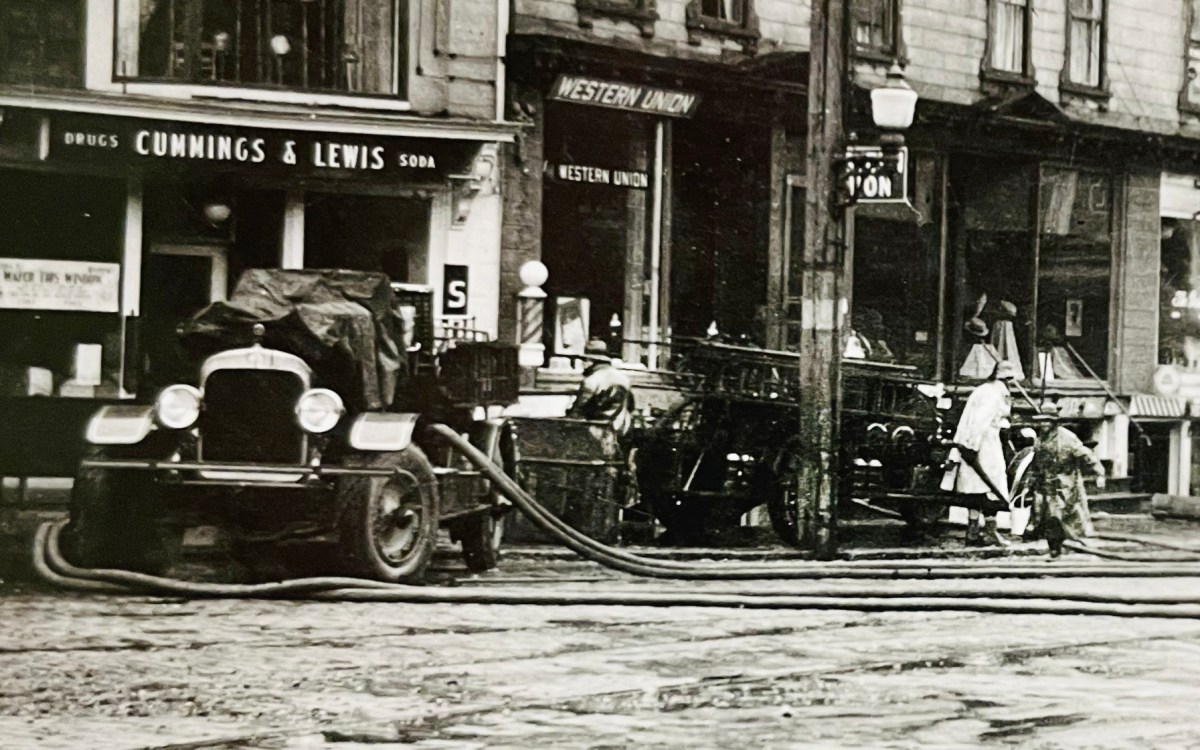

“This is the third week of the New Era,” Barre resident Athol Bell wrote in a letter on Nov. 21, 1927, “for down this way everything, including time, seems to be reckoned by the day of the Big Wave.”
He was writing on Nov. 21, 1927. The “Big Wave” he referred to was the worst flooding Vermont has ever experienced.
Hard rain started on the night of Nov. 2, and continued for 38 hours. After an hour’s break, it continued to pour for four or five more hours. Seven to nine inches of rain fell in many parts of the state.
With the ground frozen, the rainfall quickly overwhelmed the state’s rivers, creeks and streams, sending water cascading down hillsides, onto roads and into basements. When their basements filled, people rushed to the second floors of their homes, if they had them, or onto their roofs, if they didn’t. Years later, many Vermonters were still haunted by the cries for help they heard in the darkness.
The losses were staggering. Official reports recorded 84 people killed, along with 7,215 chickens, 1,704 head of cattle, 469 pigs and 202 sheep. Added to that were 187 houses, 200 barns and 257 outbuildings swept away in the floodwaters. More than 1,300 homes had been badly damaged, according to the Red Cross.
Recovery efforts were seriously hampered by the innumerable miles of roads and 1,258 bridges that had been severely damaged or destroyed.
“They are recovering but slowly and the scenes of ruin are all but indescribable,” Bell wrote after visiting Montpelier. “I couldn’t begin to give you a word picture that you would believe.” And this was nearly three weeks after the flood hit.
Saving what they could
Even before the rains stopped, Vermonters began the struggle to salvage what they could and rebuild their world.
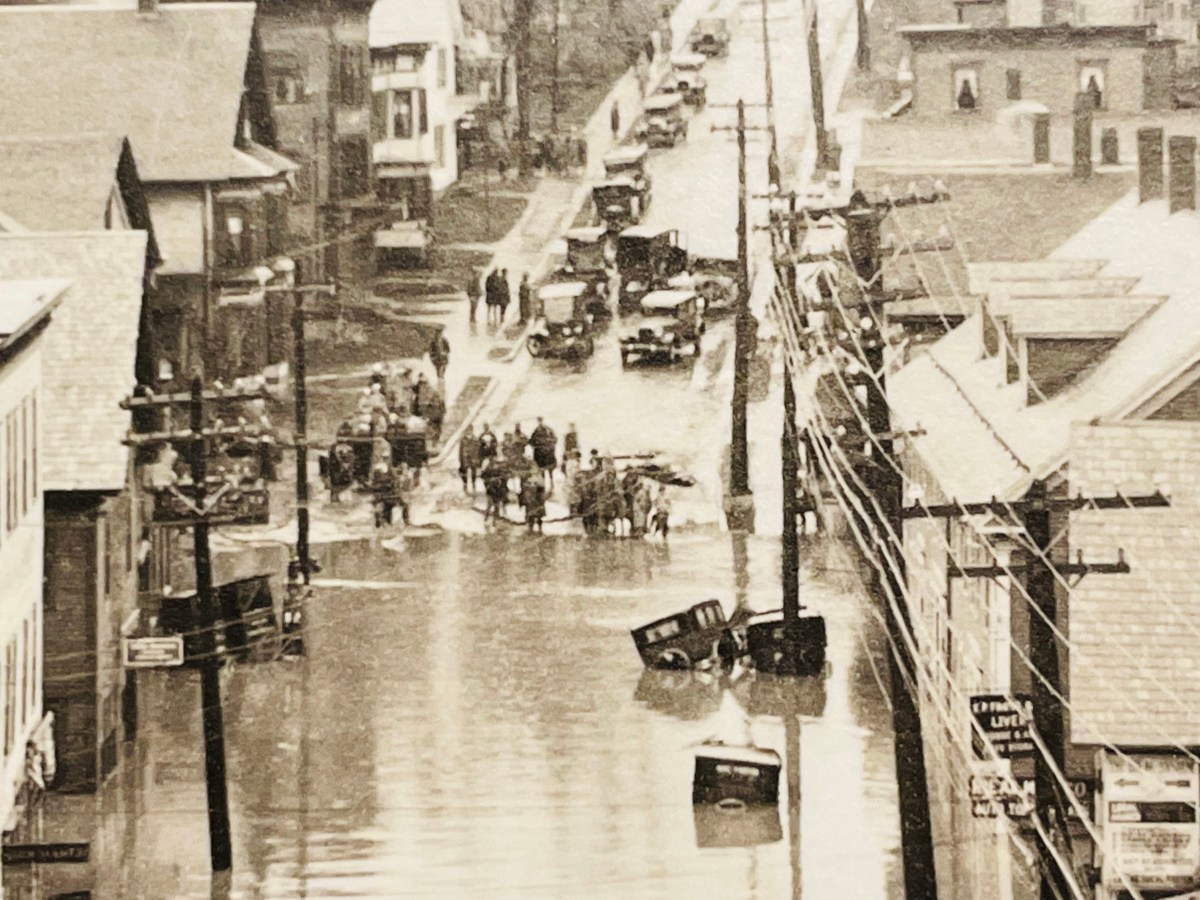
The Barre Daily Times reported on Nov. 7 that “(s)ome semblance of order began to appear in Montpelier to-day, after the terrible destruction wrought by last week’s flood. The streets are all passable and much of the wreckage has been cleared away from stores.”
The only businesses yet to reopen, the Times noted, were food stores, and outside each stood a National Guardsman with orders to admit only people bearing a requisition ticket from the Red Cross. Rationing was in effect. With so many roads out, people feared there would be food shortages.
Any fears of shortages were “somewhat lessened today when reports came that four tons of foodstuffs were well on their way here from Burlington,” the Times stated, “farmers having added contributions of provisions to the load as it proceeded toward the Capital City.”
An Army supply wagon from Fort Ethan Allen in Colchester, drawn by mules, brought bread to Montpelier. Additional wagons had been left along the way at Bolton and Waterbury, two of the hardest-hit communities in what was the hardest-hit part of the state, the Winooski Valley.
While no part of the state went unscathed, 55 of the 84 deaths in the flood were in the Winooski Valley. Nineteen of those deaths occurred when the Bolton dam broke and washed away a boardinghouse, killing the woman who ran it, Jennie Dupree Hayes, her daughter, Ruth, and granddaughter, Ethel Cilbrith, as well as 16 men who were staying there, many of whom were railroad workers.

Another urgent shipment destined for Montpelier was one of yeast and serum. The yeast was needed for baking — most people still made their own bread at the time. The serum was to treat typhoid contracted from contaminated drinking water. Fortunately, people had gotten the word to boil their water before use, so no outbreak occurred.
Seven Burlington-area doctors and several interns traveled to Montpelier to help. Among the doctors was H. Nelson Jackson, who had gained celebrity in 1903 for being the first person to drive across the United States. During the trek cross-country, Jackson and his driving companion had to find their way over crude and many times barely existent roads. In 1927, the drive from Burlington to Montpelier might have felt equally challenging. Jackson and the others finally abandoned their vehicles and walked the last miles to the capital.
From there, Jackson continued on to Barre to arrange the funeral of his brother, Lt. Gov. S. Hollister Jackson, who was one of the flood’s victims. The lieutenant governor had tried to jump what appeared to be a narrow rivulet, but the earth next to it had been undermined by the water. One edge collapsed as Jackson leapt and he fell into the rushing water and drowned.

President Calvin Coolidge and U.S. Attorney General John Garibaldi Sargent, both native Vermonters, were “frantically trying to get word from northern Vermont,” reported the Barre Daily Times on Nov. 7. “The President has been able to get some wires from the fringes of Vermont but these wires tell nothing of the places of greatest danger.” Sargent, a native of Ludlow, the paper said, “has been able to get no word” from his hometown.
That same day, the St. Albans Daily Messenger reported that officials were urging people not to drive “pleasure cars” on the streets of Montpelier in order to conserve fuel and allow for “other more important vehicles a better chance to clean up debris.”
The biggest challenge was dealing with that debris: “The fifth day following the great flood found Montpelier today resolutely struggling with debris, shoring up half-toppling buildings, and cleaning the last of the mud from the merchandise that was left in the stores,” wrote the Brattleboro Reporter on Nov. 8. “Women owners of shops as well as men were to be seen in mud-bespattered knickers and boots shoveling the silt deposits from floors, counters and shelves — everyone weary but trying to be cheerful in the midst of calamity whose proportions here have grown larger, rather than smaller.”
The cleanup continued for weeks. “Waterbury citizens have been shoveling mud out of their houses, off their verandas, off their lawns, out of their cellars, and still there seem to be oceans of mud remaining. Though not disheartened, they are beginning to wonder if this mud is not really an endless chain of black filth,” wrote the Burlington Free Press.
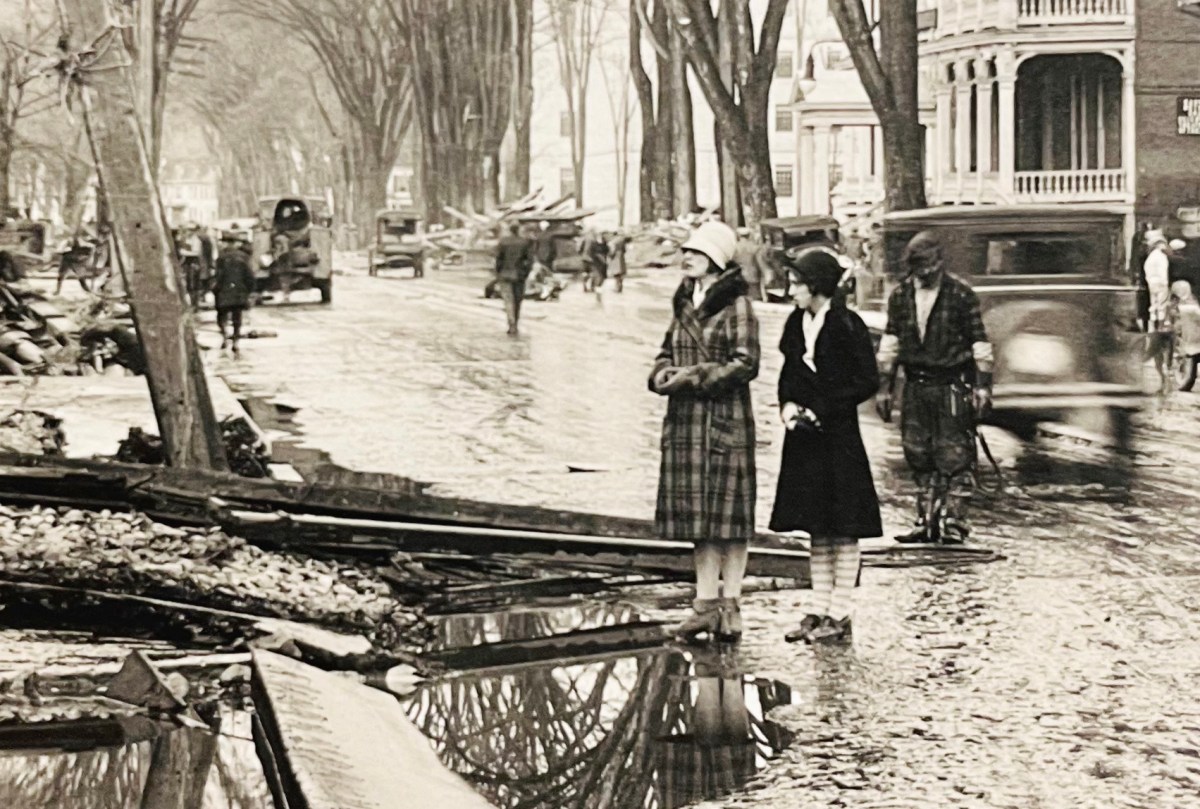
Tempers occasionally flared. The Free Press reported on Nov. 18 that when a traveling salesman stopped in Montpelier to check on the progress of repairs, he was accosted by a woman who said, “What right have you to come here all dressed up(?) You ought to be wearing overalls, and helping to clean out this mud.”
Help did come. Hundreds of college students pitched in, often bringing their own shovels. They came from the University of Vermont, Norwich, Middlebury, St. Michael’s and Dartmouth. High school students helped too.
And neighboring towns helped one another. Among the many examples, folks in Hyde Park, which was spared serious flooding, helped people in the stricken town of Johnson, while women from Morrisville and Stowe made food and delivered it to the people of Waterbury.
Local churches and civic organizations, including the Elks, Knights of Columbus, Rotary and Lions clubs, collected money and other donations for flood relief.
This willingness to accept the shared burden of coping with a disaster didn’t spring up out of nowhere. Cooperation in times of need is a distinctive trait in rural New England, according to Brandeis professor Karen Hansen. As she once wrote, the region has a long tradition of “mutuality, reciprocity, volunteerism, and localism.”
Despite Vermonters’ herculean efforts, Gov. John Weeks knew the state needed more help. “Our loss has been so great,” he wired the president, “that we shall need all the assistance the government and the Red Cross can give.”
The estimate of total flood damage came to $35 million. Congress ultimately granted Vermont roughly $2.7 million in flood relief for road reconstruction. (During the 1930s, a federal program would help prevent a repeat of such massive and deadly flooding when the Civilian Conservation Corps built three flood-control dams in the Winooski Valley at East Barre, Waterbury and Wrightsville.) The Red Cross provided another $600,000 to aid flood victims.
Much more aid came from a $8.5 million bond approved by the Vermont Legislature in a special session in late November. The money would be repaid through a flood tax.

The emergency convinced legislators to abandon the state’s “pay-as-you-go” budgeting practice and took away much of the towns’ responsibility to maintain roads and bridges. As with the physical work involved in the cleanup, most of the financial burden of paying for it fell to town governments and residents.
That work was well underway, but far from finished, when Calvin Coolidge toured the state for three days in September 1928. Staff for the famously taciturn president announced that Coolidge would make no remarks.
But on Sept. 21, when the train carrying him and First Lady Grace Coolidge reached Bennington, its final stop in Vermont, the president changed his mind. He stepped out onto the train’s rear platform and surveyed the estimated crowd of 5,000 that had assembled to see him off.
Speaking without notes, Coolidge delivered a speech that would give Vermont a new nickname, the Brave Little State.
“Vermont is a state I love,” he began. “I could not look upon the peaks of Ascutney, Killington, Mansfield, and Equinox, without being moved in a way that no other scene could move me.”
(The next day, many newspapers quoted Coolidge as listing the “peaks of Ascutney, Whittier and Mansfield.” The White House said that he had been misquoted, that the president certainly knew his Vermont geography, and that Whittier was in New Hampshire. Backing up that claim: The Boston Globe of Nov. 22 quoted him listing only Vermont mountains and in the order the White House said.)
“It was here that I first saw the light of day;” Coolidge continued, “here I received my bride, here my dead lie pillowed on the loving breast of our eternal hills.
“I love Vermont because of her hills and valleys, her scenery and invigorating climate, but most of all because of her indomitable people. They are a race of pioneers who have almost beggared themselves to serve others. If the spirit of liberty should vanish in other parts of the Union, and support of our institutions should languish, it could all be replenished from the generous store held by the people of this brave little state of Vermont.”
Note: The Vermont Historical Society has materials online related to the flood of 1927 in the form of a podcast, oral history transcripts, and scans of period letters and photos. Also, the Vermont Historical Society will soon be launching a website where Vermonters can upload their own photos of the recent flooding.
Correction: After publication, a reader unearthed a 1927 report from the Burlington Free Press, explaining that not all of the 19 people who died when the Bolton dam broke and washed away a boardinghouse were railroad workers. They included the woman who ran the boardinghouse, Jennie Dupree Hayes, her daughter, Ruth, and granddaughter, Ethel Cilbrith. Many of the 16 men who were staying there were railroad workers.

