


Kristin Atwood, the town clerk and treasurer in Barton, spent most of her waking hours last week subbing in as part of the town’s road crew.
This week, she’s leading the municipal outreach to affected residents, trying to persuade neighbors she’s known since childhood to accept help recovering from the worst flooding to hit this small Orleans County town in living memory.
As the only full-time town employee who’s not able to operate heavy machinery, Atwood took on the tasks of driving all the back roads to find washed-out sections and place orange cones around them, so that others could get to work fixing them, she said in an interview on Wednesday.
That’s why, when representatives from the Federal Emergency Management Agency arrived at her office without warning the previous Saturday morning to visit residences damaged in last week’s historic flooding, the homes she knew of to show them were those of people who had posted pictures on social media, she said.
“I only got a call when people were outside my door,” Atwood said. “I didn’t have time to organize a list.”
With new Vermont counties added to the major disaster declaration Friday morning, Atwood hopes the federal assessors will come back to Barton.
Going door to door on Monday and Tuesday, she’s found a lot for them to see — dozens of residences that were severely flooded in town, both on both the north and south side of Barton Village and in downtown Orleans Village.
In Barton, and other small towns across the state impacted by flooding, municipal officials and nonprofit groups are realizing that the people who may need the most help are often the least willing or able to reach out and request it. You have to talk to them, and even then they may not reveal the full extent of what they are facing. To know that, you have to visit and see for yourself.
In Glover, another Orleans County town, the new town administrator, Theresa Perron, coordinated with Glover Rescue volunteers and other townspeople late last week, trying to reach every affected household. At least 10 and likely “well over” suffered damage she called “extensive” to their living space, some of which she was able to show FEMA representatives.
In addition to the door-knocking, Atwood has asked the owner and clerks at the nearby C&C Supermarket to try to engage anyone buying large amounts of cleanup supplies, such as garbage bags and bleach, to find out where they live.
In Greensboro Bend — a village in the Orleans County town of Greensboro between Glover and Hardwick — Jen Thompson, who co-owns Smith’s Grocery with her husband, Brendan, is taking on that role.
The store is up and running, although it took on water in the basement. Thompson is coordinating with another small business owner in Stannard who is trying to visit and check on every home.
“A lot of people, particularly in these areas, do not have internet and social media,” Thompson said on Thursday. “I feel like the damage is out there and I feel like it is a lot more than we know. It’s just trying to figure out who they are.”
‘People don’t like to ask for help’
For town leaders and social service organizations, finding those most impacted by the flooding is only the first challenge. The second is getting them to agree to accept assistance from people outside of their immediate family and friends.
“People don’t like to ask for help. They think their issue is nothing compared to somebody else’s,” said Thompson.
Atwood echoed that sentiment. “Asking for help is hard, especially for a lot of Vermonters. It’s an independent group,” she said in an interview on Wednesday.
When she visited, people smiled and shrugged and told her, “We made out fine” and “What can you do?” when she asked them how they were doing, she said.
At that point, the people she spoke with hadn’t called 2-1-1, Vermont’s flood damage hotline, but they promised to do so once she explained that reporting damage could help their neighbors access federal funds.
“Many of these houses are just over that line of acceptable” for safely living in, Atwood said. “A lot of the folks are older people used to doing for themselves and they are plugging away.”
Over the course of those two days, she gave out four dehumidifiers and 22 industrial-strength fans — everything that had been delivered the previous week to the town hall by the Vermont National Guard.
She wasn’t sure on Wednesday morning how many would actually stop by the “Multi Agency Resource Center,” a gathering of state and regional resources that was going to be set up the following day beneath the town offices on Barton’s village square. If people heard about it, some would need to get a ride — many personal vehicles were damaged by flooding.

On Thursday afternoon, a modest but steady stream of visitors was passing through the MARC, as it’s called by Vermont Emergency Management, in the basement of the Barton Memorial Building, which was flanked by large vehicles showing the logos of the Salvation Army and Red Cross. The pop-up center is scheduled to remain until 5 p.m. Saturday.
Outside, most of the people were gathering to pick up cases of water and a bucket of cleaning supplies from the Salvation Army, and a hot meal of sauerkraut and kielbasa from the Red Cross. Nearby, staff from the Vermont Food Bank and Northeast Kingdom Community Action, or NEKCA, answered questions and distributed food boxes, diapers and flashlights.
The Vermont Department of Health also had a table there, with free water-testing kits available for those with household springs and wells, as well as informational flyers that outlined the risk and potential health impacts of mold growth and how to safely clean out your home following a flood.
But several people had also made it inside to consult with the state Agency of Human Services about the loss of items purchased through the Three Squares food assistance program, said regional field representative Chris Mitchell. Nearby staff from the Department of Labor said they also had assisted a few people with information about unemployment insurance.
Momentum seemed to be building throughout the day as people in and around Barton told each other about what was there, Mitchell said. He knows they need to do more than simply tell town officials and state representatives, and announce the pop-up center on social media.
“We’re hoping word of mouth works,” Mitchell said. “We’re trying to spread the word.”

NEKCA is also aware that personal outreach is essential, said Casey Winterson, the group’s director of economic and community services. That’s one reason the nonprofit purchased two mobile units of their own, so they could provide direct services outside their offices in Newport and St. Johnsbury.
On Wednesday, his staff were in Groton, where they made contact with one family with young children who were without shelter and no longer able to stay in a campground that had been closed due to flooding, he said.
‘We need to go to them’
Consistent engagement is needed to reach many of the residents of the Northeast Kingdom and other rural regions who need the most help to recover after the flooding, said town officials.
These are households headed by elderly or disabled people, and those that have taken in extended families impacted by substance abuse, many including young children. Many could use a hand in clearing out the water and cleaning up what was left behind.
There were a few homes in Glover where cleanup appeared to be challenging the residents’ resources, whether financially, physically or emotionally, said Perron, the town administrator. “Some were overwhelmed with how to do it and what to do, or can’t do it. Some people do not have the capacity to make that happen,” she said.
Atwood estimated that in Barton there are at least 15 homes in town where there still is a significant amount of basic cleanup work to do, removing water-damaged items and housing materials. But for some, she said, “the help that is being accepted is the help that just shows up.”
That was the primary reason David “Opie” Upson, the town manager in Hardwick, declined the state’s offer to put the regional pop-up resource center in Hardwick. After visiting 50 affected households himself earlier in the week, he did not see how the center could help the dozen that still had significant damage they are unable to address, let alone the roughly seven that are not salvageable, he said.
“These are folks that aren’t going to show up at a crisis center. These folks won’t go to a multi-agency anything,” he said. “We need to go to them.”
He had asked his contact at the Agency of Human Services to provide direct individual assistance to those households. “This is a major construction project for these families,” Upson said. Meanwhile, “where they live is not getting any drier.”
Trying to bridge the gap
Across the Northeast Kingdom and the state, family, friends and neighbors are showing up to help each other and their local business community recover. But in every community, there are people who have lost connections to both formal and informal resources.
In Orleans County, like elsewhere, two relatively new nonprofit groups have stepped in to try to bridge the gap.
“The opioid epidemic has destroyed a lot of familial connections,” said Meghan Wayland on Monday afternoon while organizing donated food and cleaning supplies at the NEKO Depot, located in the back rooms of the Orleans Federated Church in Orleans Village. That’s where Northeast Kingdom Organizing set up its own resource center and communication hub within days of the flooding.
NEKO was born out of a collaboration among regional churches, the Caledonia Grange and the Center for Agricultural Economy in Hardwick, starting in 2017. The Orleans church was not one of the original organizations, but supporting the mutual aid group’s mission by opening up its space is an outgrowth of faith, said minister Alyssa May.
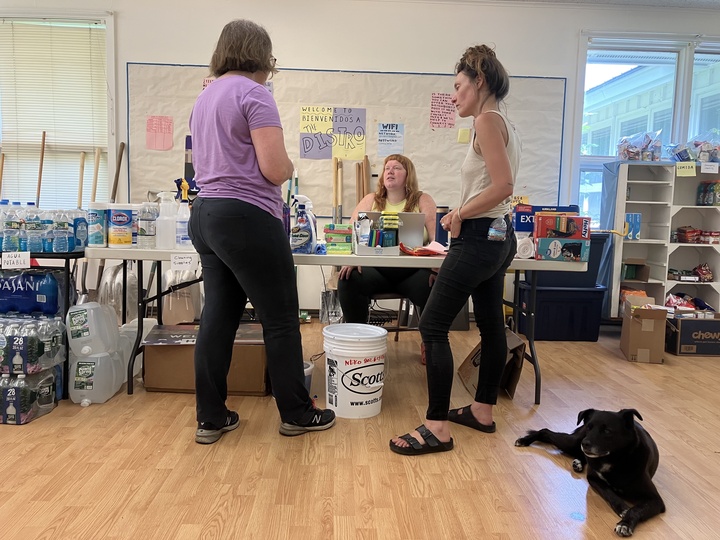
The group has been building relationships with people in the most affected communities for more than four years, said Ally Howell, who works for the agricultural nonprofit and is part of the NEKO leadership team.
“We were positioned really well to respond quickly in Barton and Glover and Orleans,” Howell said.
They began checking in with the families they knew as soon as roads were passable, and are trying to be in continuous touch and to understand their goals and needs, said Wayland, who is NEKO’s lead organizer and its primary eyes and ears on the ground.
“It may not look devastating. The pictures are not catastrophic,” they said on Thursday afternoon. “But we live in a region where people have already been on a tightrope. These people are living in low-lying areas and they have been clobbered by this thing.”
‘A delicate dance’
In Hardwick, the leaders of The Civic Standard, a nonprofit operating out of the former Hardwick Gazette building in the village, have been doing similar things. They mobilized volunteers to staff an emergency shelter that opened afternoon July 10, the first night of flooding there.
They also say the work is made possible by the presence The Civic Standard has been building in town for over a year. The group’s purpose, as described by co-founder Tara Reese, is simple but profound: “for people to be seen, to no longer be invisible to each other because of their differences,” she said.
A resource center, set up by The Civic Standard and the Hardwick Neighbor to Neighbor group, opened on the following Monday at the Hardwick Senior Center. By Wednesday morning, it had already given out all its dehumidifiers and more than 30 fans, and provided other kinds of support to 20 families, said volunteer Sara Behrsing, who was staffing it then.
“It’s something we’ve been building on all the time anyway,” said co-founder Rose Friedman. The organization wasn’t founded to respond to a disaster, but it is able to fill that role because of connections it has made. Supporting a community is varied. “Sometimes that looks like disaster relief and sometimes it looks like trivia (night),” she said.
Other, older nonprofits are also playing a role. Thompson, the Greensboro Bend shopkeeper, said the Greensboro Association has provided funds for immediate assistance to local families. One family might need nights in a hotel; another one, help with material disposal.
“Going to the garbage is not cheap,” she said. “It’s definitely heartbreaking to see families who don’t have the means and resources.”
Having Wayland and other NEKO staff on the ground in affected communities has been invaluable in helping the state and regional groups understand community needs, said NEKCA’s Winterson. “They have been huge in that regard,” he said.
Mitchell said that, because of Wayland’s work, he is trying to coordinate deliveries to specific households by the Salvation Army’s van while it is in Barton.
NEKO is currently trying to bring materials and volunteers, while respecting residents’ wishes, to seven locations — and more are being added as they are found, Wayland said. The greatest need right now for the group are people in the trades and restoration professions who can help residents evaluate what is salvageable and what is not, they said.
“We need people who have done this before. We can’t order the dumpsters and leave people to coordinate the volunteers,” Wayland said. “We have a relationship; we don’t have the expertise.”
The Civic Standard group is working at three locations currently and matching volunteers at a few other locations, said Friedman on Thursday. It already has sufficient volunteers connected currently, and the work is not about ripping and tearing.
“People are still living in these houses and have a life in them and a lot of attachment to the things in them,” Reese said. At the Gazette building, they are also providing a quiet place where people can come to sit and talk.
Both NEKO and The Civic Standard know that they cannot solve every problem many of these households face. They can’t even make sure this doesn’t happen again.
“We can’t lift these houses out of a floodplain,” said Hardwick resident Helen Sherr, a summer fellow with The Civic Standard.
But people active in those organizations, as well as town officials, hope this long-term and difficult work —- which Friedman calls a “delicate dance” — will allow information and assistance to come more easily next time.
“I love these people. I grew up here. I want to help them look to the future,” Barton’s Atwood said. “I’m not naive enough to think this is the only time we are going to see this kind of water.”
Correction: An earlier version of this story misstated the date that floods began.
