

House lawmakers have taken their first pass at a sweeping measure that would inject tens of millions of dollars into Vermont’s child care system, moving to further increase reimbursement rates to home-based providers while also raising co-pays for families.
The House Human Services Committee on Wednesday afternoon advanced an amended version of S.56 by a 10-1 vote, with Rep. Anne Donahue, R-Northfield, the lone ‘nay.’
Overall, it would cost an estimated $135 million in 2025, the first full year of operation — about $28 million less than the Senate-passed version. (About half of that reduction reflects the House’s intent to address parental leave, which is included in the Senate’s bill, separately.)
That remains a historic sum for the sector — and perhaps the largest investment in Vermont’s social services in a generation.
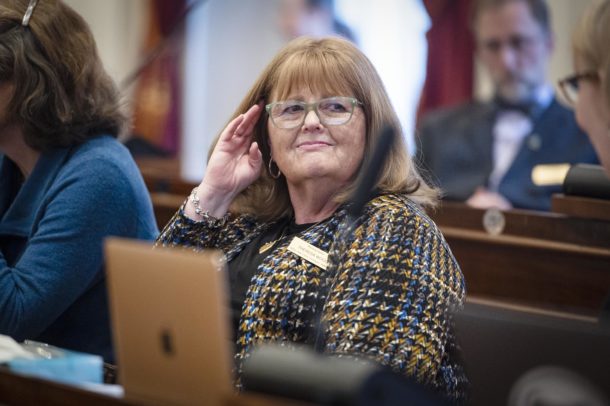
“It’s not lost on me or on the body that this is a very significant investment,” House Human Services chair Theresa Wood, D-Waterbury, told committee members moments before the vote. “And the thing that I want to say is that I really, deep down in my heart, feel that this is an investment in the future of Vermont.”
The House’s bill preserves the Senate’s nearly 40% reimbursement rate increase for child care providers. It additionally boosts home-based providers by reducing the gap between what they get and what centers receive by half.
But it reduces the number of families who would be newly eligible for subsidies, compared to the Senate bill, and moderately increases co-pays on a sliding scale.
Currently, families living at or below 150% of the federal poverty level are not charged a co-payment to receive a full subsidy from the state. As passed out of the Senate, the bill would eliminate co-pays for those making up to 185% of that metric, increasing the threshold from $45,000 to $55,500 for a family of four.
The human services panel’s version of the bill would reintroduce co-pays for those making between 150% and 185% of the federal poverty level — and slightly increase them, from the current weekly rate of $25 to $27.
Because the subsidies themselves would pay for a much higher cost of care, “the value of their benefit is rising substantially,” Wood said in an interview.
“So our committee landed on feeling that it was reasonable to ask for very small co-pay increases for families,” she said.
While the Senate’s version would have extended partial subsidies to those making up to 600% of the federal poverty level ($180,000 for a family of four), the House panel’s amendments would cut off subsidies for those above 550% ($172,500). Right now, subsidies cut off for those at 350%.
As lawmakers prepare to plow new funds into the sector, they’re also exploring ways to ensure money flows to higher wages for workers and quality improvements — not excess profits.
The House Human Services panel’s version of the bill would cap tuition increases. Rep. Emilie Kornheiser, the chair of the tax-writing Ways and Means committee, which will soon take possession of S.56, said she’s also interested in provisions that would require providers to disclose their ownership and require certain pay scales.
The tax-writing committee is also likely to give the bill’s financing mechanisms a substantial rewrite. To pay for the legislation, the Senate has proposed a 0.42% payroll tax and killing the child tax credit.
But Kornheiser said she’s committed to keeping the credit intact. Her committee is exploring funding the measure with a mix of personal income and corporate tax increases.
The tax-writing chair also said her takeaway from testimony is to avoid half measures. She’s therefore exploring a seven-year timeline, she said, in which Vermont might fully implement the recommendations of a report that outlined how the state might meet its affordability and quality goals for child care.
Neither the Senate-passed bill nor the latest amendments would fully reimburse care at the rates recommended in the report, nor would they achieve the goal that families pay less than 10% of their income on care.
“When we only go halfway, we’re never sure if our original strategy was a good one, because we haven’t fully funded it right? We didn’t fully test the theory change,” Kornheiser said.
As originally introduced, S.56 would have tasked public schools with delivering full-day prekindergarten to all 4-year-olds for free. But the Senate scrapped that after intense pushback from child care providers, whose finances heavily rely on existing publicly funded pre-K vouchers, and instead ordered a study on the subject. The Human Services amendments would replace that study with an “implementation committee” charged with coming up with a plan to do so by 2026.
With the proposal for full-day prekindergarten off the table for now, public schools have been pushing lawmakers to tweak Vermont’s school property tax formula so that schools already providing the programming don’t suffer a tax penalty. Right now, pre-kindergarteners are counted as part-time students, whether or not a school offers full-day programming. That inflates a school’s “per-pupil spending” figure, which in turn raises that district’s tax rate.
As advanced out of the human services panel, the bill wouldn’t change the tax formula until all schools are charged with offering full-day programming. Rep. Peter Conlon, D-Cornwall, who chairs the House education panel, which will review the legislation next, said Wednesday he’s open to the idea.
But Kornheiser, whose committee may get the last word, expressed doubt about it. She emphasized she wants public schools to take over pre-kindergarten for 4-year-olds — but not right now.
“I think it’s really, really important for early care and education as like, a full system, to be stabilized before we start incentivizing more public schools to move to full-day for 4-year-olds (for) pre-K,” she said.
