

BRATTLEBORO — Here at this town’s Public Works Department, mud season is usually mired in tradition: Slog each morning along 25 miles of local dirt roads, scribble down trouble spots on a piece of paper, then share with the switchboard by evening for drivers aiming to avoid problems the next day.
Enter Darren Pacheco, the new highway supervisor. Working online, he stumbled over a hiking link that reports the latest trail conditions with a simple swipe.
Like muck, the idea stuck.
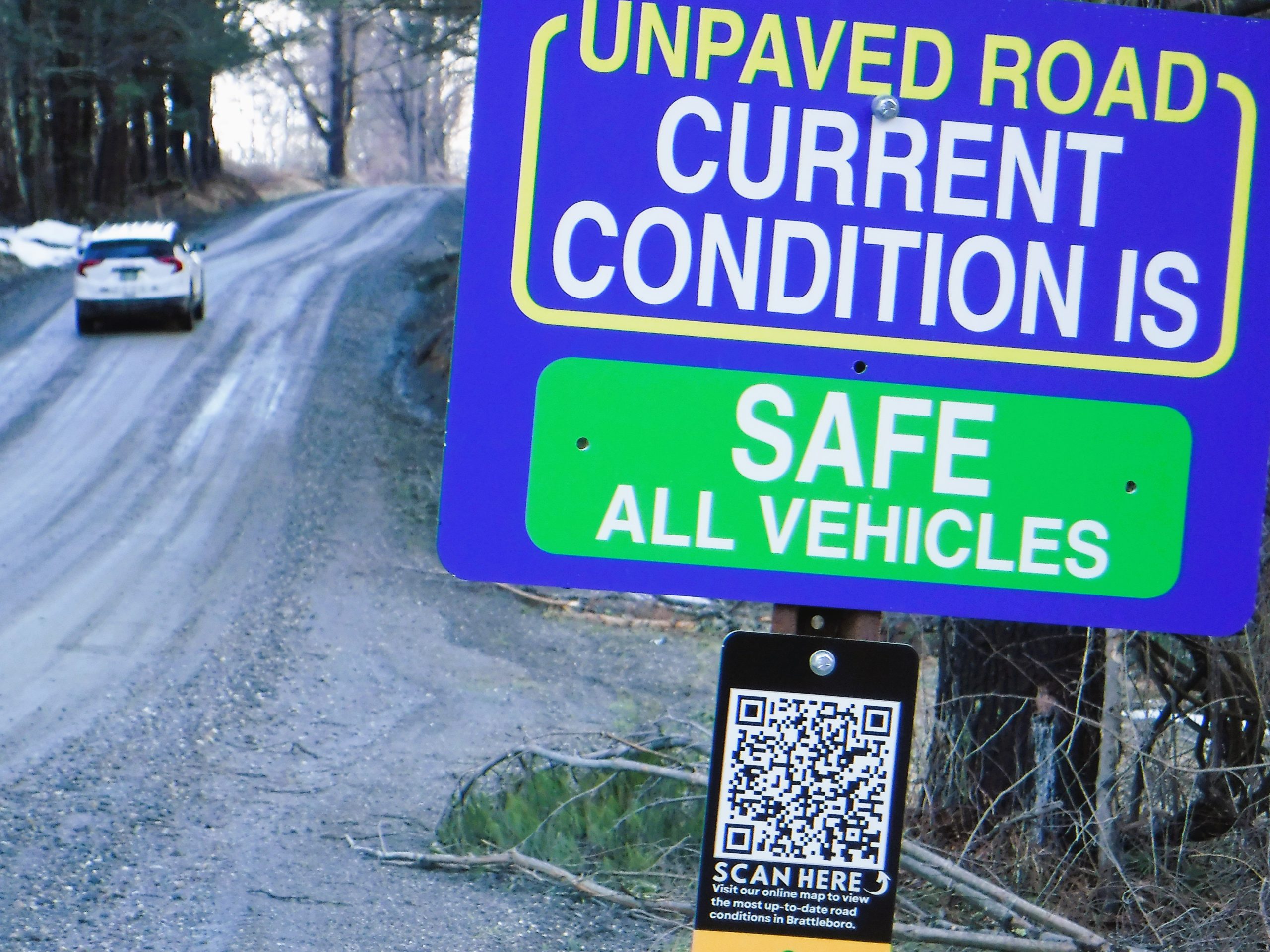
In what’s believed to be a state first, Brattleboro has installed new signs along its gravel roads that feature not only green, yellow, orange or red advisory labels, but also QR codes that cellphone users can scan to learn the latest driving conditions on every sloppy, soggy twist and turn.
“It’s instant information,” Pacheco said.
In a state where more than half of all roads are dirt, one might think a municipality could literally just pave over rabbets and ruts. But Vermont’s 247 cities and towns, each facing an average of 46 miles of gravel routes, have found asphalt and its maintenance can cost even more.

Merriam-Webster added the term “mud season” to its dictionary only last fall. But state geologists say the quagmire dates back 13,000 years, when melting glaciers smeared Vermont’s bedrock with a layer of silt and clay.
The resulting spread acts less like a sieve than a sponge. That means when the sun hits most dirt roads each spring, the melt doesn’t seep down or out but instead sits and stews.
“Mud Season in Vermont,” the state Agency of Natural Resources says on its website, “generally spans the six-week period between snowmelt and Memorial Day.”
Brattleboro, the southernmost exit on Interstate 91, is the first to feel the thaw. It installed 40 new signs with QR codes just after March Town Meeting Day and expects them to stay until the end of this month.
“We’re not going to leave them up year-round,” said Peter Lynch, assistant public works director, “because we don’t want people to get used to them and then ignore.”
The state maintains only paved roads, so the Vermont Agency of Transportation doesn’t track local mud-season problems. Brattleboro has yet to report any driving challenges for residents, emergency responders or truckers, with its advisory labels still an all-go green.
“This is a trial run,” Pacheco said of the signs. “We’re looking for feedback.”
Just no mudslinging, please.
