

This commentary is by Mary L. Collins of Elmore, a graduate of Johnson State College. She holds a BFA in writing.

I am a book collector. Over the years, I’ve come to understand the importance of books goes way beyond reading a particular title or author. Books are networks of thought, connection, scholarship, artistry and expression.
So what does this have to do with the impending closure of all four Vermont State University libraries?
It’s this: We cannot learn solely from a prescribed, digital syllabus. We learn from doing “walkabouts” through many subjects, experiences and influences that shape our thinking and, to some extent, our actions and involvement in the world.
College is not the end of learning but an introduction to it. It is the foundation from which many of us launch our adult lives and careers in our own unique and nuanced way in hopes of adding to the rich tapestry that shapes communities and societies.
If our experience does not include the discovery of new voices, minds and expressions, we are little more than a husk without the corn. That is what happens when access to resources is limited or restricted by a predetermined curriculum.
What is happening at our Vermont State Colleges through the closing of all four of its libraries is disturbing on so many levels. It is, in my estimation, dangerous.
To eliminate one of the most foundational resources students can rely upon — a library — is to say that their desire for knowledge is secondary to the “efficiencies” created by controlled access to information, a reduction of it.
When administrators are more concerned with balancing budgets than furthering students’ lived experience — discovery, creativity, and expression of knowledge, we have ceased to be a college. We become diploma mills, hamstringing students, faculty and staff who enrich all of our lives by their presence, knowledge, capacity, and resources available to them which, in turn, become available to their students and to the greater community.
Here’s an example: Robert Frost was a poet. He was also a naturalist. A lover of botany and astronomy. Frost could not have written his poems without having a deeply curious mind.
From an essay published in Poetry Foundation, educator and poet Karen Glenn said of Frost, “Throughout his life, Frost was drawn to science. As a boy, he sold magazine subscriptions to earn a telescope. He subscribed to Scientific American. When he taught at Amherst, he knew Nobelist Niels Bohr and wrote a poem (‘For Once, Then Something’) about his atomic wave and particle theories. It’s possible the scientists he knew influenced some of his most famous poems, including ‘Fire and Ice.’
“Harlow Shapley, a well-known Harvard astronomer, reported that Frost had asked him on two separate occasions the most likely ways in which the world could end. Shapley told him of two possibilities: the sun could grow into a giant red star and incinerate the Earth, or the Earth could veer away from the sun, triggering a permanent ice age.
Some time later, Frost wrote “Fire and Ice”.
“Some say the world will end in fire,
Some say in ice.
From what I’ve tasted of desire
I hold with those who favor fire.
But if it had to perish twice,
I think I know enough of hate
To say that for destruction ice
Is also great
And would suffice.”
Libraries are not dead relics of past societies. They are living cultures that depend upon the quality and vibrancy of their management and investment to serve in ways that feed and nurture those who frequent them. Reducing or eliminating access to college libraries is perversely contrary to the purpose of education — how we learn, why we learn, and why we must continue to be broad in our thinking and application of that learning experience.
In his essay in The Guardian (October 2013), author Neil Gaman speaks about the importance of libraries as “a place that is a repository of information and gives every citizen equal access to it. That includes health information. And mental health information. It’s a community space. It’s a place of safety, a haven from the world. It’s a place with librarians in it.
“What the libraries of the future will be like is something we should be imagining now. Libraries are the gates to the future. So it is unfortunate that, round the world, we observe local authorities seizing the opportunity to close libraries as an easy way to save money, without realizing that they are stealing from the future to pay for today. They are closing the gates that should be open.”
When we reduce education to economic efficiencies, when we take meandering across disciplines out of the equation, we take Robert Frost out of the forest, two little girls with their library cards in hand away from the windswept island of Prince Edward, and college students from their own search for meaning and self-expression.
While no college can operate without healthy investments in its total operation, investing in those things that invigorate and enliven one’s college (and life) experience goes far deeper than any quick surgical cut. We can begin by ensuring that our public college libraries remain open, alive and thriving. The choice now being made assures, instead, that they will continue to wither and eventually die by a form of “death by a thousand cuts” — of which much more information about the saying, its meaning and its origin can be found with a visit to your college library and a chat with a librarian who would be thrilled to help you explore its meaning, history, and current implications further.
My love of books has never abated. My love of libraries has actually increased. I see how our local library in Morristown operates. It is a place to gather, explore, and knit together introductions to possible interests we may have not considered.
For the board of trustees of the Vermont State Colleges to triage its financial woes by cutting off such essential limbs will only hasten the university’s demise.
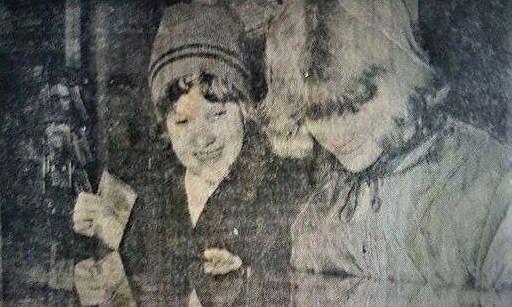
Here is a photo taken in 1966. It is of my childhood friend Nikki and me. Each Saturday morning we would walk to the Fletcher Free Library in Burlington, where we would exchange one week’s worth of books for another. On this particular occasion, we had been corralled by a Burlington Free Press photographer to stage a photo showcasing a collection of paperweights on display. If you look closely, you’ll see something in my hand. It’s my library card.
Vibrant libraries are the difference Vermont State University students deserve and have already paid for. Let’s assure that they can continue to hold the world in their hand, too.

