


EAST MONTPELIER — A dark sky greeted dozens of line workers at Washington Electric Cooperative’s warehouse on the last Thursday morning of 2022. Most listened expressionless, many with heavy eyelids, while their manager listed their assignments.
As they began their sixth consecutive 5 a.m. shift, the line workers hoped to bring power back to the utility’s final 68 households nearly a week after a historic winter storm.
The team, which included Washington Electric’s staff and other crews from around the state, had restored power to around 700 households the day before, but this day wouldn’t be much easier. The utility prioritized the least complicated outages in order to restore power to the greatest number of people, which left the trickiest situations for last.
By day’s end — 17 hours later — their work was done, capping a grueling week in which crews labored day and night to return power to more than 5,700 of the approximately 11,000 households that Washington Electric serves. Their only respite came on Christmas morning, when some workers spent a few hours at home with their families.

On Dec. 23, Winter Storm Elliot sent record-high winds across Vermont, leaving it strewn with trees ripped up by the roots. In total, more than 75,000 homes and businesses lost power throughout the state.
Green Mountain Power — by far the state’s largest electric utility — had turned the lights back on for tens of thousands of customers by Christmas day, and most utilities had wholly restored electricity by Monday, the day after Christmas. Vermont Electric, a larger co-op serving 32,000 members in a sprawling band of northern towns, was wrapping up its work, with 375 outages remaining.
But hundreds of Washington Electric customers waited five days, and some a full week, for their power to flick on again. Nearly 2,000 members were still out on that Monday night, and while some had generators and wood stoves, others went without heat, internet and cell phone reception.
During what may have been the most expensive storm on record for Washington Electric, the cooperative’s small model — it employs only 14 full-time line workers — struggled with the unwieldy task of restoring power to thousands of homes in dangerous conditions across particularly challenging terrain in more than 40 towns.

When a utility’s territory experiences widespread outages, a mutual aid system usually kicks in, sending crews from other areas to provide assistance.
All of the state’s utilities “prepared for what they were being told was a potentially historic storm” by bringing in crews ahead of time, said Erica Bornemann, director of Vermont Emergency Management.
“It was really challenging, though, because this was a regional storm, and so all of the mutual aid agreements that these utilities are a part of — it was really difficult for them to find additional crews because they were already being utilized in the other states like New Hampshire and Maine and New York,” Bornemann said.
Save for two crews from Burlington Electric Department, which was largely unaffected by outages, spare line workers didn’t reach Washington Electric for several days, according to Louis Porter, the utility’s general manager.
For Porter — who took the helm of Washington Electric in the fall of 2021, shortly after he left his post as the commissioner of the Vermont Fish and Wildlife Department — navigating climate change is a big part of the job.
As storms grow more intense and frequent, small co-op utilities such as Washington Electric may find themselves more frequently needing to take on an amount of work that is disproportionate to the resources they have in hand.

An expensive storm
As Porter tells it, Washington Electric was founded about 80 years ago because commercial, private utilities declined to enroll the territory over concerns that stringing and maintaining lines throughout such a rural, challenging landscape wouldn’t turn a profit.
Instead, farmers gathered and stood up an electric utility within a year. In an effort to minimize costs, they strung lines the shortest distances possible.
“And they were stringing a lot of it with horses, and others with tractors,” Porter said. “A lot of those (lines), in our territory, don’t go near the roads.”
Washington Electric is set up for off-roading. Machines that look made for war — off-road buckets and off-road diggers — can traverse snow and woods where utility trucks can’t. Other utilities employ similar machines, but Washington Electric makes regular use of them, Porter said. The utility averages just nine members per mile of line.
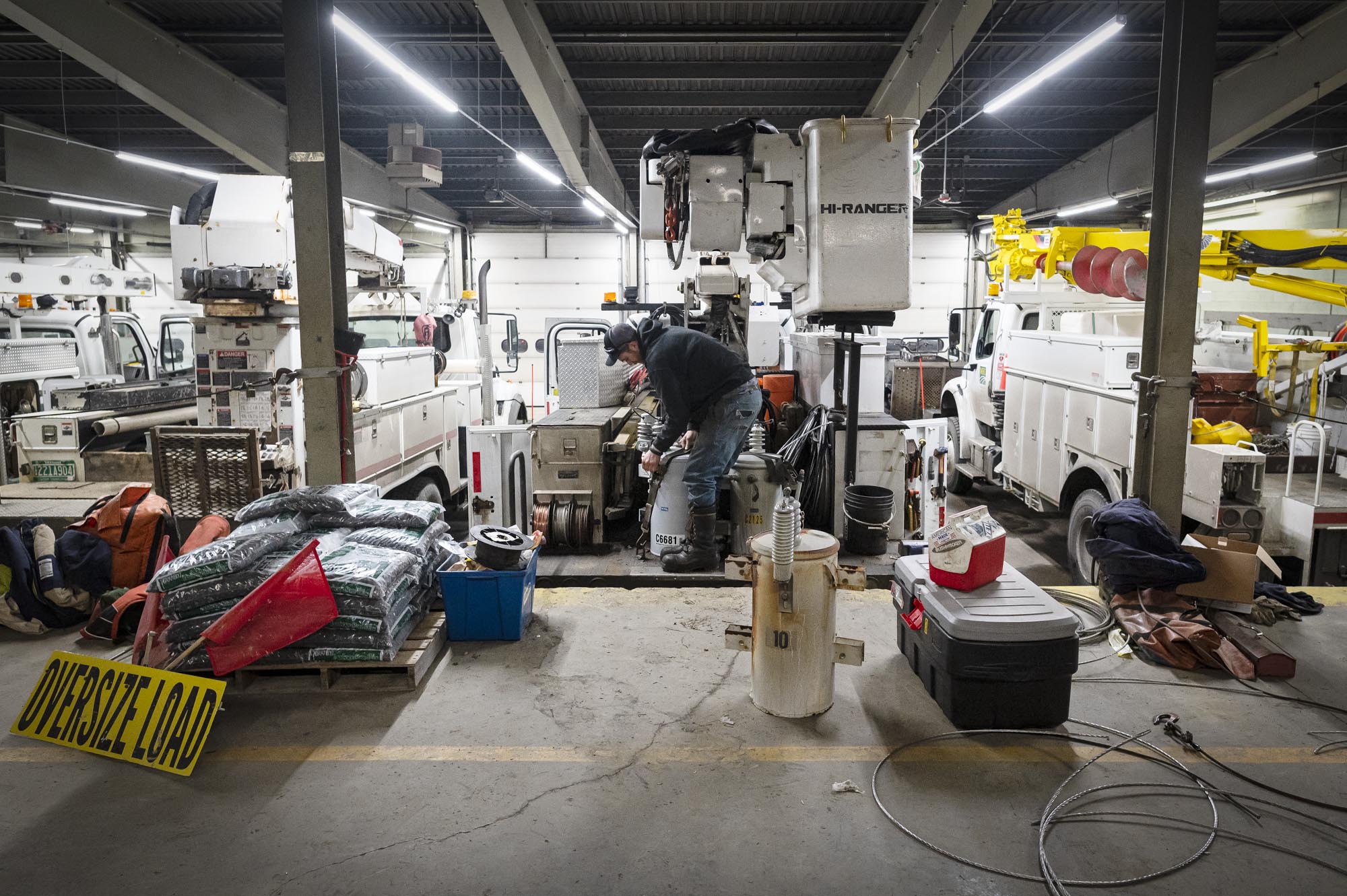
“All these things are things that make it challenging, both physically to keep the infrastructure going, and financially to pay for it,” Porter said.
Then came the storm, with record-high winds that blew at an unusual angle. Prevailing winds come from the west or the northwest, but these winds came from the southeast and southwest, according to Porter.
“That meant that trees that haven’t come down for many, many years and many storms came down,” Porter said.
The storm broke more than 37 poles, which was “pretty unprecedented,” Porter said. Poles are time-consuming to repair, and supply chain disruptions have made some equipment, particularly transformers and poles, harder to come by. About half of the broken poles had been replaced around a week after the storm hit, he said.

The utility budgets for around $300,000 in emergency storm management each year, a number that’s based on a 10-year average. Porter estimates that Winter Storm Elliot will cost Washington Electric $1.3 million — and it’s unclear whether it will benefit from federal aid.
Kristin Carlson, who leads energy services for Green Mountain Power, said the statewide utility also serves rural areas of Vermont and has worked to prepare for storms so that it can return power as quickly as possible.
But, with 25 times as many customers and an entirely different business model, the utility has many more resources than cooperative utilities such as Washington Electric. Its leadership team typically sets aside $6 million to handle emergency storm situations each year, Carlson said.
Green Mountain Power has 150 line workers and brought in 280 contract line workers, who aren’t regular staff members of any utility. Washington Electric used some contract line workers, too, and like traveling nurses, contract workers typically come at a higher expense for a utility, Porter said. GMP also brought in 200 more workers to manage the downed trees.
“We are seeing more frequent and severe storms due to climate change,” Carlson said. “And this is fueling our fire to really speed up a lot of the innovations we’ve already deployed in partnership with customers to help keep everyone powered up.”

Extra steps
As utility crews dispersed throughout the state, thousands waited for power, and sometimes heat, to return.
While East Montpelier resident Simone Labbance grew up in Vermont, her husband, Juan Vistro, grew up in Manila, where power black-outs were frequent — but he hadn’t experienced a prolonged blackout in winter. During their five-day outage, Labbance was grateful they could get ahold of more wood for their stove, though that marked a significant expense for the couple, she said.
“My partner, she’s been constantly reassuring me that this is very unusual for power outages,” Vistro said. “It really means you just have to do extra steps, right? For basic things like using the bathroom.”
As the storm began to take shape, town officials in Calais began preparing a warming shelter. Nearly all of the roughly 1,600 residents in the town ultimately were left without power.
“Our greatest concern was people who do not have a source of backup heat, which — there are plenty,” said Nick Emlen, the town’s emergency management director. “There are lots of generators out there, and there are lots of wood stoves, but many people don’t have either of those things.”
Municipal emergency management directors such as Emlen help officials with Vermont Emergency Management understand how and where to send help when it’s needed.
There were several situations, Bornemann said, in which utilities would become aware of customers who had medical needs or safety issues — maybe the customer was elderly and didn’t have a secondary heat source. Even though the territory was out of power for longer than others, Bornemann said, Washington Electric did not stand out as a territory that needed more emergency help than other utility territories.
Mary Admasian, who lives down the road from Labbance and Vistro, was also out of power for five days. She, too, had a wood stove, and relied on friends and neighbors with generators. It’s the longest time she’s been without power, she said. While she fared well, she worried for those with no generators or backup heat.
“If you didn’t have some of those things, you’re in trouble,” she said.

The events following the storm made her question the structure of the utility and whether it was able to serve its most essential function during emergencies.
She pointed to difficulties with communication, in particular. In one instance, people were driving down her road, under a downed tree with a live wire. She tried to call the utility but was directed to a national hotline that was answering Washington Electric’s calls. When a neighbor called Vermont State Police, the agency directed the caller to contact the utility, Admasian said.
“I think we need to rethink, really take a hard look, at how things are working or not working and how best we can support our rural communities, whether it’s through the co-op infrastructure, or creating an alliance or something with Green Mountain Power … or whatever it is that’s around us,” Admasian said.
Porter said the communication system represented one of the utility’s biggest challenges during the storm. It used the national answering service hoping that would serve a greater number of members. The co-op only has three or four people to answer the phones.
“We just can’t compete with, you know, 400 personnel,” Porter said. “But that call center was overwhelmed because many utilities across the country had a lot of damage. Members had a hard time getting through in some cases. Which is on us.”
The combination of the national phone system and the lack of phone service from the power outage prompted members to show up at Washington Electric’s door, Porter said.

A size problem
Michael Dworkin is well-poised to untangle the web of challenges Washington Electric faces with a storm like Elliot, and into the future.
Dworkin, a former utility regulator and the founding director of Vermont Law School’s Institute for Energy and the Environment, is also a member of Washington Electric. Out of power for five and a half days at his East Montpelier home after the storm, he temporarily relocated to Plainfield to stay with his daughter.
Running any utility is a challenge, he said, and the U.S. model, in which investors typically own utilities, is unusual on a worldwide scale.
The investor-owned model — of which Green Mountain Power is an example — has “proponents and opponents in what’s been called a 100-year war between public and private power,” Dworkin said. Both sides are almost religious in their belief, he said, and both models have seen successes and failures.
What may matter more in this case than the public or private model, he said, is the utility’s size. He raised the mutual aid problem, in which spare crews are less available to assist during large, regional storms. Without such aid, line workers — who have some of the most dangerous jobs in the country, he noted — can easily become overworked.

“Even in the best of circumstances, it’s dangerous work that needs to be done with care. And that means it cannot be done by people that are in terrible fatigue,” he said.
Storms are likely to become more intense, more frequent and last longer as climate change progresses, he said.
Federal funding and support is already built into the small co-ops’ economic fabric, Dworkin said. But it will take more than that for a small, public utility to survive. Utilities will need to focus on the energy efficiency of the homes and businesses they serve through measures such as weatherization. They’ll also need to have power generation that’s more dispersed, and therefore less vulnerable.
“It’s impossible for small utilities to survive in the pattern they’ve dealt with for the last two decades,” he said. “Whether they’ll be able to continue turns mostly on how severe a set of storm damages and climate changes we have to deal with.”
As climate change persists, he said, “you have to be doing much, much better to avoid major rate increases and major, significant reductions in reliability.”
Porter is no stranger to the challenges of a small co-op utility. He grew up in Washington Electric’s territory and remembers utility crews rowing across a pond near his home in Adamant to reach a pole on the water’s far side. (That line has since been removed.)
The model poses a challenge “all the time, because you have fewer people paying into the system to support the infrastructure of the utility,” he said.
Porter is still waiting to see if the Federal Emergency Management Agency will help the utility cover the cost of the storm. With the exception of FEMA events, the cost of major storms gets paid by the ratepayers, he said, whether it’s through a line of credit that’s paid back over time or a direct rate increase.
The option to combine some of the small utilities, such as Vermont Electric Co-op and Washington Electric, “is always kind of out there,” Porter said. Ultimately, it’s up to the members who own the cooperative, though he says it’s a change that’s unlikely to take shape any time soon.
“I think the membership, or at least some portion of the membership, is pretty connected and is devoted to their particular co-op, whether it’s VEC or us,” he said. “So, you know, I’m not sure that they’d want to do that.”

First light
For the line workers who were gathered on that Thursday morning, neither the hope for a conclusion to their long work week nor the rows of brown-bagged breakfast sandwiches — made special for the crew by the nearby Dudley’s Store — seemed to perk their spirits.
Two safety incidents had made the week more difficult. In one, a 40-foot log from a maple tree that had been teetering on a powerline fell toward a line worker, hitting him in the chest and knocking him down, giving him a concussion and otherwise mild injuries.
Telling the story, holding coffees as they greeted line workers who filed in for work, Porter and David Young, safety and environmental compliance specialist with Washington Electric, shook their heads. It could have so easily been worse, Porter said.

“It’s also gonna be hard for him because they’re doers. You know?” Young said. “Now you’ve got this guy sitting at home when all of his team is out getting stuff done.”
Another crew member fell asleep on his way to work, and his truck slid off the road. Other than swapping a tire, there was no damage — and he worked through the day, Young said.
The crew and its leaders were all too aware of the risks. Less than a month earlier, Lucas Donahue, a crew member with Green Mountain Power, died while he was working to restore power during a windstorm. Before Donahue, it had been a long time since a line worker died in Vermont.
Dawn had begun painting red ribbons of light above the horizon when the workers piled into their freshly equipped utility trucks, filing out of the warehouse driveway one by one.

