

This commentary is by Rick Winston, who was co-owner of the Savoy Theater in Montpelier from its inception in 1980 until 2009. He is now a film history instructor at the Montpelier Senior Activity Center, and a speaker on film history for the Vermont Humanities Council. He is the author of the recently published “Red Scare in the Green Mountains: Vermont in the McCarthy Era 1946-1960.”
On Wednesday, Dec. 6, a New York Times obituary was headlined, “Don Luce, Activist Who Helped End the Vietnam War, Dies at 88.”
Some readers may have never heard of Don Luce. Others may know the name only in connection with his role in uncovering the notorious “tiger cage” prisons in South Vietnam. But several paragraphs into the obituary, there is some biographical information that gives the story special meaning for central Vermonters:
“Donald Sanders Luce was born on Sept. 20, 1934, in East Calais, Vt., to Collins and Margaret (Sanders) Luce. His father ran a dairy farm, and his mother was a teacher.”
The journalist Gloria Emerson described Don as “a gentle and austere man, born without a temper, almost unable to return anger.”
This unassuming man who played such a vital role in turning American public opinion against the Vietnam War was a product of Calais schools and the University of Vermont. He earned a bachelor’s degree from the University of Vermont and a master’s in agricultural development from Cornell. It was his friendship with some Malay students at Cornell that sparked his interest in Asia. Soon he headed to South Vietnam with International Voluntary Services in 1958, running an experimental agricultural station to help the villagers grow a better variety of sweet potato.
In 1961, he became director of International Voluntary Services. All the while he was learning Vietnamese and befriending many young, disaffected Vietnamese students. He was an eyewitness to the growing American involvement in Vietnam (this was the era of Graham Greene’s prescient novel “The Quiet American”).
Although Luce eventually obtained press credentials from the Ecumenical Press Service of the World Council of Churches, “his was a Vietnamese world,” wrote Gloria Emerson in her book “Winners and Losers: Battles, Retreats, Gains, Losses, and Ruins from a Long War.” “He did not hang out with American reporters or personnel, and saved documents other reporters did not read.”
In 1967, Luce, along with three other officials, resigned from the International Voluntary Services in protest, writing a letter that said, “We are finding it increasingly difficult to quietly pursue our main objective: helping the people of Vietnam. The war as it is presently being waged is self-defeating in approach.”
When a congressional delegation arrived in 1970, it was Luce who suggested they visit the Con Son prison. Although the Vietnamese officials insisted that the brutal treatment of the tiny “tiger cages” were a thing of the past, Luce suspected otherwise — and the horrified congressmen soon saw the appalling conditions for themselves. Luce had a hand-drawn map that led to a secret door behind which the visitors found hundreds of starving and brutalized men and women crammed together in cages under grates in a walkway.
The ensuing controversy made Don Luce persona non grata to both the U.S. and South Vietnamese governments. He was expelled in 1971, and on behalf of his new organization, the Indochina Resource Center, began a speaking tour that took him all over the United States — including 23 stops in Vermont in the summer of 1971 (one of those was at his hometown East Calais Church, where I heard him speak).
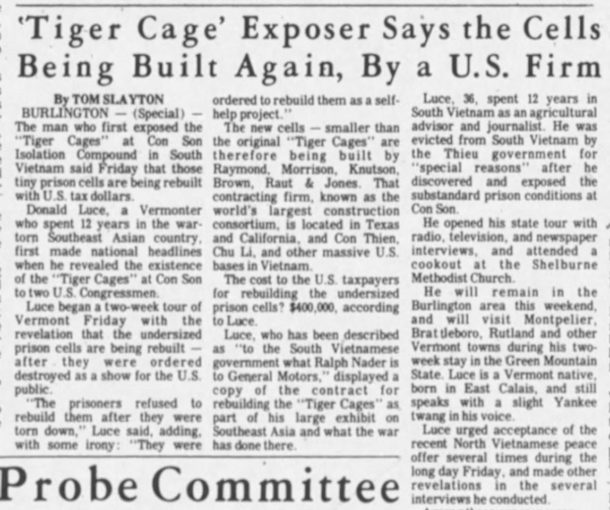
The Vermont part of Luce’s tour was sponsored by the Vermont Ecumenical Council. Tom Slayton covered Luce’s central Vermont appearances for the Times Argus, relating the revelation that the infamous prison cells were being rebuilt — after they were ordered destroyed.
Slayton reported, “‘The prisoners refused to build them after they were torn down,” said Luce, adding with some irony, ‘They were ordered to rebuild them as a self-help project.’” Luce was also quoted as saying, “When a village is bombed, most of the people are killed. From the villagers’ viewpoint, there is a My Lai massacre every day.”
Times Argus editor Nicholas Monserrat wrote a lengthy editorial about Luce’s tour titled “Revelations on Vietnam.” Monserrat noted that Luce brought the viewpoint of ordinary Vietnamese who had suffered through political repression, defoliation of their forests, and forced relocation. These experiences “more often than not have been completely ignored in U.S. policy decisions about the war.” Monserrat concluded, “It’s a voice that hasn’t been heard too often in respect to the war, and obviously one to be listened to.”
Scudder Parker, who worked with Luce as part of the organization Clergy and Laity Concerned, remembers that 1971 tour vividly: “Don Luce’s opposition to the Vietnam war grew out of his knowledge of and love for the people of Vietnam. … His way of protesting was to bring a stunning display of almost life-sized panels showing the people he knew at work, at play, at rest. He shared their poetry, history, music and stories. He set up the display in the basement of the church in which I was the pastor, in East St. Johnsbury, and in many other communities (often in churches) around Vermont. He stayed and talked with people, and through his conversations and presentations, the war moved from abstraction to an opportunity for learning, sharing, and connection.”
Luce continued to speak out against the war until it ended in 1975. He was surprised to learn that in 1976, Graham Martin, the last American ambassador in South Vietnam, placed primary responsibility for the loss of the war on Don Luce and the Indochina Resource Center and their “propaganda extravangza.”
Since the early 2000s, Luce and his husband, Mark Bonacci, had lived a quiet life in Niagara Falls, New York. His interest in Southeast Asia never waned, as he led study groups to Vietnam and accompanied journalists on reporting trips to Vietnam and Cambodia. But his main activity was as the public relations director for Community Missions of Niagara Frontier, which offers a range of social services, including a homeless shelter and soup kitchen.
He was quoted in The New York Times obituary as saying, “I try to concentrate on helping a few people have an easier life, and look out at the world from a Niagara Falls soup kitchen perspective.”
Scudder Parker takes this lesson from Don Luce’s life: “His powerful public leadership against the war, for LGBTQ rights, to protect victims of sexual exploitation and homelessness, always came from that deep reservoir of caring and intimate knowledge of people’s suffering and hope. … He knew that this level of caring was deeper and more powerful than mere political argument.”

