


When the public finally had its turn to speak in Winooski on Tuesday evening, Dina John’s concerns took center stage.
During a forum at the O’Brien Community Center about diversity, equity and inclusion within the state’s court system, John, who is a judicial assistant, voiced her feelings of discomfort within the courthouse and the frustration she’s felt when coworkers have asked if the 22-year-old is a student intern.
“At what point do I get that same level of respect that they have with their colleagues?” asked John, who made an unsuccessful bid for a Burlington City Council seat earlier this month.
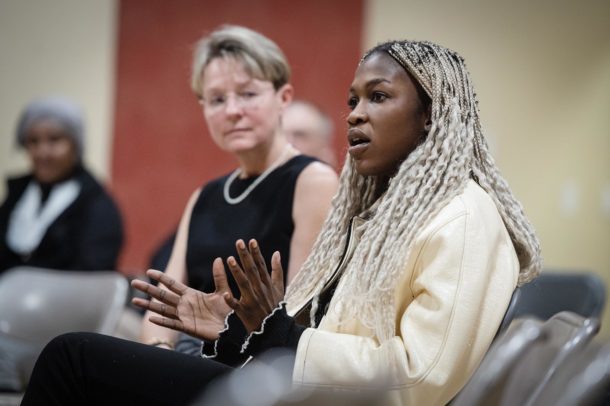
In response, Associate Justice Nancy Waples asked John, who is Black, if her experience might also have to do with race. Waples said she could certainly relate to John, describing her own experiences — such as being mistaken for a defendant or translator, because she is Asian American, by a Burlington court officer when she was a criminal defense attorney.
Waples made history earlier this year as the first woman of color appointed to the state’s highest court. In addition to co-chairing the judiciary’s Commission on Diversity, Equity, and Inclusion, she chairs its administration and operations committee.
John said her race may be the reason she feels more comfortable working in family court than in criminal court, due to the “historical background of Black people always involved in all the criminal cases.”
She told committee members that, to recruit a more diverse applicant pool, they should “enter the spaces that (are) already doing the work” and not wait for communities to come to the court system.
“It’s certainly something we’re aware of, and it’s certainly something that, as the chair of this committee, is going to be one of my bigger goals,” Waples said, with next steps being better training and diversified recruitment of staff members.

Racial disparities in the judicial system persist in Vermont, one of the whitest states in the nation. According to a study issued by the Council of State Governments in April, Black people were six times more likely to be in Vermont’s sentenced prison population than white people in fiscal year 2019. They were 14 times more likely to be defendants in a felony case between 2014 and 2019.
This was the second public forum held around the state throughout the 14 counties. The public’s comments will factor into recommendations that will be delivered to the Vermont Judiciary next year, according to Chief Justice Paul Reiber.
Yet it wasn’t the public who did most of the talking, but the committee itself, as members spent more than half of the forum on introductions, discussing the commission’s plans and addressing tangential topics, including New York Mayor Eric Adams’ plan to involuntarily hospitalize people with mental illnesses.
In addition to John, the committee heard from Rev. Mark Hughes, the executive director of the Vermont Racial Justice Alliance, who advocated for the commission to partner and collaborate with the public to create solutions.
“There are some of us in the community that just don’t have necessarily concerns that we need you to solve. But there are concerns that we’d like to solve with you,” Hughes said.

Despite the U.S. Constitution’s Fourteenth Amendment, which ensures equal protection under the law, disparate outcomes persist along racial lines, he said. He suggested changes could be made to the state constitution to rectify that.
In a subsequent interview, Hughes pointed to the “insular nature” of the planning and rollout of the commission and said he thinks that there should be more representation from impacted communities.
Other discussion at the public forum centered on a lack of mental health services in marginalized communities and some of the commission’s biggest challenges, such as how to get people more involved in diversity, equity and inclusion work; how to get the court system to continue to innovate; and how to get the public to understand what the courts actually do.
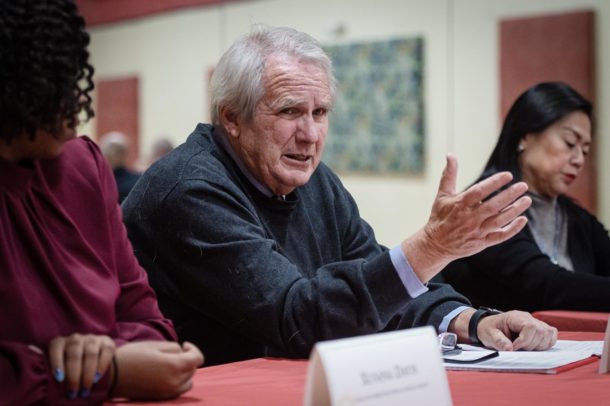
About 35 people attended the first event earlier this month in Burlington, according to Reiber. He said he was a little disappointed with the turnout at the Winooski event, which was attended by roughly two dozen people, including a number of court staff.
Xusana Davis, the state’s executive director of racial equity, said people at the Burlington meeting advocated for considering poverty and socioeconomic status during discussions of diversity, equity and inclusion practices. There was also a discussion about how to use data to meaningfully shape people’s lives.
