

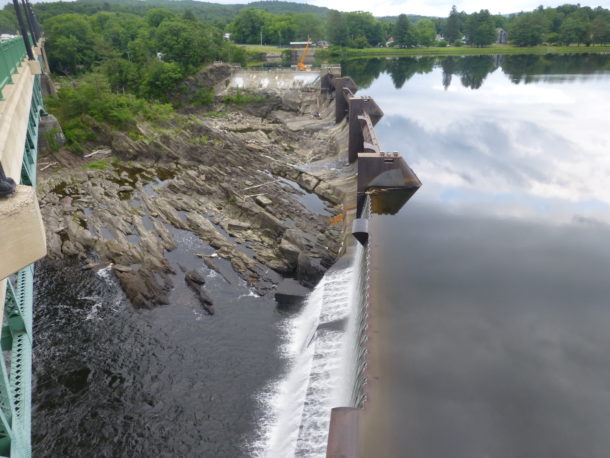
This commentary is by Karl Meyer, who lives in Greenfield, Massachusetts, has attended the meetings of the Connecticut River Atlantic Salmon Commission since 2009, and has been a stakeholder, intervener and a fish and aquatics studies team member in the Federal Energy Regulatory Commission’s relicensing process for Northfield Mountain since 2012. He is a member of the Society of Environmental Journalists.
Rivers don’t stagger. They don’t stutter and stop, then run backward and uphill. They don’t inhale themselves in giant gulps, then cough and spew.
They don’t feed on nuclear energy or gorge on natural gas from the power grid. Rivers don’t ratchet up and down, forward and back, like a heart attack followed by a stroke. And rivers don’t kill their own, devour baby fish, and disappear in darkness.
But the Connecticut River in Massachusetts does. It has, daily, for half a century.
As of December, over 100 citizens had gone on the record with the Federal Energy Regulatory Commission, stating FirstLight Power’s Northfield Mountain Pumped Storage Station — just south of the Vermont border — must be denied a new federal license to kill. Early in June, half a dozen members of Extinction Rebellion trespassed at Northfield Mountain, hanging banners over its deadly suctioning mouth on the Connecticut River, calling for its immediate shutdown.
Northfield Mountain is the most direct-deadly, energy-wasting machine ever built on the 410-mile Connecticut River. It feeds monstrously off the river and voraciously from the New England power grid, squandering one-third more juice than it ever produces as exportable, net-power-loss, peak-priced megawatts.
It was completed in 1972, though its machinery had already been banned for a full century by the 1872 landmark U.S. Supreme Court decision in Holyoke Co. v. Lyman — mandating safe upstream and downstream fish passage on the Connecticut and all rivers.
Northfield’s daily killing violates federal and state law — it literally scrambles and impedes fish migration, reverses miles of flow, and outright kills juvenile and adult migrants and unaccounted for hundreds of millions of annually spawned fish eggs.
In 1967, five years before it was built, federal agencies were seeding fertilized eggs of American shad miles upriver of where the station’s giant suction pipe would later sit. Thus began the federal/state “Cooperative Fishery Restoration Program for the Connecticut River Basin.”
Spearheaded by what are today’s U.S. Fish & Wildlife Service, the National Marine Fisheries Service, and the fish agencies of four states, it promised restored American shad runs of “one million fish at Holyoke; 850,000 at Turners Falls; and 750,000 at Vernon (VT/NH).” Its federal mandate was “to provide the public with high-quality sport fishing opportunities in a highly urbanized area, as well as to provide for the long-term needs of the population for seafood.”
Disastrously, that program soon morphed itself into a massive hatchery program for a long-extinct (since 1809) Connecticut River salmon strain, a decision that’s failed the river to this day. Hundreds of millions were spent across 43 years raising hatchery fish, yet not a single salmon was counted at the Holyoke Fishway this year — while the shad tally there was the worst since 2010.
Instead of that 850,000 shad at Turners Falls, a trickle of 22,000 had passed that dam as of June 1 — a site hugely impacted by Northfield’s monstrous water appetite and deadly suck-and-surge river diversions.
Today that failed restoration-bureaucracy goes by the name Connecticut River Atlantic Salmon Commission. Ironically it’s being chaired by Andy Fisk, director of the Connecticut River Watershed Council/Conservancy. In business since 1952, the council was the watchdog that should have prevented Northfield’s being built in 1972. But it never rallied against Northeast Utilities’ proposed pumped storage nightmare.
Simultaneously, over on the Hudson, a tiny collection of people decided to fight Consolidated Edison’s pumped storage proposal. Rallying fishermen and working folks, they went to court. After 15 years in the trenches they won that battle — preventing Storm King Mountain from becoming their river’s monster predator.
Today called Hudson Riverkeeper, the group’s tactics have become the key protection model for successful river nonprofits. Its ready-to-prosecute blueprint has spawned over 350 Waterkeeper organizations worldwide.
Today we have a Watershed Council rebranded as the Connecticut River Conservancy, folded into the Atlantic salmon commission bureaucracy — but also still in an unending partnership with electricity and natural gas giant Eversource. The conservancy gets big bucks for greenwashing Northeast Utilities — the same former NU that built Northfield on its namesake river.
Look at the Connecticut River Conservancy’s legacy board, donors and PR, and it is no surprise the perennial key funder of the annual fall, one-day, Source to Sea Cleanup remains NU/Eversource.
To my view, Mr. Fisk has no business chairing the Connecticut River Atlantic Salmon Commission — a position purportedly to act on the public’s behalf in Massachusetts and three other states, while he’s also directing the Connecticut River Conservancy. His conservancy, a self-described watchdog, remains in bed with the corporation that continues benefitting via the horrific exploitation it set in motion at Northfield in 1972.
Eversource is wired directly to that plant. But Fisk and the Connecticut River Conservancy also continue collecting funding from, and through, the Connecticut River Atlantic Salmon Commission’s federal and state members — the ones whose mistakes, policies, and lack of enforcement action a true watchdog must remain unencumbered by.
Wendi Weber, director of the U.S. Fish & Wildlife Service’s 13-state Northeast Region, headquartered in Hadley, Massachusetts, serves in the titular roles as Connecticut River Atlantic Salmon Commission’s secretary. One can’t hold agencies responsible for enforcing environmental law and policy, and publicly expose and prosecute them, when your hands are in their pockets.
In 2018 FirstLight Power, owned by Canada’s global venture capital giant Public Sector Pension Investments, transferred Northfield’s nameplate ownership into a Delaware tax shelter. Early this year, the Connecticut River Conservancy cut a new deal with FirstLight, which is seeking a new 50-year federal operating license for Northfield. It was for weekend flow releases for recreationists, a key constituency of the conservancy.
This year, the conservancy is also expecting to cull some $102,000 in public funds for its own staff and benefits, and $44,000 more in expenses, as part of a proposed $514 million Connecticut River Atlantic Salmon Commission federal budget. Yet after 70 years, it still lacks even a single staff lawyer, but still wants to be seen as an independent watchdog — though one that’s now taken up a handmaiden’s role in the salmon commission’s bureaucratic structure.
Andy Fisk is now acting as key lobbyist and congressional contact for the Connecticut River Atlantic Salmon Commission’s bid to reauthorize that foundered restoration bureaucracy for another 20 years in 2023. Yet its byzantine structure — all but publicly unknown and rarely reported on — has never been held accountable for this river’s 50 years of protection and management failures.
Northfield is operating in direct conflict with landmark environmental law at the expense of our river — for FirstLight profits that reach into the hundreds of millions annually. Deadly from inception, it is horrifically inefficient and ruinous to a four-state ecosystem. Its daily suck-and-surge carnage is patently unnecessary for the day-to-day operation of the New England power grid, yet it soldiers on.
FirstLight’s federal license for Northfield expired on April 30, 2018. It should have been shuttered that day.
This March 17, in what may come to be known as the “Connecticut River St. Patrick’s Day Massacre,” the U.S. Fish & Wildlife, National Marine Fisheries, and Massachusetts Division of Fish & Wildlife — instead of denying FirstLight a new deadly license, signed off on an “agreement in principle” with FirstLight for a new, decades-long, river-killing lease. The terms are grim; a green light for a deadened river for generations.
FirstLight‘s plan was to have government agencies do a final sign-off on their completed final agreement by yesterday, June 30. Once they’ve signed up under those new venture-capital terms, it may be time our public trust agencies rebrand under a new, blanket Connecticut River moniker: Extinction Completion.

