


A lawsuit in federal court, aiming to prevent the long-beleaguered Champlain Parkway, could soon pick up some muscle, as several groups opposed to the project have thrown their support behind the legal case.
Although federal officials and Burlington leaders have green-lighted construction on the parkway’s first phase, the lawsuit, filed two years ago, contends that the 25 mph route through Burlington’s South End would disproportionately harm people of color and with low incomes.
That claim runs counter to findings approved by federal officials in January. In that decision, the Federal Highway Administration said that, while the parkway would empty out in Burlington’s racially diverse King and Maple neighborhood, the project would not harm those residents more than others along the route, and therefore complies with federal environmental justice rules.
But in a brief submitted Thursday, a program of students from Vermont Law School blasted that claim, saying the government rammed through the project without enough public engagement from King and Maple residents, and relied on imprecise data that made the neighborhood look less diverse.
“The concerns of Black and Brown residents of the Maple/King neighborhood were devalued to promote a project that will mostly benefit more affluent white communities in Vermont,” the students argued in the brief.
Students wrote the brief on behalf of the Vermont Racial Justice Alliance, a statewide organization. They gathered support from a number of co-signatories, including the Champlain Valley Office of Economic Opportunity, one of the area’s largest social services providers, and the Vermont Center for Independent Living, whose Burlington branch is adjacent to the planned parkway route.
Also this week, the Innovation Center of Vermont — an office building that sits along the parkway’s planned route — asked to join the lawsuit’s initial sponsor, an activist group called the Friends of Pine Street. Judge Geoffrey Crawford of U.S. District Court in Vermont has yet to grant that request.
Crawford has indicated he will hold a hearing in early August on the Friends of Pine Street’s bid to halt the project. Until then, the city is free to begin construction — something officials previously said would happen by next month.
In response to a question about the city’s construction timeline, Burlington City Engineer Norm Baldwin said in an email: “We are continuing our work to advance the Champlain Parkway. I am not in a position to comment on the on-going litigation.”
In a statement, a lawyer representing Burlington in the lawsuit said that the city will address the brief “specifically within the context of the litigation.”
“The City remains confident in the federal environmental review to the (sic) which (the Racial Justice Alliance’s) briefing and the litigation relate,” said Jonathan Rose, a lawyer at the Burlington-based firm Dunkiel Sanders.
A proposal for the Champlain Parkway has existed in some form since 1965, when state officials pitched a four-lane freeway through Burlington along the city’s waterfront. But after more than half a century of obstacles and staunch opposition, the only section of the project that’s been built is a now-overgrown leg from Interstate 189 to Home Avenue.
The latest plans for the project would call for that section of road to be revamped only after the parkway’s first phase is completed. That first phase would create a new north-south thoroughfare from Home Avenue to Lakeside Avenue, where the parkway would join Lakeside Avenue and Pine Street until reaching Maple Street.
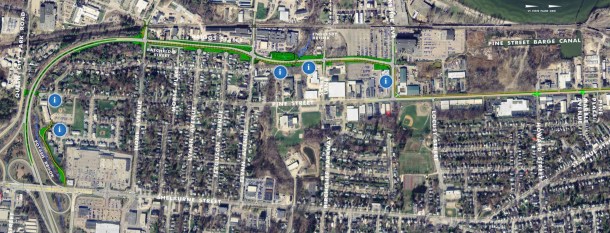
City officials say they’re holding off, for now, on connecting the parkway to interstate traffic, in hopes that they receive federal funding for the “Railyard Enterprise Project.” That initiative would create a diagonal street between Pine and Battery to bypass the King and Maple neighborhood.
But the proposal of a King and Maple bypass hasn’t persuaded the project’s opponents to drop their lawsuit. Even though the Friends of Pine Street support the idea, they’re skeptical that the federal government would commit more money than the millions it’s already pumping into the project.
Instead of the parkway, the Racial Justice Alliance and the Friends of Pine Street have put forward their own design for the project called “The Champlain RIGHTway.” In addition to incorporating the Railyard Enterprise Project, their version of the route would cut out the stretch of new road between Flynn Avenue and Lakeside Avenue.

The RIGHTway would also leave intact the intersection of Pine Street and Queen City Park Road, which the parkway design would turn into a dead end. Tony Redington, the Friends of Pine Street’s leader, said blocking the end of Pine Street would make it harder for low-income residents in the South Meadow neighborhood to reach Shelburne Road businesses such as a Hannaford supermarket.
Redington has also called for the entire parkway route to include protected bike lanes and sidewalks. The current design features a mixed-use path, which Redington said is unsafe because it forces pedestrians and cyclists to share the same space.
In response to the RIGHTway proposal, city officials have insisted that the current design sufficiently accommodates cyclists and walkers. They also contend that stopping the new road at Flynn Avenue would reroute the parkway — and thus bring more traffic — past Champlain Elementary School.
But Redington maintains that his vision for an alternate Champlain Parkway is “totally buildable,” and said it could be a starting place for settlement negotiations between his group and the city.
“We’ve always sought to work out something collaboratively,” Redington said. “We could sit down and find a solution with some public engagement in the process.”

