


BURLINGTON — In 1965, Vermont highway officials recommended building the “Burlington Beltline,” a four-lane highway that would whisk traffic along the city waterfront, past its growing downtown.
Fifty-six years, $45 million and several redesigns later, the Champlain Parkway — a descendent of that initial concept — received a final thumbs up from the federal government Friday. City officials say it could be a matter of months until construction begins.
Instead of providing a fast-traffic bypass of downtown, the latest plan for the project would direct cars from Interstate 189 in South Burlington to a 25-mph street through the city’s South End. The route would briefly join with Lakeside Avenue before heading north on Pine Street toward the city center.

Another initiative that organizers plan to build concurrently with the parkway, the Railyard Enterprise Project, would steer cars away from the parkway’s terminus in the densely settled King and Maple neighborhood, sending them to Battery Street instead.
Equipped with a host of crosswalks and a paved, mixed-use path running alongside it, proponents of the Champlain Parkway’s most recent design say it includes adequate safeguards for pedestrians while reducing the burden placed on Pine and Shelburne streets, the two main north-south thoroughfares on the city’s southern edge.
But the project still faces some headwinds, as it has throughout its nearly six-decade existence. A community group is suing to block the parkway in federal court, arguing that the government’s decision to approve the project was based on an outdated understanding of its environmental impact.
The project’s opponents also contend that if the Railyard Enterprise Project doesn’t succeed, the parkway would deposit more traffic in the King and Maple neighborhood, disproportionately harming low-income residents and people of color.
Yet that claim was contested in Friday’s decision, which said that — although the area is forecast to see an increase in traffic because of the parkway — it wouldn’t cause an uptick in emissions or collisions. It also found that, while it had a slightly higher proportion of racial minorities living there, the King and Maple Street neighborhood would not be any more impacted than other neighborhoods.
Additionally, the decision found that the area could not be classified as “low-income,” according to U.S. Census data.
Democratic Mayor Miro Weinberger told VTDigger in an interview last month he’s confident his administration can win the lawsuit and move the project forward.
“If you look back at the decade I’ve been responsible for, you’ll see a record of settling a lot of disputes,” said Weinberger, the eighth Burlington mayor to oversee the project, “and you also see a consistent record of winning case after case.”

‘Maintain the momentum’
One reason why city officials are so determined to finish the Champlain Parkway: At this point, the road would be cheaper to build than to not build.
Because of its long history, the project benefits from a now-phased-out funding model. Whereas Uncle Sam would pay for 80% of a federally funded highway project today, the federal government is slated to pay for 95% of the Champlain Parkway, with the state of Vermont chipping in 3% on top of that.
As a result, Burlington would pay for 2% of the project, a roughly $36 million sum. But if plans for the parkway fall through, the city has to pay back state and federal agencies for the money they already funneled into the project, roughly $45 million.
In a Sept. 10 letter, federal officials made clear to Vermont Secretary of Transportation Joe Flynn that, should the city fail to complete the project, they would want their money back.
While there can be extensions, a Federal Highway Administration official said his agency wouldn’t grant one because of “shifting priorities, insufficient transportation budgets, state appropriation constraints and staffing levels.”
Three days later, Flynn penned a letter to Weinberger.
“In the unfortunate event that the City is unable to maintain the momentum to advance this project, the Agency will be required to seek project cost recovery action against the City,” Flynn wrote. “The Agency remains optimistic that the City will advance the Parkway project to construction.”

In between the parkway’s sponsors and opponents sits Chapin Spencer, Burlington’s director of public works. A onetime opponent of the project when he was head of the bike-promoting nonprofit Local Motion, Spencer said he has since sought to make the road’s design safer for pedestrians, cyclists and neighbors.
“We have funding partners on one side who say, ‘The city’s committed 26 decisions … to advance a project, you need to finish it.’ We hear from the community, ‘You need the best design possible.’ So we’ve evolved the design as best we can within its constraints,” Spencer said in an interview last month.
In addition to changing the design of the parkway, the city has also sought to alleviate concerns about the project by rolling it out in coordination with other South End construction projects.
Under the “South End Construction Coordination Plan,” officials would construct the parkway and Railyard Enterprise Project before redoing the section of the highway that was already built in 1981, a leg connecting 189 and Home Avenue. That way, the South End would be better equipped to handle the increased traffic coming off of 189 and U.S. Route 7, Spencer said.
City councilors would sign off on the decision to repair the 189 to Home Avenue stretch, thus allowing them to put a ‘check’ on the project, according to the plan.
Still, Spencer told VTDigger that the plan is just that — a plan. “There is no guarantee that the Railyard Enterprise Project happens before, concurrent, after any other project,” he said.
The Railyard Enterprise Project, in addition to being years from construction, has received blowback from businesses that would have to forfeit part of their property to make way for the new road.

City officials say they’re trying to work with businesses as they chart one of three alternatives for the road.
“Regardless of which alternative is selected, the city will work collaboratively with the property owners to secure the property rights,” Spencer said. “Of course, if the negotiations do not go well, the city does have other opportunities to secure the right-of-way.”
Tony Redington — who heads the Pine Street Coalition, which is suing to stop the Champlain Parkway — said the city’s plan to phase its construction hasn’t tempered his opposition to the project.
“It is not a question of sequencing, it is the content of the project,” Redington told VTDigger.
The Vermont Alliance for Racial Justice and the Innovation Center, a Lakeside Avenue office building, have also actively opposed the project but have not signed on to the litigation.
Parkway vs. ‘RIGHTway’
The Pine Street Coalition is pushing for a rerouting of the parkway, referring to it as “The Champlain RIGHTway.”
The alternate route, drawn by Vermont Alliance for Racial Justice coordinator Mark Hughes, would end the parkway’s new section at Flynn Avenue, instead of Lakeside Avenue, and rely on the Railyard Enterprise Project to dodge the King Maple neighborhood.

Spencer has criticized the Champlain RIGHTway concept, saying it has not been cleared by federal officials and would send more traffic past Champlain Elementary School, which sits on Pine Street between Flynn and Lakeside avenues.
In addition to the RIGHTway concept, Redington has advocated for including three features in the parkway’s design that, in his eyes, would make the road safer.
First, the former state Agency of Transportation staffer would swap out all the stoplights along the route with roundabouts, in an effort to lower both the statistical probability of crashes and the carbon emissions from cars waiting for a green.
Second, Redington proposed adding both sidewalks and “multi-modal” paths (another term for a bike path) along the road. Right now, the design only includes multi-modal paths, which Redington said is dangerous because it forces slow-moving pedestrians to mix with bicyclists.
Third, Redington would install bike lanes in the road itself, saying that the current pattern of cars and bikes sharing a single lane could lead to collisions.
[See more renderings of the project from the City of Burlington.]
Spencer defended the parkway’s current design as safe, and pointed to its plan for raised crosswalks and intersections along the route.
Redington has also criticized the city’s removal of the Sears Lane encampment, which abutted the proposed route of the parkway.
Emails obtained by VTDigger through a public records request show that Spencer at one point sought to inquire from project consultants whether they could build a “formalized encampment” next to the parkway, citing a request from Weinberger. Eight days later, however, Weinberger announced he would shut down the camp.
The crux of the group’s lawsuit concerns whether the parkway meets environmental justice regulations that were enacted by the Federal Highway Administration during the presidency of Barack Obama. While the route’s flow into the King and Maple neighborhood had not previously been scrutinized, the new regulations triggered a review of the impact traffic could have on the neighborhood.
That review — which was completed in 2021, and rubber stamped by the highway administration Friday — concluded that “though it was found that there are adverse effects on the Maple and King Street Neighborhood … the neighborhood will also experience project benefits and adverse effects will be mitigated.”
“Since adverse effects will be mitigated and are shared throughout the project area,” the review continued, “the Project will not cause disproportionately high and adverse effects on any minority populations.”
Redington and his allies filed the lawsuit in 2019, but the Federal Highway Administration — which is named in the suit along with the state Agency of Transportation — asked for a stay until the federal government endorsed the review. Now that it has, the lawsuit is slated to proceed.
‘It’s been a battle’
Not all of the Burlington Beltline met the same fate as the Champlain Parkway. What contemporary Burlingtonians call “the Beltline” (Route 127 from Manhattan Drive to Colchester) was one of six sections the planners originally recommended.

In an echo of today’s circumstances, Burlington residents fought “Phase IV” by forming a coalition and proposing an alternate route for the road. Instead of cutting through a swampy section of the New North End parallel to North Avenue, the “Non-Partisan Civic Association to Build a Better Burlington” pressed officials to reroute the highway along the bed of the dormant Rutland Railroad (now the Burlington Greenway).
The effort reached a climax in 1968, when the city voted to build the highway in a 60-40 referendum vote, a decision a Burlington Free Press editorial hailed as “high-minded.”
But while the North End section continued on as officials hoped, the section through the South End did not. It later evolved into the “Southern Connector,” a separate project that would have followed the route of today’s proposal, but go through the Pine Street Barge Canal, the site of a former coal gasification plant.
Officials steered away from the barge canal site, however, after discovering pollution there in the late 1970s. In 1981, while the section from 189 to Home Avenue was completed, officials declared the canal a Superfund site for toxic waste cleanup.
In the 1990s, leaders adopted the “Champlain Parkway” moniker and shifted control of the project from the state to the city. The 2010s brought a Vermont Supreme Court fight over the project’s Act 250 land use permit. In that case, the city — then led by Weinberger — beat the Innovation Center, a plaintiff in the city’s current suit.
From her home at 97 Briggs St., 81-year-old Marie Boisvert has witnessed the entire project’s history. A resident since 1959 of the red-shingled house that sits mere yards from the parkway’s proposed route, Boisvert has long opposed the project that, at one point in its development, threatened to tear down her home.
Starting in the 1970s, city officials asked Boisvert and her husband, who is now deceased, how much money they would take to give up their home for razing, she said. But the Boisverts resisted, in part because of the effects a move could have on their two children.
“We didn’t want to have to change kindergartens. Oh, then the talk dropped down. And oh, we didn’t want them to have to change grade schools. Same thing with junior high. Same thing with high school,” Boisvert recalled.
Her children are now 59 and 61 years old.
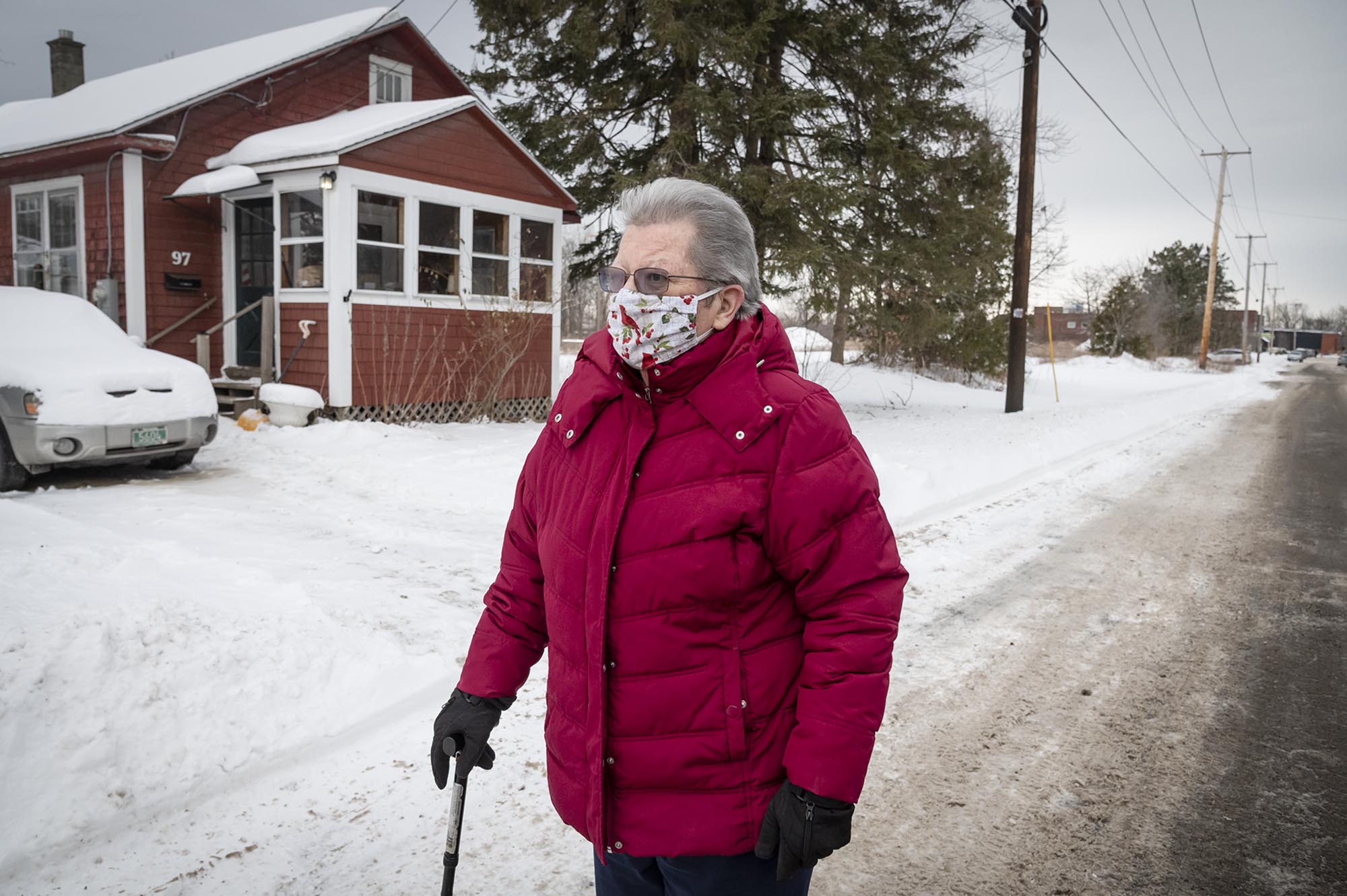
The project still frustrates Boisvert. Proponents of it will sometimes use the phrase “free money” to refer to federal dollars bound for the highway (“Look at your pay stub and those taxes are not free money”). Her street has not been paved for years, accumulating scores of potholes, as officials wait to start work on the Parkway (“60-some-odd years and nothing’s been done”).
But that frustration doesn’t translate into resistance anymore, Boisvert said, because she doesn’t feel as if her voice gets heard.
“It’s been a battle that got to where we stopped battling over it,” she said. “I’ll probably be dead and gone by the time it comes through.”
Correction: An earlier version of this story referred imprecisely to the role of the Vermont Alliance for Social Justice and the Innovation Center in opposing the parkway. While both have actively fought the project, they have not formally signed on to the Pine Street Coalition lawsuit.
