


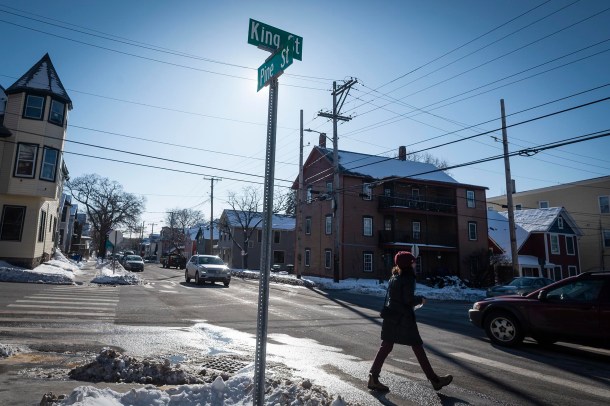
BURLINGTON — City councilors unanimously approved a $45 million contract Monday to build the first phase of the Champlain Parkway, a planned north-south thoroughfare connecting the city’s South End and downtown.
With the contract’s approval, the planned 25-mph neighborhood street — replete with raised crosswalks and mixed-use paths — is set to break ground in July, said Chapin Spencer, the city’s director of public works, at the Monday night meeting.
The project’s first section would create a new roadway from Home Avenue to Lakeside Avenue, and redo an existing section of Pine Street from Lakeside Avenue to Kilburn Street. Subsequent contracts would build the “Railyard Enterprise Project,” allowing downtown traffic to bypass the dense King and Maple neighborhood, and restore a decrepit section of the parkway from Interstate 189 to Home Avenue.
The proposal, which was first conceived as a four-lane freeway in 1965, has elicited staunch opposition from residents for as long as it’s been considered.
Most recently, a community group has filed a lawsuit in federal court accusing the city of not properly accounting for the parkway’s environmental impacts. But city officials contest those claims, and have the blessing of the Federal Highway Administration on their side.
Two construction companies, S.D. Ireland and Kubricky, are slated to cooperate on building the parkway. The city received no other bids, officials said, which contributed to the contract being 57% more expensive than anticipated. The sum includes $41 million for construction services and $4 million in contingency funds.
Inflation and increased fuel prices related to the war in Ukraine also pushed the price higher, according to the officials.

Although the project’s price tag surged, its old age allows it to benefit from a now-phased-out funding model where the federal government pays for 95% of the project. The state of Vermont provides another 3%, leaving the city to contribute 2% of the total price — about $4.4 million for the project’s first phase.
If the city fails to complete the project, however, it will have to pay back the roughly $45 million spent by federal and state governments so far on the project, officials said.
While the contract received ‘yes’ votes from all 10 councilors who attended Monday night’s meeting (Councilors Ali House, P-Ward 8, and Perri Freeman, P-Central District, were absent), some councilors expressed reservations about the controversial project.
Councilor Gene Bergman, P-Ward 2, voiced concern about its potential impacts on the King and Maple neighborhood. But he said he was won over by data Spencer provided showing that the parkway wouldn’t cause an uptick in emissions or collisions in the area.
Councilor Jack Hanson, P-East District, said spending money on the parkway was the right move. But building new roads that prioritize car traffic is not an effective response to climate change, he said.
“In some ways, it’s a missed opportunity,” Hanson said. “The primary objective of this is not to decarbonize transportation. … I don’t see it as the dramatic shift in our transportation system that billions of dollars should be going towards.”
During public comment, a Burlington resident identified as “Escher” threatened to block the parkway’s construction in a protest similar to the one decrying police’s use of force that occupied Battery Park during summer 2020.
“If that road is built, I’m going to get all of my friends and we’re going to do Battery Park Part Two, but on the fucking construction site,” the speaker said. “It’s going to be a long summer, and we’ve been preparing for this just as long as you have.”
Redistricting
Also on Monday night, the City Council brainstormed possibilities for how its configuration could look in future years.
As part of the once-a-decade redistricting process that accompanies a new U.S. Census, the council must draw precinct lines that give every resident of the city (but not necessarily every eligible voter) equal representation on the city’s deliberative body.
Councilors are otherwise free to reinvent their current setup, which has 12 members representing eight wards and four districts (a district is the combination of two wards).
A committee appointed to provide feedback on the current system largely deplored what is now known as Ward 8, which was drawn to enfranchise the city’s college students in one precinct. The district system was also unpopular among councilors, who said it made running for office more difficult.
But on specific questions, such as how many wards the city should have, councilors evaded a solid consensus.
Some councilors petitioned for each ward to have two councilors representing it — a throwback to the council’s previous makeup before the latest round of redistricting.
“I think it’s important for constituents to have two representatives, one that’s maybe slightly more seasoned than if you bring a new councilor on … so there’s always someone who is more in tune with what’s going on,” said Councilor Mark Barlow, I-North District.
But unless councilors cut the number of wards — a notion no councilors voiced support for — doubling the number of councilors in each precinct would mean increasing the body’s current size.
Multiple members backed that idea, saying it would result in more direct democracy. But both Democratic Mayor Miro Weinberger and Councilor Joan Shannon, D-South District, said they disapproved, arguing that more voices would extend the body’s already lengthy meetings.
“It takes a lot more time at the table when this body gets too large,” Shannon said.
Yet Bergman said that more debate would be positive, not negative.

“I sat through the discussion about the giant council being a mess,” he said. “I just disagree. I think that we can use the people to do the work, and we can get our work done.”
After a prolonged discussion, councilors voted 9-1 to ask city staff to produce three maps dividing the city into seven, eight and 12 wards, with Hanson casting the lone ‘no’ vote. Those maps are expected to come back before the Council at its May 23 meeting.
In other business Monday night, officials from the Burlington Electric Department told councilors that the city is not on target to achieve its goal of carbon neutrality by 2030. Still, they said, the city is emitting less carbon than when it started tracking its fossil fuel use in 2018.
