

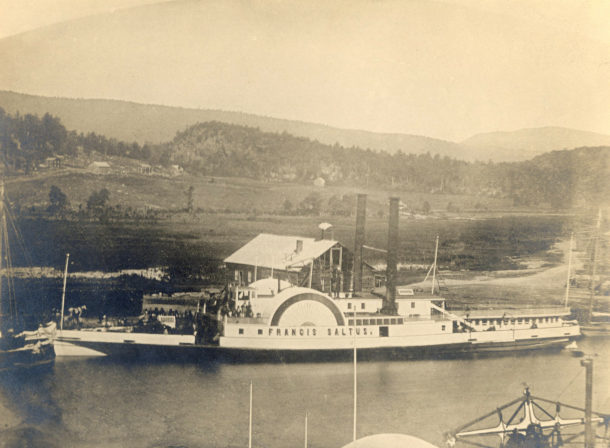
The Francis Saltus was controversial from the moment it was conceived. Blame the times. The steamboat cruised Lake Champlain during the 1840s and ’50s, a period of intense, often bitter competition between transportation companies for control of passenger transportation in the region.
During this era of corporate duplicity and double-dealing, the Saltus was hardly the only ferry on the lake, but it was at the center of more than its share of disputes. The steamboat incited passions, even fistfights, and, on two occasions, acts of piracy.
Even before its launch, the Francis Saltus sparked tension. Boats weren’t supposed to be built to compete with the Champlain Transportation Co. At least, that was how the ferry company’s directors viewed things. They wanted to earn money the old-fashioned way, through monopoly. And if that didn’t work, they weren’t above a bit of skullduggery. Their most effective technique, however, proved to be buying up the competition.
For the first decade after its founding in 1826, the Champlain Transportation Co. pretty much had the ferry business on Lake Champlain to itself. Then in 1836, Peter Comstock, a successful businessman, got in on the action. Comstock had nurtured a thriving enterprise, running passenger ferries on the Champlain Canal, which connected the lake with the Hudson River. Expanding operations onto the lake made obvious sense, so Comstock arranged to have a new steamboat built at the shipyard in Whitehall, New York.
His boat was intended to compete with the Champlain Transportation’s new luxury ferry, the Burlington. (The Burlington was a formidable rival, drawing lavish praise from a tough critic of things American, British novelist Charles Dickens. Dickens wrote at length of his voyage on the Burlington, extolling it as a “perfectly exquisite achievement of neatness, elegance, and order.” As a Brit, Dickens had a natural appreciation of its captain, Richard Sherman, who had used the Burlington to transport British troops to quell a Canadian rebellion.)
To head off competition, Champlain Transportation Co. officials paid Comstock $20,000 for his unfinished steamboat, elected him to their board, and paid him $1,000 a year to represent the company in Whitehall. As part of the contract, Comstock agreed not to build a competing vessel for at least eight years.
When company officials learned in 1843 that entrepreneurs were seeking permission from the New York Legislature to create a rival steamboat corporation, they took a similar tack, paying off the investors and electing three of them to the company board.
Perhaps predictably, when his eight-year noncompete deal expired, Comstock immediately announced plans to build a steamboat. He might have hoped that this time he could sell off his right to compete before even starting construction. Rumors circulated that Comstock had enlisted some Champlain Transportation Co. shareholders and directors in his latest scheme. Surely they would use their sway to ensure that the ferry company would buy him out again.
But the company decided to take another approach with Comstock. It would wait to see if he was serious. And if Comstock did build a boat, the company would find a different way to beat him.
Snobbery on The Burlington
So it was that Comstock launched his Francis Saltus at Whitehall in 1844. The Champlain Transportation Co., which operated three steamboats at the time, responded by putting the incomparable Burlington on the same route. The Burlington could steam as quickly as the Saltus and do so while offering passengers considerably more elegance. As a further enticement, the ferry company cut its fares drastically.
The Saltus seemed doomed. But to the ferry company’s surprise, the Saltus attracted a loyal following. Some were drawn to the Saltus’ underdog status. Others were repelled by the presence on the Burlington of Capt. Sherman, who they viewed as a traitor for carrying British troops to crush the Canadian uprising. Anti-British sentiment was still common in Vermont; the War of 1812, which featured open warfare on Lake Champlain, was well within living memory.
Another strike against the Burlington was that many prospective passengers were plain folk who simply needed transportation, not fineries. These passengers hated Sherman not only for supporting the British, but apparently for also being a snob.
Some wag even wrote a cutting ditty about Sherman, which went in part:
“Oh! Dicky is a gallant lad,
He makes the ladies very glad;
He smiles and flirts with great parade,
And then makes love to the cabin maid.
Ha, ha, ha. That’s the fun
For Dandy Dick of the Burlington.
His decks are scrubbed with so much care
That cowhide boots can’t come in there;
If you can’t make your money rattle
You must go forward with the cattle.
Ha, ha, ha. That’s the fun
For Dandy Dick of the Burlington.”
Ferry company directors eventually decided to put the Burlington onto a lucrative night route, where it had no competition, and put another boat, the Saranac, up against the Saltus.
The Saranac offered service between Burlington, Whitehall, Port Kent, Port Jackson and Plattsburgh. Company directors charged a fare of only 25 cents, running the boat at a loss made up for by their other routes. Comstock struggled financially, but kept his business afloat.
Divided loyalties
The competition created absurd scenes. The two boats ran the same schedule. They would tie up at opposite ends of the same dock, then race to get passengers disembarked and new ones embarked before racing to the next stop. The Saltus proved slightly faster than the Saranac, but the Saranac made up time by sometimes departing ahead of schedule. The Saranac’s crew even occasionally skipped some of the smaller stops, which surely didn’t sit well with passengers heading to those destinations. Speed took precedence over service.
The public divided its loyalties between the boats, as if they were sports teams. The rivalry grew hot, with the boats’ supporters arguing their merits, sometimes even coming to blows.
Finally, Comstock could take no more losses. He sold the Saltus to businessmen from Troy, New York, who continued the competition. The Champlain Transportation Co. trusted technology to increase pressure on the new owners, building a new steamer, the United States, which at 240 feet was 55 feet longer than the Saltus.
On a spring day in 1847, the United States lay at dock in Burlington while nearby the Saltus took on passengers. William Anderson, captain of the United States, let the Saltus pull away from the dock first and get a fair lead before ordering his crew to cast off and take the United States to full speed. Anderson’s boat closed the gap. Then, to the shouts and cheers of those on board, it steamed past the Saltus.
The superior speed of the United States soon wore down the Saltus. The next winter, its owners relented and sold the Saltus to the Champlain Transportation Co.
But the Saltus’s controversial career was hardly over. A pair of unscrupulous investors, St. Albans businessman Oscar Alexis Burton and New York schemer Daniel Drew, bought the Champlain Transportation Co. in 1849. Three years later, they sold their steamboats to the Rutland and Burlington Railroad, which wanted a way to connect passengers with rail lines across the lake.
It was a sucker’s deal. Burton and Drew retained the company’s charter. The Rutland and Burlington Railroad soon found it faced new competition on the lake, none other than Burton and Drew, who had purchased two new steamboats that were faster than the ones they had just sold.
Two years later, the railroad surrendered, reselling its steamboats to Burton and Drew for one-third what they had paid. One steamboat, however, was excluded from this deal, the Saltus.
Enter piracy
This is where the piracy comes in. The Champlain Transportation Co. twice sent crews to seize the Saltus, on the pretext that the company was owed money for previous repairs on the vessel. One time the company sent a Captain Chamberlin and a prize crew to capture the Saltus from the Plattsburgh dock. The other time, Chamberlin and crew slipped into Canadian waters and stole the boat from where it lay in St. Jean, Quebec.
The railroad men from Plattsburgh needed the Saltus to stay competitive. A rival rail line had struck an exclusive deal with the Champlain Transportation Co. to carry passengers across the lake to their tracks to Montreal.
The Plattsburgh railroad stored the Francis Saltus in Shelburne Bay during the winter of 1853-54. When a crew from the company arrived to retrieve the boat in April, the men found that parts of the Saltus’ engine had been removed and hidden.
A court ordered the Champlain Transportation Co. not to interfere with the boat’s removal, but company officials, arguing that the ruling was null because it had been issued by the court’s clerk, moved the Saltus to a less accessible part of the bay.
This is when things got hotter. The Burlington Free Press described the scene:
“(A) small steamer and sloop with something like a hundred men on board came over to the harbor from Plattsburg. The steamer made fast to the Saltus and was about to tow her out, when the Saranac fired up, and running across and cutting the tow-line, took a position which prevented further attempts at removal.”
That night, the Champlain Transportation Co. sank two old steamers near the Saltus, making it impossible to tow the vessel out. “The foregoing proceedings were accompanied with an indefinite amount of hard words, high temper, swearing, threats, show of clubs and pistols, &c., &c., on both sides, on which it is unnecessary to dwell,” the Free Press reported.
The Saltus’ would-be liberators retreated. The standoff landed in the courts, which sided with the Plattsburgh rail line. Eventually, the Champlain Transportation Co. found a means of taking possession of the Saltus that was clearly legal; it purchased the vessel.
The Saltus was no longer state of the art — faster, more elegant vessels had followed in its wake — so it’s perhaps understandable that company officials soon found a permanent means of ridding themselves of this former nuisance. They had a crew pilot the boat into the middle of Shelburne Bay and sink her.

