This story by Claire Potter originally appeared in the Valley News on Feb. 28.
CHELSEA — The Planning Commission recommended that AT&T find another site for its proposed 140-foot cell tower off of Creamery Road after strong local opposition.
“Public reaction to the proposal has been profound and eloquent, with the vast majority opposed to the proposal,” Dickson Corbett, who chairs the Chelsea Planning Commission wrote in a letter to AT&T at the end of February. More than 60 residents signed a petition against siting the cell tower off of Creamery Road by the submission deadline, and almost all of the residents who attended a Feb. 3 public hearing spoke out against the tower.
Creamery Road was the third site that AT&T proposed for the tower over the last two years. In 2017, the network was awarded a contract to build 36 cell towers across Vermont with $25 million in federal funds. The towers are part of the First Responder Network Authority, also called FirstNet, which is a post-Sept. 11 program to improve communication networks for public safety workers.
Section 248a gives the Public Utilities Commission final say over any application to build a cell tower, so towns have limited jurisdiction. Still, the PUC gives “substantial deference” to town officials’ recommendations.
“This proposed site is part of our ongoing investment to improve service and coverage for our Chelsea customers, including first responders,” wrote a spokesperson from AT&T. “Although a cell site location has not been finalized, we remain willing to work with local officials and permitting authorities to identify a solution that balances the needs of our business with the concerns of the community.”
Explaining the Commission’s recommendation, Corbett highlighted that the proposed tower would be visible from the historic village and less than 1,200 feet from the Chelsea Public School. The Town Plan guided the Commission’s deliberations. It calls on the town to “facilitate the provision of telecommunications services;” however, it also specifies that towers should not be built near sensitive towers, including schools, nor interfere with Chelsea’s “rural character.”
The Planning Board also considered residents’ concerns about the possible health effects of increased exposure to radiofrequency radiation, known as RFR, especially on children. RFR radiation from a cell tower is typically several times lower than from a cellphone, according to the American Cancer Society. While the organization affirms there is no current evidence that living, working or going to school near a cellphone tower increases the risk of cancer or other health problems, it concludes that more research is needed. In Chelsea, the prevailing view was that “our children should not be the ones to suffer if the currently unanswered scientific questions turn out to be more problematic than currently believed,” Corbett wrote.
The First Branch Unified School District submitted a letter opposing the cell tower, in part because several parents notified the school that they would not enroll their children in the Chelsea Public School if the tower were built.
The Planning Commission told AT&T that it would be more open to a site farther away from sensitive areas such as the school and the historic downtown.
AT&T had not responded to the Planning Commission as of Feb. 28. “We have a productive working relationship and I believe that we can collaboratively find a solution for this project,” Corbett said.
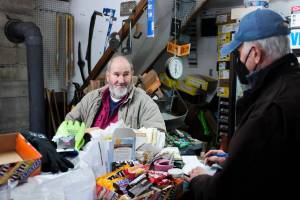
The proposed tower would be built on land owned by Bob Button, who sells feed at Button’s Store. He said that while the Planning Commission’s decision does not affect him much personally, it may affect the emergency responders who would benefit from better service.
“If a cell tower is bad, then the WiFi is bad, too,” Button added. “They should get rid of the WiFi at the school and not allow anyone to have a cellphone on school if they think it’s so bad.”
For residents who had campaigned against the cell tower, the Planning Commission’s decision was cause to celebrate. “This is such great news for me and my family,” said Christiana Potter, whose property abuts the proposed site as well as the school. She told the Valley News that she, her husband and young children would move away rather than live near the tower, and she rallied the opposition.
Alexis Smith, a Corinth resident who also opposed the cell tower, is optimistic that the tower will not be built on the Chelsea Road site. She is a curator for the political street theater group Bread and Puppet, and she is planning a festival for residents and school children on the property off of Creamery Road.
She envisions a “series of movements and dances and performances to avoid what we consider our local disaster — the proposal of a cell tower in our village, in the front yards of our neighbors” at a yet to be determined date in mid-March.