


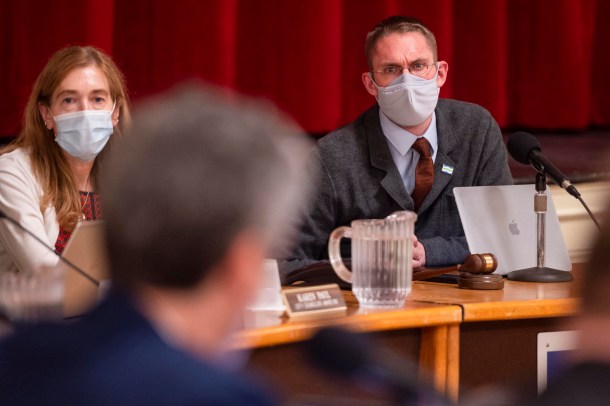
After more than two years of drafting and debate, the Burlington City Council passed regulations Tuesday night that seek to rein in the city’s short-term rental industry.
In an 8-4 vote, councilors banned short-term rentals that are operated anywhere besides the host’s primary residence — unless the short-term rental unit is in a building with one or more long-term rental units that accept Section 8 housing vouchers.
The exception represents a change from what councilors approved in December.
The ordinance, which was sponsored by Councilor Joan Shannon, D-South District, would also set up a registry for short-term rentals and subject them to inspections.
The council considered another version of the ordinance sponsored by Councilor Sarah Carpenter, D-Ward 4, which would have broadened the ordinance’s affordable housing exemption to include units deemed affordable under the city’s inclusionary zoning standard. It also would have allowed the entirety of other buildings on a host’s property, known as accessory dwelling units, to be operated as short-term rentals.
But that proposal failed in a 6-6 vote, with Shannon joining all of the council’s Progressives, save Zoraya Hightower of Ward 1.
Hightower and Councilor Karen Paul, D-Ward 6, voted for both the Shannon and Carpenter versions of the ordinance. Councilors Chip Mason, D-Ward 5; Mark Barlow, I-North District; and Ali Dieng, I-Ward 7, joined Carpenter in opposing Shannon’s language.
The two-thirds majority vote is enough to withstand a veto from Democratic Mayor Miro Weinberger, who said it would be “very challenging” for him to sign the ordinance into effect. Yet Paul’s remarks at Tuesday’s meeting suggested her vote — which came after a plea to table the discussion until councilors could try to forge another compromise — could shift.
“It’s really unfortunate that we’re in a position like this,” Paul told her colleagues. “I think what we’re showing the public is that we can’t really agree amongst ourselves and that we’re not really willing to really try to figure it out.”
Proponents see the ordinance as a way to monitor and control the growth of short-term rentals — residential units that, through sites such as Airbnb, function as temporary lodging — in an effort to up the city’s long-term housing stock.
But opponents of the regulations said they won’t create more housing since property owners won’t necessarily convert short-term rental units into long-term ones. Critics also pointed to the ordinance’s potential impact on tourism, saying that limiting short-term rentals would decrease options and drive up prices for would-be Burlington travelers.
To Shannon, however, that argument did not recognize the severity of the city’s housing shortage.
“We’ll still have tourists,” the real estate agent said. “Yes, it will be more expensive, but the tradeoff is that some of our workers will get housing.”
The ordinance would still allow owners of a single-family home to accept guests on a short-term rental basis in up to three bedrooms of their house, Shannon said.
Barlow pushed back, saying that tourists who come to Burlington want a whole-unit, short-term rental, not just a room in someone’s home.
“Visitors to our city expect (short-term rentals) in the same way they expect to be able to get an Uber when they’re here,” Barlow said.
Owners of homes that the city classifies as seasonal — because they do not have heat, for instance — can operate as short-term rentals, according to the ordinance. In addition, the language does not require hosts to be on site during a short-term rental booking, meaning a homeowner could rent their entire house as a unit, provided it is their primary residence.
Tyeastia Green’s exit
Before starting their regular business Tuesday night, three city councilors blamed Weinberger for the upcoming departure of Tyeastia Green, the city’s first director of racial equity, inclusion and belonging, which was announced last week.
Green left the position after roughly two years on the job to “pursue other opportunities,” according to a statement from Weinberger’s office. But several councilors and activists in the city have said Green actually left because she felt Weinberger did not support her work to make the city more equitable.
In the meeting’s “general affairs” section, Council President Max Tracy, P-Ward 2, blasted the mayor for meeting Green’s efforts at reform with “obstruction,” a word that Weinberger used to describe how Progressive councilors handled the hiring of a permanent police chief.
“I find it deeply disappointing that we find ourselves in this place and that we have not heard acknowledgment or an examination thoughtfully of what went wrong in this relationship,” Tracy said.
Councilors Jane Stromberg, P-Ward 8, and Dieng also criticized Weinberger’s treatment of Green and the racial equity department.
Dieng intimated that Weinberger’s hiring of Green and his declaration of racism as a public health emergency were political moves meant to win over voters. He also said that the mayor has fallen short of the goals he set out in his 2021 State of the City address — which he dedicated to improving race relations in the city — and questioned whether Weinberger himself wrote the speech.
“The words that we have heard have not been backed by action,” Dieng said.
In remarks at the end of the meeting, Weinberger offered praise and thanks to Green but did not respond to the allegations by Tracy and Dieng.
“Tyeastia has been a tireless, fearless leader throughout our time in Burlington, and I will greatly miss having her perspective and candor on the city’s leadership team,” Weinberger said. “Racial equity work is challenging, and it will be even harder without Tyeastia here.”
In other business Tuesday night, councilors opted not to extend the city’s indoor mask mandate another month, following the recommendation of city officials. It is now set to terminate March 3.
