Bars, pubs, taverns, alehouses, watering holes — by any name, these establishments have played a prominent role in American politics. They are where gossip is swapped, schemes plotted, deals struck.
That’s as true in Montpelier as in Washington, D.C. And it was at least as true two-and-a-half centuries ago as it is today. If you wanted to know what was going on in early Vermont — actually, in the years shortly before Vermont became Vermont — there was no better place to visit than the Catamount Tavern in Bennington.
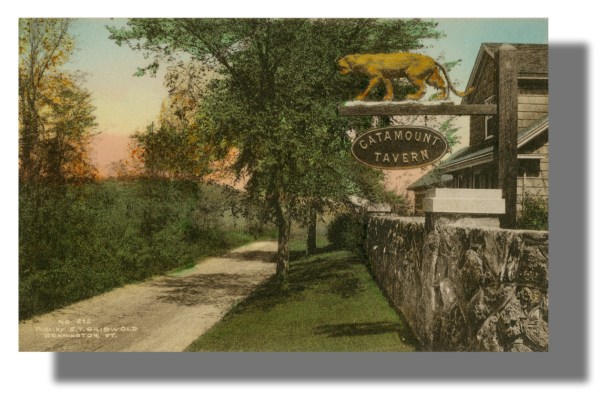
During the 1770s, the region was ablaze with partisan division and civil unrest, and Bennington was the hotspot. Stoking the flames were the insurgents (or criminals, depending on your perspective) who gathered at the Catamount Tavern. The building, clad in unpainted wooden clapboards, was blocky, measuring 34 feet by 44 feet and rising two and a half stories.
Like other taverns of the day, the Catamount was a rough-and-tumble place. The downstairs was reserved for the functions we associate with taverns: drinking and dining. The main pub room had a low ceiling and heavy pine wainscoting, and was heated by a large fireplace. Upstairs was set aside for lodgers who, to make up for the shortage of beds, sometimes had to share a bed with a stranger of the same sex.
The building reverberated with the sounds of revelers and smelled of pipe smoke and alcohol. If people needed a place to meet and talk in Bennington, this was an excellent choice.
And folks in Bennington never lacked for things to discuss. Almost from its first settlement by colonists in 1761, people fought over who had the right to settle in the area. Their dispute was with officials in the neighboring colony of New York.
Bennington’s founders had received their land titles from New Hampshire, which, like New York, claimed the right to grant land and create towns in what would become Vermont. Bennington was the first of 129 such towns chartered by New Hampshire Gov. Benning Wentworth after his state became independent from Massachusetts. (Wentworth either named the town after himself or, in a slightly less self-aggrandizing move, named it after his mother’s family, the Bennings.)
The settlers who were fighting in favor of New Hampshire’s right to issue land grants were, not surprisingly, the ones who had received their grants from that colony. But New York officials refused to back down, continuing to send surveying teams into the area to divvy up the landscape in preparation for issuing more grants. Bennington was a flashpoint because it was the largest settlement near the New York border.
The locals reacted violently to the incursions of New York surveyors. In one incident described by Ira Allen in his 1798 History of the State of Vermont, Bennington area settlers captured a surveyor and whipped him until he fainted. Once he had revived, they resumed beating him until he fainted again and, for good measure, repeated the process a third time.
Acting as a law unto themselves, these settlers threatened, beat and burned out anyone who claimed their land under New York’s authority. The men, who had been a loosely allied group, decided at a 1770 meeting in the Bennington tavern to form the Green Mountain Boys, a sort of militia. They elected as their colonel commandant Ethan Allen, who had recently arrived from Connecticut to speculate on land titles. Allen’s cousins Remember Baker and Seth Warner were made company commanders.
Some of the Green Mountain Boys had previously lived in New York and had come to hate that colony’s tenant-farmer system. What attracted them to Vermont was the chance to own their land.
As their headquarters, the Green Mountain Boys chose the newly built Catamount Tavern. It had several things going for it, including its convenient location beside the main north-south road in Bennington, and its reputation for serving the best liquor in the area.

More importantly, the tavern’s owner, Stephen Fay, welcomed the Green Mountain Boys, and not purely out of financial self-interest. He and his sons supported their cause. Five of Fay’s seven sons would fight in the Battle of Bennington in August 1777 and one was killed there. Others would go on to play prominent roles in the new state — one as Vermont secretary of state, another as a Supreme Court justice and still another as publisher of the Rutland Herald.
Stephen Fay originally named his establishment the Green Mountain Tavern, but in his day it was commonly known as Landlord Fay’s. The name Catamount Tavern came years later, when folks remembered the decision Fay made to redecorate the place.
Fay took a stuffed catamount that had been shot in the area and placed it on the 25-foot-tall signpost outside his tavern. The animal, then the most dreaded predator in the state, was said to have been mounted facing New York with its teeth bared.
One New York supporter was given a close-up look at the catamount. Dr. Samuel Adams of Arlington (not to be confused with the Boston Patriot) made the mistake of stridently and publicly championing New York’s land claims. He armed himself with pistols and threatened to shoot anyone who laid a hand on him.
A group of Green Mountain Boys, considering Adams’ threats impudent bluster, managed to kidnap the doctor without getting shot and marched him south to Bennington.

Adams was placed on trial in a large room at the tavern, with Ethan Allen presiding. Adams was quickly and predictably convicted. Allen suggested that his punishment should be humiliation rather than a whipping, so the doctor was lashed to an armchair and hoisted up the tavern’s signpost. For two hours he swung helplessly beside the catamount while onlookers jeered.
According to Ira Allen, Ethan’s youngest brother, the punishment worked. “This mild and exemplary disgrace had a salutary effect upon the Doctor, and many others,” he claimed in his book.
After the war, Adams became a tavernkeeper himself. He lived in Upper Canada (current-day Ontario) and ran a pub catering to British soldiers and fellow Loyalists.
When New York authorities offered a reward for the arrest of Green Mountain Boy leaders, Ethan Allen and others made light of the threat, issuing their own reward for the arrest and delivery of certain New York officials to Fay’s Tavern.
The Green Mountain Boys were understandably seen by New Yorkers as mere thugs. But they were able to transform themselves from ruffians to rebels with one act. In early May 1775, several dozen volunteer soldiers from Massachusetts and Connecticut gathered at the tavern with Ethan Allen and a few other Green Mountain Boy leaders. The soldiers wanted to capture nearby Fort Ticonderoga and haul its guns south to help defend Boston, and they needed help from the locals. Allen, who was already considering making such an attack, agreed to rally his men to support the attack.
After working out the initial assault plan, Allen left to meet with his men. He drummed up so much support that Green Mountain Boys constituted two-thirds of the amassed troops. As a result, Allen was selected to lead the assault alongside Benedict Arnold of Connecticut, who, before leaking intelligence to the British, was one of America’s ablest commanders.
The attack provided Boston with much-needed cannons and the Colonies with their first decisive victory in the rebellion. And suddenly, the Green Mountain Boys had won a new air of respectability and Allen had won national renown.
The tavern continued to be the stage for important events throughout the Revolution. It was there that David Redding, a Loyalist accused of stealing muskets, was imprisoned. After a speedy trial at the tavern, Redding was hanged nearby.
The tavern also acted as a planning room for Colonial officers mapping out their attack before the Battle of Bennington, which helped turn the tide in the war. And it served as a regular meeting place for the Vermont Council of Safety, the territorial government during the Revolution.
Even after the war, the tavern played an important role, this time as the home base of one of the two main political factions vying for power in the new state.
The Catamount Tavern fell into disuse in the late 1860s and burned to the ground in March 1871, reportedly because boys playing in the building had knocked over a burning lamp. The only reminder today of the building today is a large sculpture erected at the tavern’s site in 1896, a statue of a catamount.