Campaign season is in full swing, with candidates in dozens of races reporting hundreds of thousands of dollars in campaign contributions at a crucial July 1 deadline.
The midsummer deadline offers a window into the candidates’ support weeks ahead of Vermont’s primary election on Aug. 11. The general election is Nov. 3.
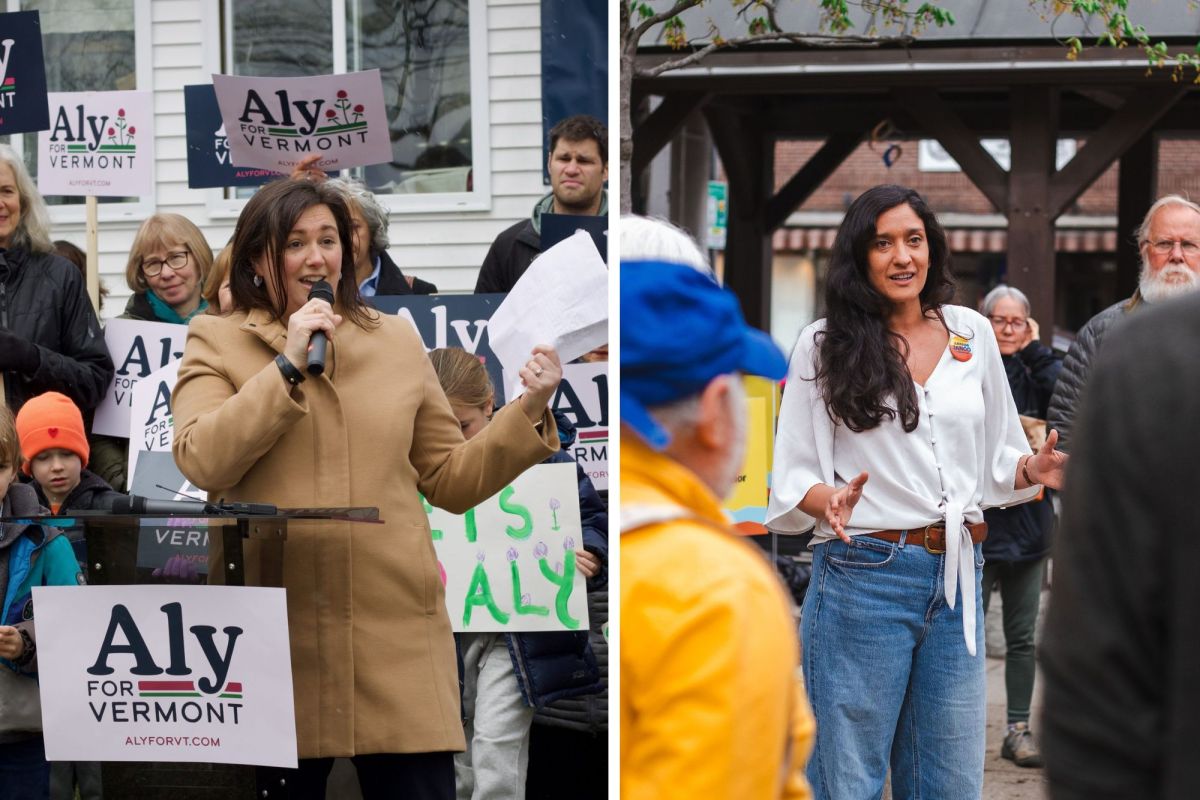
Two candidates in the Democratic primary for governor, Amanda Janoo and Aly Richards, have both raised large amounts of cash in their bids to unseat Republican Gov. Phil Scott.
Richards, the former head of the childcare lobbying group Let’s Grow Kids, reported taking in $365,867 through July 1, according to campaign contribution records.
In a press statement, Richards said a “healthy total” of her contributions came from over 1,200 individual donations.
Janoo, an economist who’s billed herself as the more progressive candidate, reported raising $164,798 in her July 1 disclosure, adding to the roughly $80,000 she had reported in a previous filing.
By comparison, Esther Charlestin, the Democratic nominee for governor in 2024 who’s now running for lieutenant governor, had raised scarcely more than $13,000 at this point in the race.
Scott, in his July 1 filing, reported $48,000 in contributions — well short of his two Democratic challengers, though Scott has a $218,000 cash surplus on hand, according to his latest report.
Scott has for years been the most popular governor in the country and is now seeking his sixth term. In 2024, he used his campaign war chest to help elect a number of Republicans to the Legislature. But he may need to spend some of his cash this time around as he faces what could be his most competitive Democratic challenger in years.
Janoo and others have pointed to a recent poll by the University of New Hampshire showing Scott’s popularity starting to wane.
And Janoo, in an emailed newsletter to supporters, touted that the poll showed her ahead of Richards in the Democratic primary.
Even more cash has been raised in the race for lieutenant governor. Molly Gray and Ryan McLaren, the two leading candidates in the Democratic primary, have both reported well over $250,000 in campaign contributions since announcing their bids.
McLaren, a longtime aide to U.S. Sen. Peter Welch, D-Vt., has pulled in $149,000 since last reporting his campaign contributions March 15, bringing his total cash raised to more than $305,000. He’s spent $143,991.
Meanwhile Gray, who previously served one term as lieutenant governor, reported $127,393 in campaign contributions since March 15, bringing her total fundraising to $282,862. She’s spent $78,335 thus far.
By comparison, 2024’s Democratic lieutenant governor candidate David Zuckerman had raised about $111,000 at this point in the campaign.
Former Democratic governors have lined up behind the candidates: Peter Shumlin has donated to McLaren’s camp, while Howard Dean and Madeleine Kunin are supporting Gray.
Charlestin, for her part, has reported $35,495 in campaign contributions to date, with $22,464 of that cash coming in recent weeks.
Whoever wins will likely face Republican Lt. Gov. John Rodgers in the November general election. Rodgers reported $17,501 in contributions through July 1, adding to his initial $36,000 haul.
Gray, in a press statement, highlighted the University of New Hampshire poll showing her in the lead for the Democratic primary for lieutenant governor.
The poll found Gray with an early advantage over Rodgers in a hypothetical general election matchup.
In such a two-way matchup, 45% of voters said they would vote for Gray, 29% said they’d vote for Rodgers and 26% said they were undecided, according to the poll.
A look down the ballot
Money is also pouring into state Senate races and other notable local races.
In the deep-blue Chittenden Central Senate district, a competitive race has emerged for three seats, one vacated by Senate President Pro Tempore Phil Baruth, a Democrat/Progressive. The longtime Senate leader announced his retirement in February.
Nikhil Goyal, a University of Vermont adjunct assistant professor, has raised $139,249 to support his bid, easily the largest amount raised among the four candidates in the race.
Meanwhile, Essex Junction City Councilor Elaine Haney, the former executive director of Emerge Vermont, has raised more than $52,000.
The two newcomers are challenging Sens. Martine Gulick, D-Chittenden Central, and Tanya Vyhovsky, P/D-Chittenden Central.
The incumbents both raised modest amounts in comparison. Gulick reported having $4,561 in reserve, with $11,494 in contributions through July 1. Vyhovsky reported $8,520 in reserve and has brought in $18,000 through July 1.
In the Windsor Senate district, four challengers and two incumbents are seeking the Democratic nomination in a three-seat district. Democratic Sens. Joe Major and Becca White are running for reelection, while Democratic Sen. Alison Clarkson announced her retirement after more than two decades in Vermont’s Legislature.
In that race, Ben Brickner, Pomfret’s Selectboard chair, has raised $64,626 in contributions through July 1, while Heather Chase, a former Vermont representative, reported $24,772. Two other Senate newcomers, Rep. Elizabeth Burrows, D-West Windsor, and Christopher Dube, reported more modest totals.
And in the Chittenden County state’s attorney race, current Franklin County State’s Attorney Bram Kranichfeld has reported raising $108,000 in campaign contributions through July 1 in a bid to oust incumbent Sarah George, who has raised $35,736 to date.
Correction: A previous version of this story included an incorrect fundraising total for Elaine Haney. The story was also updated to include Madeleine Kunin’s endorsement and more information about Elizabeth Burrows.