

Carly Berlin covers housing and infrastructure for Vermont Public, in partnership with VTDigger.
Two local nonprofits are seeking a space to open what would be Vermont’s largest year-round shelter for people experiencing homelessness.
The Champlain Valley Office of Economic Opportunity and Champlain Housing Trust are looking for a location to house a 100-bed emergency shelter in Chittenden County.
The proposed shelter would make a sizable dent in the need for shelter in Vermont’s most populous county, where tent encampments have become a common sight throughout the seasons. Last month, CVOEO counted 250 people living outdoors in and around Burlington, according to executive director Paul Dragon.
“The conditions warrant some harm reduction,” Dragon said. “People can’t keep staying outside in this heat. They can’t stay out through the winter.”
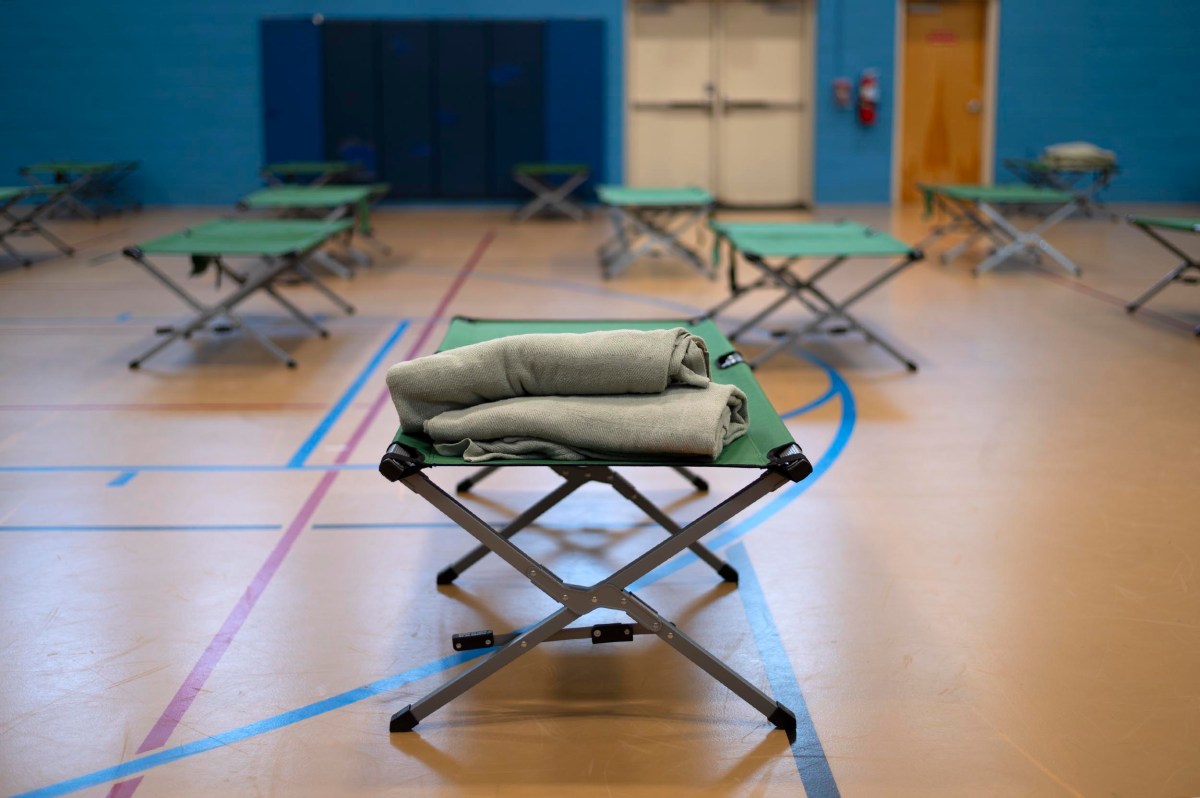
Last winter, CVOEO operated a large extreme cold weather shelter inside a Burlington community center gym when feels-like temperatures dropped to minus 10 degrees. Funded by a state program, the shelter typically operated for a few days at a time before temperatures inched above the state’s threshold and shelter guests were sent back out into the elements.
Lawmakers increased the temperature trigger for that cold-weather program this legislative session, yet the prospect of continuing to operate an on-again, off-again shelter has proved daunting to service providers, who’ve called the model a “disaster response.”
As a replacement, CVOEO hopes to operate a shelter of this scale 365 days a year, Dragon said. The shelter would be the area’s only site with walk-in availability, and would be geared toward adults currently living outdoors. It would be open only during the evening hours.
The shelter would be “congregate,” meaning there would be beds set up in one large common area. It’s a somewhat unusual model for new shelters, which typically have more private space. CVOEO sees the site as a “triage center” that would serve as an entry point for the organization to refer people to their other shelter sites, for instance one focused on substance use recovery.
The site would be low-barrier, meaning it wouldn’t enforce strict rules around sobriety. Dragon hopes to find a location that has some additional rooms for individuals who need more privacy or who have pets, along with space for medical services and food.
The organizations are searching for a space for purchase or long-term lease with a minimum of 12,000 square feet and a single-floor, open-concept layout. The location would need to be accessible for people with disabilities, and would ideally be located along a bus route within five miles of CVOEO’s Community Resource Center in Burlington’s Old North End, where shelter guests could access services during the daytime hours.
The groups have looked at four spaces thus far, though none have panned out. Dragon said they’re working on securing state funding for acquisition and operating costs, the latter of which is estimated to cost approximately $3 million annually.
The need for a shelter of this scale has grown more acute as the state has wound down its expanded pandemic-era motel voucher program in recent years, Dragon said, which has provided shelter for a large share of people experiencing homelessness in the state since 2020.
Burlington city officials are not funding the project directly but fully support it, said Rebecca Reese, Burlington’s homelessness and public health manager.
“Unsheltered homelessness has just exploded,” Reese said. “Having the opportunity to bring so many beds online…this is something that is going to make such an impact on so many lives, and we’re really pulling for it.”
The organizations hope to have the shelter ready to open by the end of the year.
Correction: This article has been updated to more accurately reflect the temperature threshold at which a CVOEO winter shelter opened last winter. A state program allowed shelters the option to open at feels-like 0 degrees; CVOEO used the mandatory minus 10 degrees threshold.
