

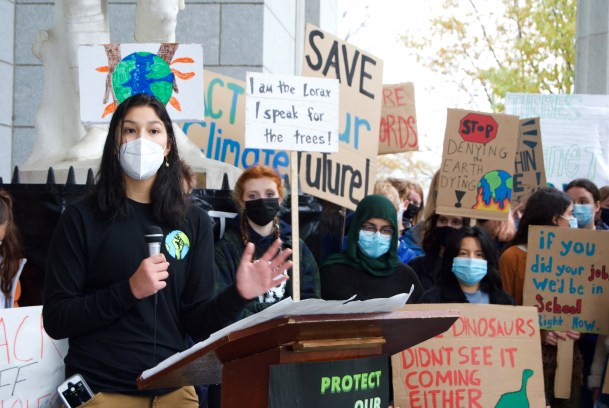
MONTPELIER — High school students from around the state braved a steady November rain Friday as they gathered in front of the Statehouse to express acute concern about the impacts of climate change and demand immediate action.
To avoid devastation in the coming decades, statewide and national leaders need to treat the issue with more urgency, speakers said. That devastation will affect their generation more than those now in power, they said — one participant’s sign read, “you’ll die of old age, we’ll die of climate change.”
Speeches also focused on the disproportionate impact of climate change on people of color, Indigenous people, low-income groups, people experiencing homelessness and those in nations that are being affected first by the planet’s warming.
“Raging fires in Australia and California, scorching heat waves in Canada and Pakistan, severe flooding in China, and a drought that has caused severe famine and displaced over 1 million people in Madagascar — climate change is no longer just a looming threat. It is here,” said Fatima Khan, a student at Essex High School.

Friday also held significance because it marked the end of COP26, the United Nations climate summit in Glasgow, Scotland. Multiple speakers expressed dismay at what they described as lack of action at the summits — both COP26 and those that came before.
“The ones who are making the decisions aren’t the ones who will be around to face the impacts, which will widen inequalities, resulting in violence and displacement,” Khan said. “The stark reality is that our future isn’t guaranteed.”
Others focused on state action. Gabe Groveman, a student from Montpelier High School, pointed to Gov. Phil Scott’s veto of the Global Warming Solutions Act, which legally requires the state to reduce emissions in the coming years. Legislators overrode the veto.
Groveman also referenced the Scott administration’s proposed agreement with GlobalFoundries, Vermont’s largest private-sector employer, which would support the utility’s request to form their own utility. The move has been criticized by environmentalists and those in the renewable energy industry, while state officials have said they would still ensure that the company reduces its emissions.
“Allowing GlobalFoundries to make that deal would not only be unfair to the planet, but all of us young people who’ve dedicated their time and energy into seeing these solutions put into action,” Groveman said.
Organizer Iris Hsiang, a student at Essex High School, also serves as a youth member of the Vermont Climate Council, the body currently racing to create an initial plan to reduce greenhouse gas emissions and prepare the state for climate change by Dec. 1 in accordance with the Global Warming Solutions Act. On several counts, the council has fallen short of its responsibilities, she told reporters.
A group of more than 100 young Vermonters met in 2019 for a Climate Congress, during which they created the Young Vermonters United Climate Declaration. It called for a number of actions, including that the state protect marginalized communities that are vulnerable to the effects of climate change.

“This was mostly tasked to the council, and we have failed,” Hsiang said. “A plan that should have been co-created with the most impacted communities instead has public engagement that looks more like marketing.”
Council members have held public meetings throughout the state about the forthcoming Climate Action Plan, but outreach has been limited because of the pandemic and the council’s ambitious timeline, council members have said.
“Without any input from the most impacted Vermonters, this plan does not, cannot harness the power of this moment of transition to repair harm in the way that we might have been able to,” Hsiang said.
While she wants the plan to move forward, she said, the council must engage frontline communities in the next few months.
Several of the young activists present on Friday told VTDigger they are planning major parts of their lives around the projected impacts of climate change.
While applying to college, Groveman said he and several peers have talked about finding a school in a location that won’t be heavily impacted by climate change.

“Is the college I go to going to be somewhere I can actually live in the next few years and have a life?” he said.
Hsiang said she’s decided against having biological children, largely because of climate change.
“I don’t think it would be responsible of me to bring people into this world who were going to have to face all of this,” she said. “That’s a big thing.”
Khan said she’s always planning her future with climate change in mind and worries about vulnerable communities on the frontlines.
“We really need to repair the harm that we’ve caused,” she said. “We have to do this by sticking together and really working instead of talking. We do a lot of talking, but rarely do I see massive change, which is what we need.”
