

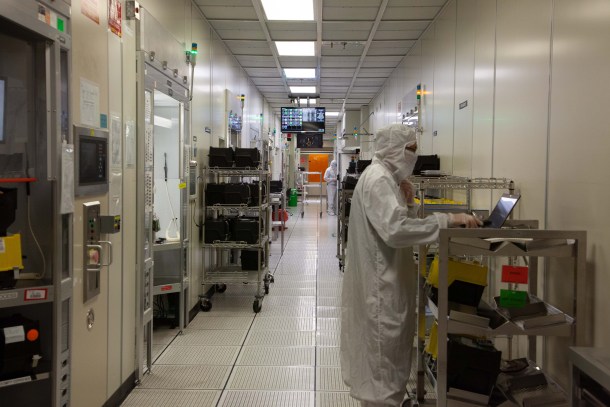
Environmentalists say a proposed agreement between state officials and GlobalFoundries, Vermont’s largest private-sector employer, does not align with the Global Warming Solutions Act.
In the spring, the international semiconductor manufacturing company filed a petition with the Public Utility Commission to make its Essex Junction facility, called “Fab 9,” an independent energy utility.
Instead of purchasing energy from Green Mountain Power, GlobalFoundries would purchase energy from the regional wholesale market for the facility and process it through its own conductors.
GlobalFoundries and members of Gov. Phil Scott’s administration recently signed a letter of intent that outlines a greenhouse gas reduction plan for the company should it become a self-managed utility.
The outlined plan “should obviate the need” to include GlobalFoundries in Vermont’s Global Warming Solutions Act rulemaking “if reduction plan is achieved,” the last line of the letter read. “Parties reserve rights regarding current or future rulemaking authority.”
The law, passed in 2020, said the state must drastically reduce greenhouse gas emissions in the coming years.
GlobalFoundries, headquartered in Malta, New York, has said it uses 8% of Vermont’s electricity — more than the city of Burlington. Based on estimates from Renewable Energy Vermont, a clean energy advocacy organization, the company’s manufacturing processes contribute to 3% of Vermont’s greenhouse gas emissions.
It’s also one of the largest semiconductor manufacturers in the world, with 2020 revenues of $5.7 billion. Between its Essex Junction and Williston campuses, it employs 2,200 people in Vermont.
Gregory Rieder, principal member of the technical staff at GlobalFoundries, said via email that the company’s energy independence would allow it to reduce electricity costs.
“Approximately 50% of our annual site operating expense in Vermont is currently allocated to the cost of electricity,” he wrote. “The Self-Managed Utility (SMU) will allow GF to purchase the commodity in the open and competitive marketplace.”
The model keeps the Vermont facility “competitive with our other manufacturing sites both in the US and abroad,” he wrote.
Meanwhile, members of the Conservation Law Foundation, Renewable Energy Vermont and AllEarth Renewables have objected to GlobalFoundries’ proposed plan, saying the company will likely get its energy from fossil fuels, that the plan doesn’t help Vermont reach its emissions reductions requirements and that it places that burden on Vermonters.
Moving backward
Reductions in greenhouse gas emissions required by the Global Warming Solutions Act include 26% below 2005 levels by 2025, 40% below 1990 levels by 2030 and 80% below 1990 levels by 2050.
Rieder said the company plans to comply with the act to the extent that it’s applicable to the company.
“Yet, presently, none of the act’s requirements are applicable to GF or any other business in the state,” he wrote. “Instead, the Global Warming Solutions Act sets requirements for greenhouse gas emissions reductions on a statewide basis, and the state could be sued if those reductions are not achieved.”
He said the letter of intent reflects the company’s commitment to combat climate change.
Elena Mihaly, interim vice president of the Conservation Law Foundation Vermont, called the plan “a pretty stunning example of corporate evasion of climate and community responsibility.”
“It’s essentially like granting the City of Burlington a free pass to not comply with the climate law that was passed, popularly, by the Legislature,” she said.
Peter Sterling, executive director of Renewable Energy Vermont, is concerned about how the plan would affect the state’s goals to produce more energy using in-state renewables.
“We’re now moving backwards by exempting 8% of all Vermont’s electricity from these requirements, which means every other Vermonter and Vermont business owner and Vermont utility owner are going to have to work harder to meet these goals,” Sterling said.
As an “aspirational target,” the letter said GlobalFoundries will aim to lower its 2025 emissions to represent a 26% reduction in its 2005 greenhouse gas emissions.
While that reduction mimics the statewide requirement mandated by the Global Warming Solutions Act, it does not represent a large reduction in the company’s emissions. GlobalFoundries’ emissions were higher in 2005 than they are now.
The Fab 9 facility emitted about 383,000 metric tons of carbon dioxide equivalent in 2005, according to the letter. A 26% reduction would bring it to 283,000 metric tons — but last year, it emitted only 289,000 metric tons, Sterling said.
The reduction from present-day emissions is less than 6,000 metric tons, a 1.9% reduction.
The plan would allow GlobalFoundries to offset as much as 3.3% of its emissions using carbon credits. Sterling said those numbers, added up, mean the company could slightly increase its emissions.
Asked about that increase, Rieder said GlobalFoundries does not necessarily plan to use the carbon credits.
“The limited opportunity on purchasing carbon offsets (capped at 3.3% of total emissions) is a method that has been approved by Vermont regulators,” he wrote. “While it is important to have the option available, GF has no current plans to purchase carbon offsets to mitigate potential increases in output.”
GlobalFoundries has committed to investing $10 million in manufacturing process projects for greenhouse reductions, he said.
“If the state wants GF’s operations to grow, the company needs flexibility on how it achieves greenhouse gas reductions to mitigate increases in output,” he wrote.
The letter seems to give the company that flexibility. It was signed by Peter Walke, commissioner of the Department of Environmental Conservation; June Tierney, commissioner of the Department of Public Service; and Glenn Colton, a representative of GlobalFoundries.
It stipulates that, in the future, the Agency of Natural Resources, the Department of Public Service and GlobalFoundries would work together to “develop a mechanism to adjust gross emissions targets to allow for responsible growth above 2020 levels.”
Jason Maulucci, the governor’s press secretary, said in an email that the governor’s strategic priorities “are to grow the economy, make Vermont more affordable and protect the most vulnerable.”
“He is also committed to combating climate change, and has proposed more funding for climate action than any governor in history,” Maulucci wrote. “With those principles in mind, we’ve been monitoring this process, and have always said that if Global Foundries commits to certain affordability and environmental goals, we would be comfortable with the arrangement.”
The decision is ultimately up to the Public Utility Commission, Maulucci said.
Green Mountain Power supports the plan for GlobalFoundries to become its own utility but was not involved with the letter of intent, said Kristin Carlson, GMP’s vice president of strategy and external relations.
Rather, GMP worked with GlobalFoundries to create a plan that wouldn’t shock its customers with inflated rates.
“If the company were to leave Vermont tomorrow, in that case, customers could face an instant rate increase of up to 3%, which, of course, would not only hurt our customers, but it also hurt the state’s economy,” she said.
Instead, GlobalFoundries would pay a $16.3 million fee over the four-year transition period to alleviate that rate hike.
Mihaly said she’s concerned that the company’s plan is voluntary and that the company has not committed to emissions reductions beyond 2025.
“We can’t have the Scott administration working on a side deal to exempt GlobalFoundries at the expense of the rest of Vermonters right now,” Mihaly said.
Essential objective
If the proposal is approved, GlobalFoundries would be the first self-managed utility in the state. The Conservation Law Foundation does not believe such a utility is legal or that the commission would have the authority to create one.
The commission has postponed hearings on GlobalFoundries’ petition to allow more time for commissioners to understand the issues at play and the scope of their own jurisdiction.
In an order amending the schedule, commissioners wrote that the proposal “involves many complex factual and legal determinations on disputed issues, including one of the central remaining issues: whether, to what extent and how GlobalFoundries would be subject to renewable energy, energy efficiency and greenhouse gas emission reduction standards if allowed to operate as a self-managed utility.”
Asked whether the company would consider moving from Vermont if the Public Utility Commission denies their petition to become a self-managed utility, Rieder said the company’s future in the state “will be significantly influenced by our ability to manage our costs efficiently and affordably compared to our other GF manufacturing sites worldwide.”
Operating a self-managed utility “will help GF achieve that essential objective,” he said.
Sterling, with Renewable Energy Vermont, said it’s hard to imagine the company leaving the state but said he isn’t sure that’s the conversation the state should be having.
“The right conversation is, are we going to allow a highly profitable, multinational corporation to pollute more in Vermont,” he said, “then ask Vermonters to keep paying to clean up our environment?”
