


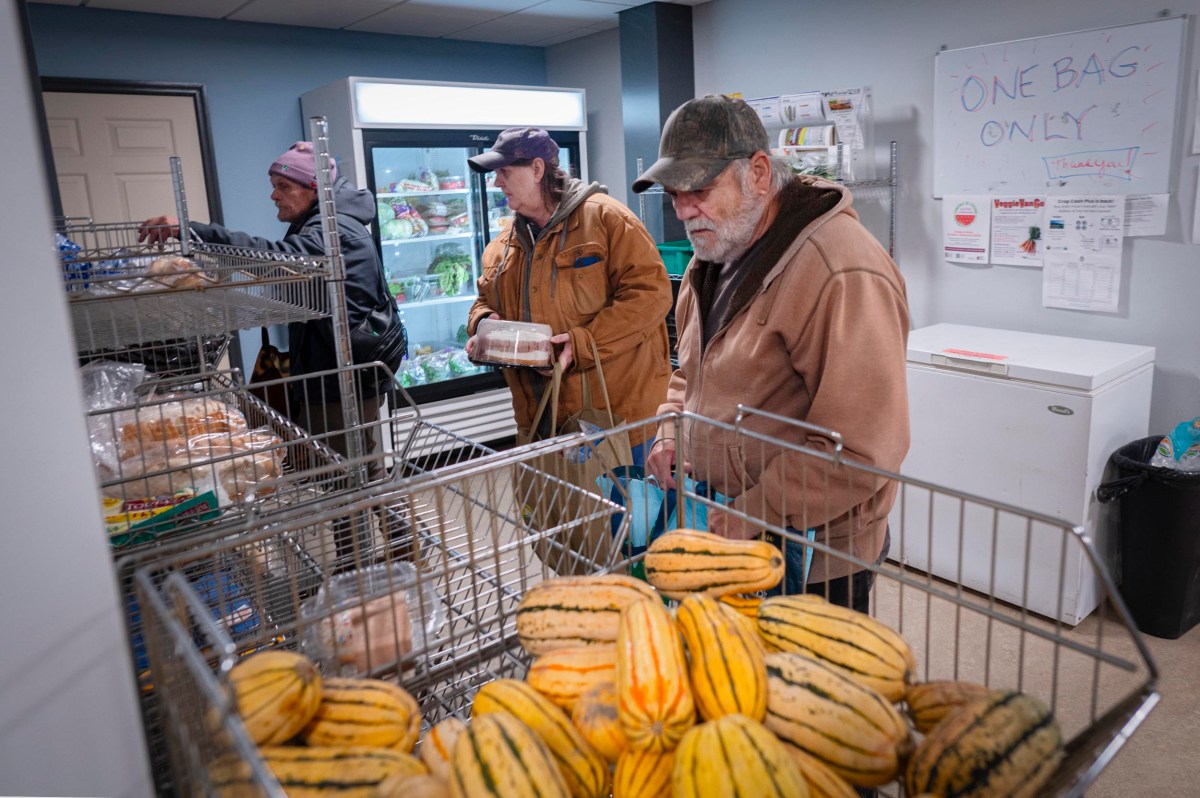
Food assistance leaders are pushing hard this legislative session to expand aid programs and fill gaps left by federal cuts — but the response from lawmakers continues to be cautious.
Becka Warren, who manages the Vermont Food Security Coalition, told the House Committee on Agriculture, Food Resiliency, and Forestry on Thursday afternoon that investment will be critical this year for the state to continue making progress against hunger.
The coalition is a joint effort of the state’s largest food-focused organizations: Vermont Foodbank, Hunger Free Vermont, the Intervale Center and others. The group’s recommendations, formalized in the Vermont Food Security Roadmap 2035, range from increases in public funding for direct food assistance programs to stabilizing the state’s farm economy.
Before the committee, Warren outlined the coalition’s strategy to maximize federal funding for nutrition aid programs wherever possible, particularly given federal cuts to the Supplemental Nutrition Assistance Program, or SNAP. Part of that effort includes requesting a new appropriation of $6.3 million to cover additional administrative costs shifted to Vermont in the One Big Beautiful Bill Act last summer, she said.
Warren also requested a $5.75 million grant for local support staff she termed “benefit assisters” to help SNAP and Medicaid recipients navigate the programs’ changes. Such an appropriation would ease transitions for vulnerable Vermonters and also help minimize errors in the benefit systems, Warren said, calling the proposal “a great bang for a buck.”
Rep. David Durfee, D-Shaftsbury, who chairs the committee, said in an interview after Warren’s testimony that while hunger is “an issue that’s become more and more critical,” he’s constantly reminded that there’s “not a lot of wiggle room” in this year’s budget.
Nonetheless, Durfee said he was “struck” by the idea of paying for support staff to guide benefit recipients and retain available funding. Sufficient funding to run the state’s SNAP program, he added, also “has to be” in the budget.
John Sayles, the CEO of Vermont Foodbank, emphasized the connection between food security and Vermont’s farms in an interview Thursday. His organization is requesting a total of $5 million next year to fund his organization’s farm-focused Vermonters Feeding Vermonters program, as well as shore up the Foodbank’s emergency preparedness. Sayles said farms are a key part of food resilience in the state.
“When crisis hits,” he said, “having local sources and a robust local ag community can really help us.”
— Theo Wells-Spackman
In the know
Vermont Education Secretary Zoie Saunders on Thursday floated three map proposals to legislators during a joint meeting of the House and Senate education committees but stopped short of endorsing one specifically.
One proposal would utilize the 11 existing Vermont School Board Association regions to organize new consolidated school districts, while another would use existing regional high schools as an organizing principle for 13 new districts — similar to an idea discussed by the school redistricting task force in the fall.
A third proposal would combine elements of the two maps into a hybrid proposal that Saunders in her presentation said would provide greater balance between districts.
Saunders called the maps a “strong starting point” that lawmakers could “build upon” as they continue their work. She added that the proposals were “viable maps for consideration.”
Asked later by Sen. Seth Bongartz, D-Bennington, the Senate Education Committee chair, whether the hybrid proposal was their “best shot” at landing on a map, Saunders said she felt the proposal “most closely aligns with the criteria and expectations put forth in Act 73.”
That proposal would feature 13 districts, and would notably split Chittenden County — the state’s most populous county — into three separate school districts, each with more than 6,000 students.
The largest district in the proposal would combine school districts in Franklin and Grand Isle counties and would have 9,122 students, according to the proposal.
Lawmakers are working to find a starting point to move forward with the consolidation of the state’s 119 school districts, and the 52 governing units that oversee them as mandated under Act 73.
— Corey McDonald
Vermont’s prisons are holding more people than in the recent past — so the state is going to have to pay up to keep providing them all health care. The Vermont Department of Corrections is asking for $4.5 million to pay its privately owned and for-profit health care contractor, Wellpath, according to Haley Sommer, a spokesperson for the department.
Out of that cost, $1.2 million could go toward expanding treatment for inmates with substance use disorder, according to Aviva Tevah, who directs health for the Corrections Department. The other $3.3 million could be spread across expanding a slate of other services to simply accommodate more people, Tevah told the House Corrections and Institutions Committee Thursday.
“We don’t want to change the level of service we’re providing. And so if the population is increasing — it’s a natural outcome that the total cost will increase as well,” Tevah said.
The cost increase is also a provision of its contract with Wellpath, which allows the cost of services to change if the incarcerated population changes significantly.
According to data from the department, the male incarcerated population was 16% higher in December 2025 than it was in the same month a year prior. The female incarcerated population was 27% higher in December 2025 than it was in the same month a year prior.
— Charlotte Oliver
The two candidates vying to be the next leader of the Vermont National Guard both told lawmakers this week they would resign that post rather than carry out an unlawful order from their superiors in the state or federal government.
Vermont’s Legislature elects an adjutant general, which is the top military officer in the state, every two years. The current office-holder, Maj. Gen. Gregory Knight, is retiring after seven years, creating an open race.
Two current guard members are vying to succeed Knight: Deputy Adjutant General Henry “Hank” Harder, who’s a retired Air National Guard general, as well as Army National Guard Col. Roger “Brent” Zeigler. Gov. Phil Scott is the commander-in-chief of the Guard, while the adjutant general is responsible for managing the force’s 2,700 members and keeping state military records.
This year’s adjutant general election is notable because it comes as members of the Vermont Air National Guard have been deployed under controversial federal orders.
Read more about the candidates’ comments to legislators here.
— Shaun Robinson
Ctrl-Z
The U.S. Department of Health and Human Services made a massive Ctrl-Z on its suspension of nearly $2 billion in addiction and mental health program funding nationwide. On Wednesday, the Vermont Agency of Human Services expected to lose $5.3 million in federal grants as part of this federal notice — including the loss of $1.8 million for a school-based mental health program, Project AWARE, and $2 million for a substance use prevention program called Partnerships for Success, confirmed Nicole Distasio, the agency’s director of federal policy who has navigated the impact of cuts from the Trump administration on the state.
By Wednesday morning, though, the feds said never mind and confirmed to national media outlets that it would reinstate the grant funds. Distasio said the agency had received rescission notices and was “cautiously optimistic” that it would receive the remaining reversals of the cancellations from the federal government on Thursday.
The federal back-and-forth is taxing on the state agency, Distasio said. She said her entire workday — from 8 a.m. through 10:05 p.m. — was consumed by this.
— Olivia Gieger
Legislative LinkedIn
Molly Moore, former deputy director of legislative affairs and communications for House Speaker Jill Krowinski, has left her post. She’ll be managing Ryan McLaren’s campaign for lieutenant governor.
— Ethan Weinstein
