

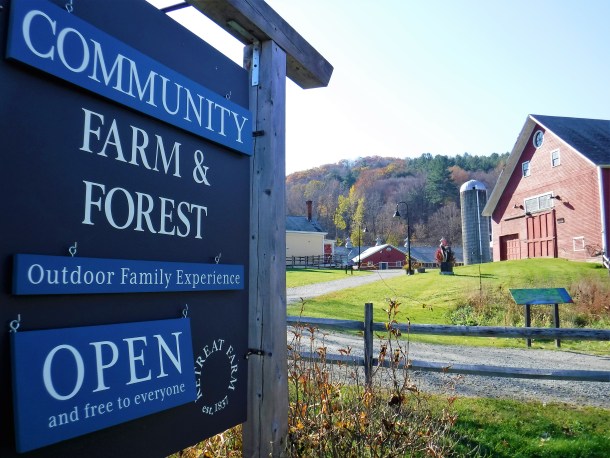
BRATTLEBORO — This town’s sprawling showcase Retreat Farm is “on a mission,” its website says, “to connect people to the land and one another.”
This month, that means unfriending Facebook and its corporate social media cousins.
“We are choosing to prioritize physical connection and authentic relationships by discontinuing our use of Facebook and Instagram,” the model farm has posted in perhaps the first case of a Vermont organization pulling the plug on the world’s biggest communication platform.
When Buzz Schmidt set up a nonprofit in 2015 to restore the property once owned by the nearby Brattleboro Retreat psychiatric hospital, he envisioned turning its historic barns and 500 acres of former Abenaki fields, forests and waters into a gathering place for both locals and tourists.
“We believe that the relationship between humans and the land is the foundation of our health, sustenance and inspiration,” the farm’s website says.
The farm has spread its message to some 5,000 followers on Facebook and 2,500 more on Instagram, helping raise free attendance to an anticipated 80,000 people this year.
“Social media has fundamentally changed our society,” managers wrote in a recent post. “Nonprofits and businesses, particularly Vermont’s tourism industry, rely heavily on platforms like Facebook because of their convenience, broad and instant reach, and low cost.”
But Schmidt has grown increasingly concerned about reports that Facebook — whose 2.9 billion monthly active users outnumber the world’s most populous nations of China and India — has hidden internal research about how its platforms can encourage disinformation and dissension.
“Facebook’s abuse of power is so detrimental and erosive to people, communities and our democracy that without government action, it is up to private institutions like Retreat Farm to seek new (and old) ways of communication that prioritize face-to-face connection and relationships,” Schmidt said in a statement.
As a result, the farm has stopped publicizing itself on social media.
“Facebook has intentionally and systematically amplified some of the worst content on its platform — facilitating hate speech, extremist rhetoric and more,” managers said in a public post explaining the action. “In doing so, they contribute to a system that increasingly erodes productive communication and independent thought, increases personal isolation and loneliness, and destabilizes our faith in democracy.”
The farm will move its promotion to more traditional media outlets, local platforms like Front Porch Forum and free emails it now sends to 5,000 subscribers.
“We don’t have it all figured out yet,” added Lindsay Fahey, managing director of community and impact.
The biggest challenge is reaching people who rely solely on social media.
“It’s important to us to make an extra effort to make sure everyone still has a way to get information,” Fahey said.
The farm’s post about quitting Facebook had received 300 “like,” “love” or “care” reactions by Monday afternoon and only one laughing face. Other organizations have expressed interest in the farm’s decision.
“Some have reached out to follow our journey,” Fahey noted, “saying it’s an admirable choice but not one they’re prepared to make yet.”
