

The Vermont Department of Health reported 318 new Covid-19 cases Thursday and disclosed two more deaths due to Covid-19.
The latest case total is the highest in the past five days, raising the rolling seven-day average to 228 cases per day. The moving average has varied from just above 200 to more than 230 cases within the past week, making it difficult to tell which way the statewide trend is going.
Hospitalizations dropped from 55 to 43 Vermonters currently in the hospital with the virus, including 11 in intensive care units. The two new deaths raised October’s death total to 23. In total, 351 people in Vermont have died as a result of the pandemic.
At a press conference Tuesday, Vermont officials did not release their own prediction for the future of Vermont’s cases, which has typically been included in their weekly modeling update. Their death forecast included only a prediction for the next week of data, which showed it remaining mostly the same.
Forecasts from national institutions — including the Centers for Disease Control, colleges and universities, and international research consortiums — have wildly differing predictions for the next month. The CDC ensemble model, pictured below, shows everything from a steady decline to a rapid rise in cases.
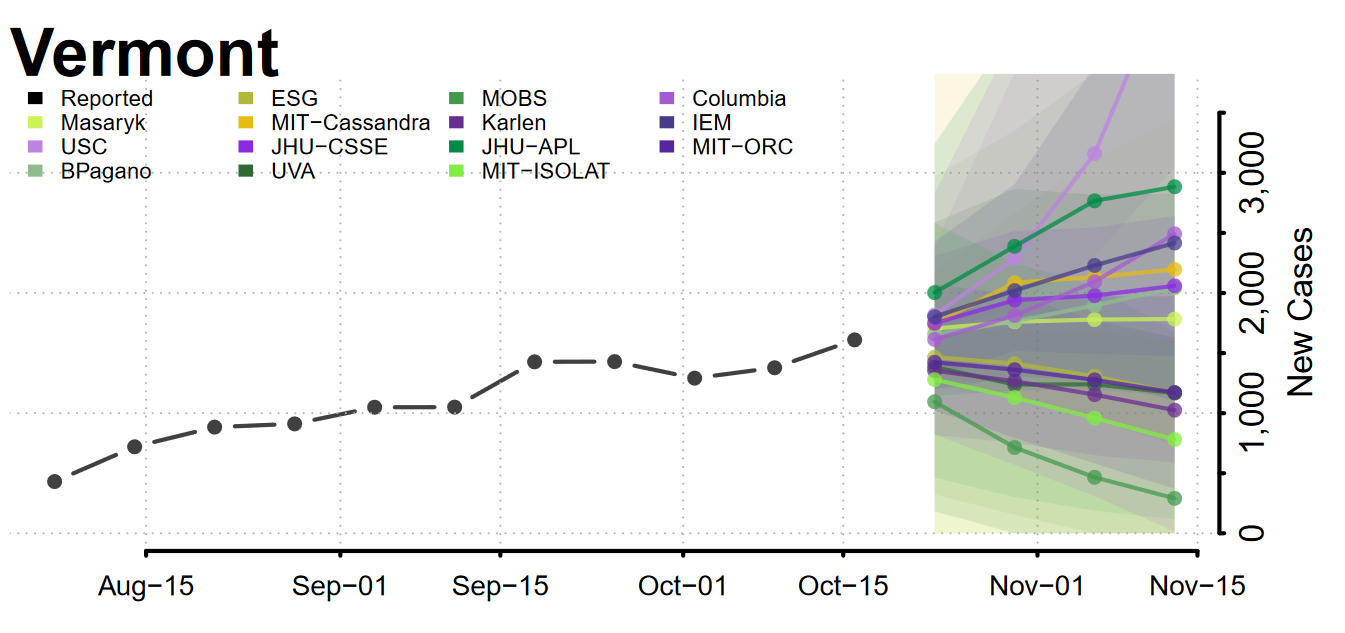
Part of the variation comes from assumptions the models make about the future of individual behaviors. For example, the Columbia University model, which Vermont officials have cited in the past, assumes that “contact rates” will slightly increase in the near future, yet it currently predicts declining case trends under that assumption.
It also produces a forecast that assumes transmission increases in winter, which results in a more pessimistic outlook: More than 400 cases per day in Vermont by the end of next month.
The Institute of Health Metrics and Evaluation, oft-cited by researchers and the media early in the pandemic, produces three projections: Cases with the current level of restrictions and social distancing, cases with no restrictions, and cases with universal masking.
Its model forecasts rising cases in Vermont under the first two projections — above 400 cases per day by the end of November — and forecasts cases leveling off under the last.
Even the Covid-19 Forecast Hub, which collects and summarizes the results of 33 models, warns of “substantial uncertainty” for hospitalizations and deaths in the coming weeks.
“During periods of relative stability, models in general show broad agreement about the predicted trajectory of the outbreak,” according to its website. “However, when there are steep surges or declines in cases or deaths, models often have quite different predictions for the upcoming weeks.”
Vermont has had such a surge in recent weeks. The United States as a whole, by contrast, has reported declining cases, hospitalizations and deaths, making its projections clearer.
The Forecast Hub predicts deaths nationwide to drop from more than 10,000 per week now, to between 6,700 and 9,600 deaths per week by the end of November. The CDC ensemble model has a similar prediction for national cases, with every model projecting a drop in cases by mid-November.
But Vermont has had the highest increases in cases in the country over the past two weeks, rising from one of the lowest case rates in the nation to the 14th-highest.
On Tuesday, Health Commissioner Mark Levine acknowledged the shifting nature of the Delta variant.
“We all know that unfortunately, the Delta variant has changed the course of the pandemic and our road to normalcy,” he said.
He said Vermonters should follow several key health rules: Get vaccinated, get tested, stay home when sick, and limit exposure to large indoor gatherings, especially with high-risk people.
