

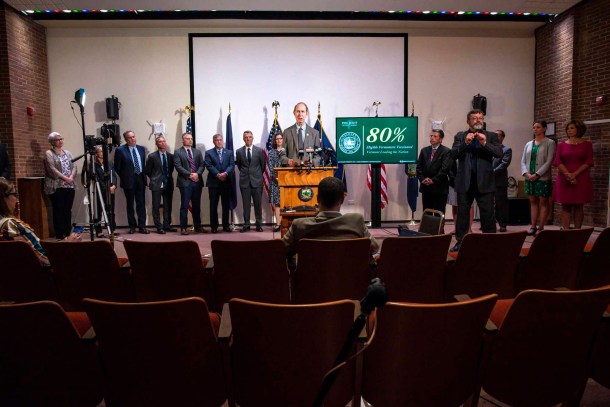
One day after Vermont’s full reopening, the 15-month-long Covid-19 state of emergency is set to expire Tuesday night.
But Gov. Phil Scott signed a new executive order Tuesday morning to continue aspects of the emergency order: providing some continued assistance to Vermonters, keeping the National Guard activated and temporarily extending to-go alcohol for restaurants and bars.
“This state of emergency has been unique, both in its length and nature, because the challenges we faced with Covid isn’t something we’ve ever seen in our lifetimes,” Scott said. “However, in our system of government, extending a state of emergency longer than it’s needed is inappropriate.”
The assistance includes Federal Emergency Management Assistance funding for emergency housing and food programs, said Mike Smith, secretary of the Agency of Human Services.
Vermont is ending its unlimited eligibility for its motel housing program, which currently houses 2,300 people throughout the state, at the end of June, Smith said.
But about two-thirds of that group can get an 84-day extension of their stay, and certain populations — such as families and people with disabilities — can qualify to stay indefinitely, he said.
For the roughly 720 households no longer eligible, the state has some money available to help the transition to other housing situations. People can qualify for a $2,500 “essential payment” to help cover costs related to the move, said Josh Hanford, commissioner of the Department of Housing and Community Development.
Others may qualify for emergency rental assistance or the rapid rehousing program, Smith said.
The executive order also extends some food programs. The Department for Children and Families plans to still provide the maximum amount of 3SquaresVT benefits, Smith said.
The end of the emergency order means that Vermont’s eviction moratorium could end in 30 days, as set by the Legislature last year. Asked about a potential surge in evictions, Hanford said some funding is available to help with rent.
“We feel we have the resources in place to help folks,” he said.
He also mentioned new budget initiatives geared toward developing permanent housing solutions, although that housing won’t necessarily be available next month.
Covid cases falling, even in Canada
Vermont’s Covid cases have tanked by 97% since April 1, the peak of the pandemic, and continue to drop, said Mike Pieciak, commissioner of the Department of Financial Regulation. They’re down 41% in just the past week.
With cases lower than they’ve been since last September, deaths are down, too. No deaths were reported in the past week, and only one in the past four weeks. A maximum of five deaths are forecasted this month.
Though Vermont’s case and death rates remain the best in the region, the numbers are dropping in other states, too. The six New England states all continue to see falling case rates after they’ve fully reopened.
Canada hasn’t reopened yet, but it’s also reported lower case counts as its vaccination program catches up to its southern neighbors. About 65% of Canadians have at least one dose of the vaccine, and 12% are fully vaccinated, according to a presentation at the news conference.
In Quebec, 69% of people have received at least one dose and 11% are fully vaccinated. Prime Minister Justin Trudeau has set a nationwide goal of 75% partially vaccinated and 20% fully vaccinated in order to reopen the country, including the border.
Scott said Canadian and United States officials will meet “fairly soon” to discuss the border reopening. “I’m really hopeful that this will happen sometime, and maybe July,” he said.
Another meeting is scheduled for Friday to discuss booster shots, Scott said. They’re trying to determine what research will be needed to figure out how long immunity lasts.
Asked about booster shots, Levine said research continues on people who began vaccine trials a year ago.
“No one is committing to a one-year booster yet, but it’s been foreshadowed for a long time,” he said, and immunization could last “longer than a year if people’s immune response is really robust.”
What could have been different
Scott and Dr. Mark Levine, the health commissioner, reflected on what Vermont, and the world, could have done differently to prepare for or deal with the Covid pandemic.
While Scott said “we did the best we could under the circumstances,” there were issues “we as a world weren’t prepared for.”
“I think we’ve relied heavily, especially with (personal protective equipment), on other countries and I wish we had had more manufacturing ability right here in the U.S., and we could have controlled that more and protected ourselves better,” he said.
Levine said he wished the U.S. had a better stockpile of PPE and avoided fights between states and nations to get what it needed.
Does he second-guess Vermont’s efforts?
“Anytime you have 256 people who are no longer with us, you ask yourself those questions in the middle of the night all the time,” Levine said.
He added that we need to remember that viruses like Covid will probably remain in our future.
“The ultimate answer to the question is a country that is invested much more in public health and in emergency preparedness,” he said.
