


Vermont is days away from dropping Covid-19 restrictions, thanks to vaccination efforts that have led nearly 80% of eligible Vermonters to get the jab — and officials are ready to party.
“You can get together with friends and family, most likely without masks and distancing, if you’re fully vaccinated,” Mark Levine, state health commissioner, said at a press conference last week. “You can grill, swim, boat. … You can go to a farmers market or concert or car race or a baseball game. You can travel without having to get tested.”
But Lisa Donnelly has reason to hang on to her mask for a little longer.
While data shows that vaccines protect the vast majority of people from the effects of Covid-19, and likely prevent them from transmitting the disease, the Brattleboro resident has an autoimmune condition that requires her to take immune-suppressing medication.
She’s one of thousands of Vermonters whose health conditions might reduce their bodies’ ability to respond to the vaccine, potentially reducing its effectiveness.
“I feel a little bit less stressed about having to go out and get groceries and things like that,” Donnelly said, as a result of the rising vaccination rates. “[But] I’m still going to wear a mask in public places, unless it’s with people that I can verify are vaccinated.”
Across the state, Vermonters with weakened immune systems are navigating a newly vaccinated society while knowing they could still be at risk. That includes people with cancer or who are undergoing chemotherapy, transplant recipients, HIV-positive people and a variety of other conditions that require someone to take immune-suppressing medication.
Research shows that people with weakened immune systems are less likely to produce antibodies from the vaccine, putting them at risk of being unprotected.
Dr. Tim Lahey, infectious disease physician at UVM Medical Center, said exactly how much risk can be unclear and varies by condition. He advises patients to ask their doctors.
“We don’t really know how that translates to the level of protection they’ll get,” he said. “It could be that they’re just as protected as the average person, or it could be that those immunosuppressants take the edges off of their protection.”
On social media, some people with weakened immune systems celebrated the comfort of being able to go out in a vaccinated community for the first time in more than a year.
“[I’m] generally feeling great about reopening, eager to go to events and social events that have been duly missed since the pandemic started,” one person wrote on Reddit.
But another wrote, “It’s scary as heck, and we can’t assess the uncertainty yet. A lot of folks don’t know that this issue exists. I certainly wouldn’t if it weren’t happening to me.”
Lahey said there’s still a lot of “gray area” when it comes to what immunocompromised people should or shouldn’t do now.
“I wouldn’t advise [even] somebody who has a healthy immune system to hang out in a crowded indoor setting, and I wouldn’t tell anybody who’s been vaccinated not to hang out with people outside because it’s so incredibly low risk,” he said.
There are other activities where it comes down to individual preference, such as whether to eat indoors at a restaurant.
He advises his immunocompromised patients to “maybe lean more toward not doing those things that are discretionary,” he said.
For many immunocompromised Vermonters, the pandemic is the most pressing disease they need to fear — but not the only one.

Donnelly, who has rheumatoid arthritis, said even before the pandemic, “going someplace public where someone doesn’t wipe down the equipment after they’re done or they’re sneezing and not covering their mouth were already kind of horrifying.”
Kirsten Isgro, a Champlain College faculty member, is the mother of a 15-year-old daughter, Sylvie, with a rare multisystem disorder that prevents her from walking, talking and eating on her own. While it’s unclear how her condition could affect her response to the vaccine, the family’s not taking any chances: Sylvie nearly died of the flu three years ago.
“People were living the way we’ve been living for a very long time: being very diligent about who we’re hanging out with, and having people wearing masks and spending a lot of time socially isolating,” she said.
Even as the state reopens, the family hopes Sylvie can continue online schooling in the fall, and they still don’t feel comfortable traveling or having people over in the house, Isgro said.
The boom in online events has been a boon to the family, she said. Sylvie was able to attend music therapy and “First Night” events nationwide, a trend that Isgro hopes will continue after the pandemic is over.
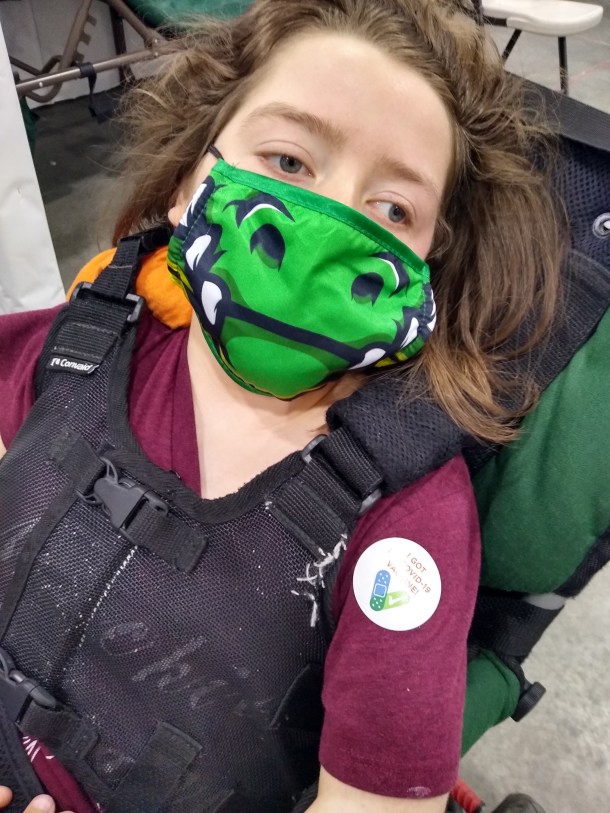
At the same time, the pandemic brought to the forefront the struggle for care her family has been living with for years. Long before the pandemic, the lack of in-home nursing care in Vermont forced them to become Sylvie’s caretakers.
“There wasn’t even any pretense anymore that we were going to get help once Covid hit,” because nurses weren’t coming into people’s homes, she said. “It just sort of cut our losses, and there was something actually very both sad, and also very freeing, about that.”
In an email, she wrote that a full return to normal “would be when people with disabilities are fully included in public policies and social life.”
Donnelly also noted how the pandemic brought everyone into the same boat.
“Even though Covid is really scary as an immunocompromised person, it’s kind of nice having everybody around you take those precautions,” she said.
Donnelly wants people to be aware that others around them may have invisible disabilities that could be the reason they’re still wearing a mask or staying socially distanced.
She hasn’t encountered much opposition to her mask-wearing in her community, but she is aware that “people who see me might assume that I’m paranoid, where it’s a reasonable precaution for me.”
“You don’t know why somebody might still be wearing a mask, even if there isn’t a mask mandate,” she said. “The kind thing to do is to just mind your own business and let people do what they need to do.”
