

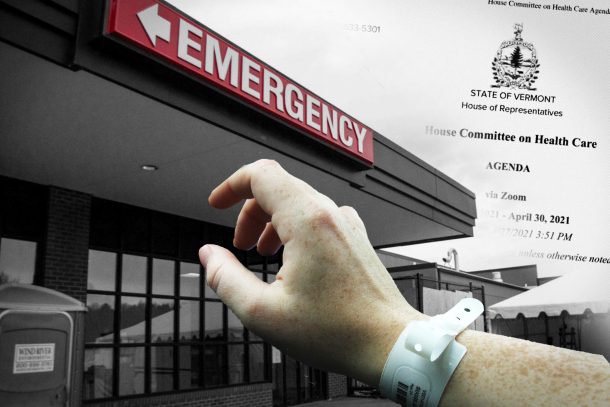
Jodi Girouard was in the emergency room getting her liver checked out when she noticed the kids. Rows of kids in rooms, doors half-open, all waiting for mental health care. A young girl — who looked about 10, with eyes wet from crying — touched Girouard enough to write a letter: Why couldn’t kids get the mental health care they needed?
“I want to challenge the state to find ways to immediately relieve the despair, the tragedy, the hurt that I saw locked in those young eyes,” she wrote in a letter to Rep. Anne Donahue, R-Northfield, and to the mental health publication Counterpoint. “Stop the wasted hours, the waiting room of a hospital bed for days and days and days.”
Girouard raised the alarm for lawmakers on what has become a pressing concern in hospitals around the state: The number of kids requiring inpatient mental health has surged, leaving more youths waiting in the emergency rooms around the state for days on end. The average wait time has risen to 80 hours, or more than three days.
In testimony before lawmakers last week, advocates and parents decried the scenario, calling it “devastating” and “mind-boggling.”
It’s reached a “level of immediate urgency,” said Laurel Omland, director of the Child, Adolescent & Family Unit at the Department of Mental Health.
Pre-pandemic, the state had inpatient mental health capacity for 48 kids under age 18 — 30 inpatient beds at the Brattleboro Retreat and 18 beds at Northeastern Family Institute’s hospital diversion programs and the Howard Center’s Crisis Stabilization Program.
With Covid-19, that number has shrunk by 30% to 33 beds. Virus safety precautions, combined with staffing shortages, have forced programs to limit capacity, according to Omland.
Demand for mental health care typically surges during the spring as the school year drags on. But the social isolation, anxiety and depression caused by Covid-19 has exacerbated the situation.
As of Friday, 19 children across the state were waiting for inpatient psychiatric beds, according to data collected by the Vermont Association of Hospitals and Health Systems. The association started collecting information earlier this month as a result of the mounting crisis. Fourteen of that total had been waiting more than 24 hours, and three others had languished in an emergency room for more than a week. One teenager had been there 15 days.
“One child waiting more than a day is a crisis. Nineteen waiting for days is unthinkable,” Donahue said in an interview.
A trauma of its own
One Chittenden County mother, who spoke with VTDigger on condition of anonymity to protect her privacy, said she took her 12-year-old daughter — who has a developmental disability and autism — to the emergency room twice in March. The woman, who works in health care, knew it wouldn’t provide ideal care, but “I just broke down,” she said. It was late at night, and her daughter, who’s nonverbal, had escalated, becoming aggressive and trying to hurt herself.
They waited 17 hours — her daughter lay on a stretcher; she slept on a recliner. There were no windows and no place to take a walk. In the afternoon of the following day, the 12-year-old finally received medication but no promise of ongoing care. It’s a seven-month wait to see a University of Vermont Medical Center child psychiatrist.
“To have a kid wait seven months, and if there’s a crisis show up at the ER, that’s not very therapeutic,” her mother said, adding that Brattleboro Retreat would be an absolute last resort. “I want to feel like I’m doing something for my child.”
Emergency rooms rarely have trained mental health professionals and can further exacerbate the distress of kids in mental health crisis, said Alison Kapadia, site director at Brattleboro Memorial Hospital’s emergency department.
The rooms are often loud and chaotic, as patients come in requiring resuscitation or detoxing from alcohol. The lights may be on all night. Kapadia said she tries to provide coloring books or worksheets and to allow the child to take a walk. But despite her best efforts, “they don’t even get the basic, basic needs met,” she said.
Many of the children ultimately end up at the Brattleboro Retreat. The facility has staffing shortages that make it difficult to take patients, especially the ones who need the highest levels of care, spokesperson Konstantin von Krusenstiern said in an email to VTDigger. There also are not enough options for kids who are ready to be discharged from the Retreat’s hospital-level care but aren’t yet well enough to go home.
The Retreat is working with the state to resolve the challenges, von Krusenstiern said. “We all share the same goal: that children and adolescents get the care they need when they need it.”
But last week, lawmakers expressed disbelief and outrage at the situation.
“When you say, waiting in the emergency department, are they physically waiting there all those hours?” Rep. Art Peterson, R-Clarendon, asked. “So someone could be, I mean, just waiting there all those days?”
“I’m really struggling to see why the largest hospital in the state can’t find some extra beds somewhere,” said Rep. Alyssa Black, D-Essex. “If we had a shortage of surgical suites, we’d find surgical suites somewhere.”
Growing waitlists
The dearth of mental health treatment options for Vermont youth is nothing new.
For years, legislators have noted the need for more services in schools and in hospitals alike. The only inpatient beds are in Brattleboro, a three-hour drive from northern parts of the state.
Demand also has risen steadily: The number of kids seeking inpatient care tripled between 2010 and 2019, said Christian Pulcini, a pediatric emergency medicine physician at the University of Vermont Medical Center.
In 2019, 2,200 children under age 18 came to the hospital’s emergency room with mental health complaints, he told lawmakers — though that doesn’t include kids who arrive reporting chest or stomach pain that doctors later determine is stress-induced.
The need has spiked during the pandemic — up “40% at least,” said Jen Colman, a Burlington psychiatrist who primarily sees low-income children.
The challenges she hears from kids and their families are numerous and complex: Food insecurity, abuse and neglect, drug use, and domestic violence seem increasingly common. Colman said she spends more time on the phone with the Department for Children and Families than ever before.
Across the board, “anxiety has skyrocketed,” she said.
Colman has stopped taking new patients, and her waitlist is so long that she can longer add any more families. She said she doesn’t know any providers accepting new patients.
The shortage of outpatient services means that families have no choice but to wait until a child’s anxiety or depression gets so severe that they go to the emergency room, according to Donahue.
“When there are waiting lists at community mental health agencies, we know we have systemic problems,” she said. “It always becomes a question of what are we doing further upstream.”
To limit the wait times for kids in the ER, the state has started sending some children to Champlain Valley Physicians Hospital in Plattsburgh, though the hospital accepts only voluntary patients and has limited bedspace. As of last week, five of the 12 beds were filled by Vermonters, UVM Medical Center spokesperson Neal Goswami said.
The state has also started discussing alternatives to hospitalization. In 2018, United Counseling Service and Southwestern Medical Center in Bennington launched a Pediatric Urgent Care for Kids, an experiment funded by OneCare Vermont to keep youths out of the emergency room. The Bennington home reduced emergency department visits by 33% and could be a model for the rest of the state, Omland told legislators.
Donahue and others on the House Committee on Health Care asked last week for immediate action from the Department of Mental Health. The department will return to testify and propose short-term solutions early next week.
For families and children who need mental health care, “it’s no relief to hear that we’re thinking about it in the Legislature. They’re absolutely horrified,” said committee chair Bill Lippert, D-Hinesburg.
He urged state officials to treat the issue with the urgency of the response to the Covid-19 pandemic. “If we considered this truly an emergency situation, broadly, that children are waiting for days in emergency rooms, what would we do? What would it take for us to respond?” he said.
Clarification: This article has been updated to clarify the Bennington groups that started Pediatric Urgent Care for Kids.
