

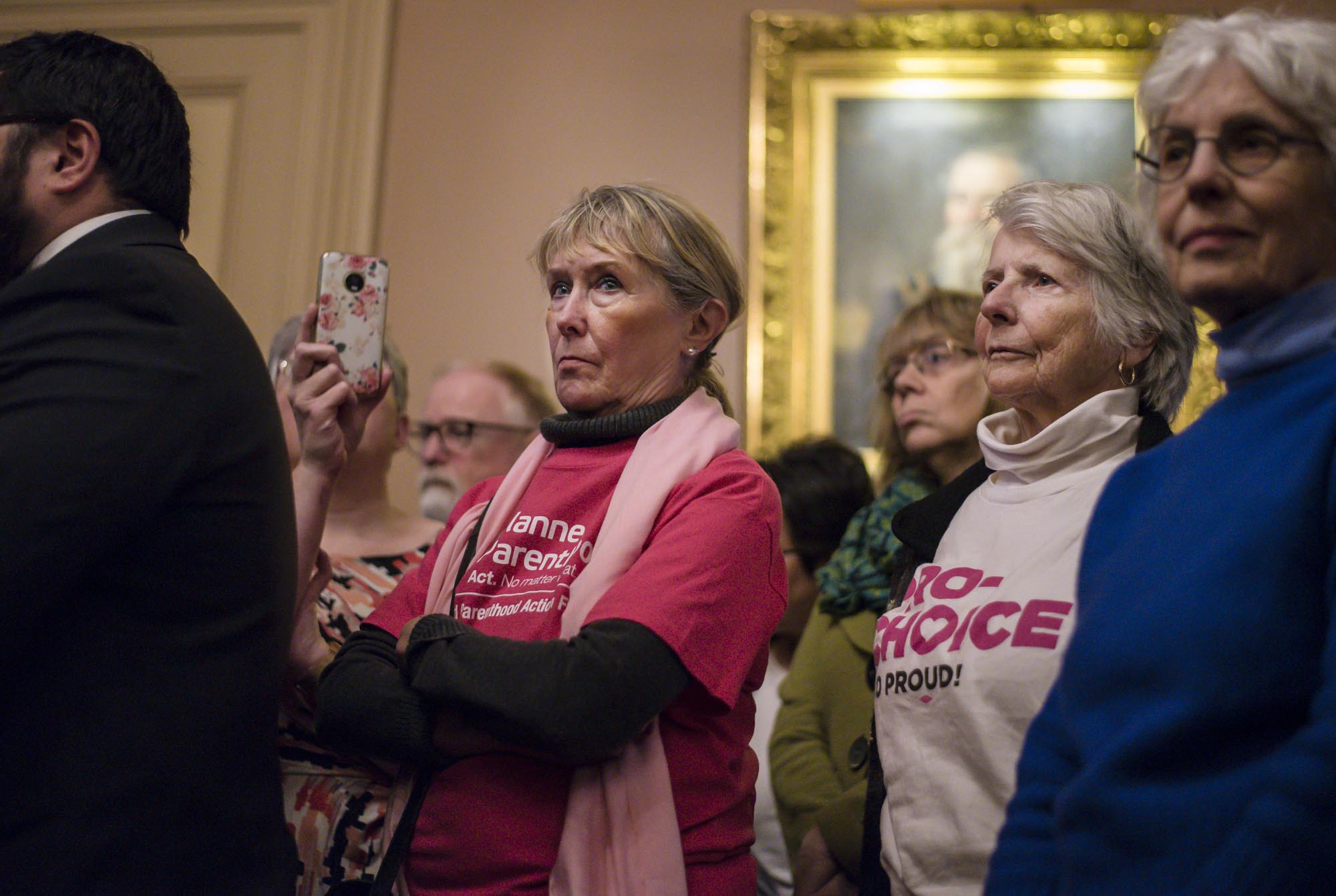
Two proposed amendments to the Vermont Constitution were approved Friday by the state Senate: one to protect abortion rights, and the other to clarify that slavery and indentured servitude are prohibited “in any form.”
The proposals were approved by the House and Senate in 2019. Constitutional amendments need to be approved by two separately elected Legislatures before they can be placed on the ballot for voters to decide.
On Friday, senators voted 29-1 to advance Proposal 2, which would clarify the state prohibition on slavery and indentured servitude. The constitution currently states that “no person born in this country, or brought from over sea, ought to be holden by law, to serve any person as a servant, slave or apprentice, after arriving to the age of twenty-one years, unless bound by the person’s own consent, after arriving to such age, or bound by law for the payment of debts, damages, fines, costs, or the like.”
The constitution does not specify that slavery is illegal for all people.
Senate President Becca Balint, D-Windham, said the amendment “would serve as an important foundation for addressing systemic racism in our state’s laws and institutions. Many Vermonters want a future that is racially just, but we can’t get there until we’ve addressed the injustice of our past.”
Sen. Dick McCormack, D-Windsor, was the only senator to oppose the amendment. McCormack said the constitutional language has importance as a historic record.
He said some have likened the effort to change the constitution “to the removal of a Confederate flag or to the removal of a statue of a Confederate notable.” But he said that’s not an accurate comparison.
“I think it’s good to lower the Confederate flag. I think it’s good to remove statues of Robert E. Lee, because they glorify slavery, and we shouldn’t be glorifying slavery,” he said.
“But the original language does not glorify slavery. It outlaws it because it’s an outrage. It recognizes it as an outrage,” he said. He compared the proposed amendment to “putting a smiley face on history.”
Sen. Kesha Ram, D-Chittenden, said the Vermont Constitution’s ban on slavery is “profoundly muddled: qualified by age, supposed consent and debt bondage.”
“Those who have advocated for years for this constitutional reckoning do not think they will win over those who continually deny their humanity. Rather, they hope to lift the cloud of Vermont exceptionalism from the eyes of those who think we were somehow not a part of that original sin of this nation,” Ram said.
“With this vote we do not rewrite history. We learn from it. We build on it. We begin to heal, and we encourage our fellow citizens to do the same,” she said.
Worries about Roe v. Wade
Proposal 5, the abortion rights measure, was approved 26-4.
The amendment was introduced two years ago over concerns about political and judicial changes at the federal level, including the makeup of the U.S. Supreme Court.
Lawmakers worry that new conservative members of the nation’s highest court could reverse the landmark Roe v. Wade ruling that legalized abortion in 1973.
Speaking on the virtual Senate floor, Sen. Ginny Lyons, D-Chittenden, said “threats to weaken or overturn Roe v. Wade” and “multistate efforts to erode reproductive autonomy build a strong case for support of Prop 5.”
“Times are turbulent, and reproductive liberty is under serious attack. Clarity is needed,” Lyons said. “Vermont’s history and values support the freedoms included in reproductive autonomy. For nearly 50 years, Vermont has supported reproductive liberty. It is necessary and appropriate to let the voters decide that this fundamental right will continue in our state.”
Balint said that, unlike many places in the country, “Vermonters support and value reproductive freedom.”
“The vast majority of people in Vermont believe that people should make their own personal health care decisions. They support the right to access reproductive care safely and legally with their health care providers, without interference from politicians. This amendment reflects this value,” Balint said.
Three Republican senators — Brian Collamore, R-Rutland; Joshua Terenzini, R-Rutland; and Russ Ingalls, R-Essex/Orleans — and one Democrat, Sen. Bobby Starr of Essex/Orleans, voted against the amendment.
After Friday’s vote, Collamore, who is anti-abortion, said the majority of constituents who contacted him about the amendment asked him to oppose it.
He added that, “despite some people thinking that there might be some erosion someday,” Roe v. Wade is still “the law of the land.”
“We already have a Supreme Court decision that establishes a woman’s legal right to choose for herself,” Collamore said.
Collamore also said that in 2019, Vermont adopted legislation offering the broadest protections for reproductive rights of any state in the country.
The Vermont House doesn’t plan to take up the constitutional amendments until next year. It has until the end of the 2022 legislative session to pass the constitutional amendments. Otherwise, they go nowhere.
Assuming the House endorses the measures, they will be placed on the statewide election ballot in November 2022.

