


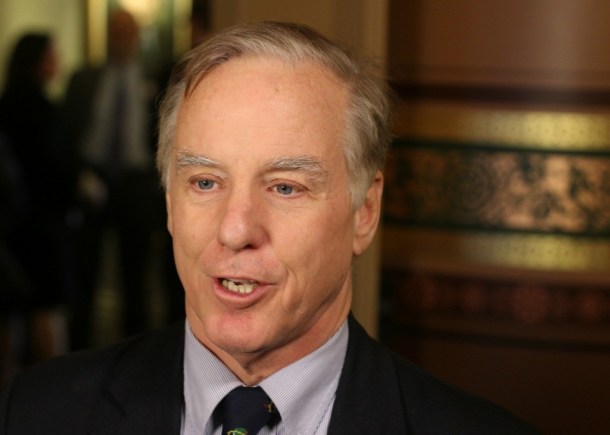
Howard Dean, the Democrat who was governor of Vermont for 12 years and has been a fixture in Washington, D.C., political circles, is under fire for arguing that President Joe Biden should reject a waiver that would make it easier for low-income countries to produce coronavirus vaccines.
Last fall, the governments of India and South Africa petitioned the World Trade Organization to waive intellectual property rights on the vaccines — a proposal that human rights groups and public health experts say would advance global vaccine equity. Now, 90 other countries have joined that push.
In a Barron’s op-ed in March, Dean argued the waiver would set a “dangerous precedent” by allowing countries to copy American-produced vaccines years before the patents expire.
Low-income countries have lagged behind the U.S. and Europe in the vaccine rollout, raising concerns about when the world will reach herd immunity. But while improving global vaccine equity should be a priority of Biden’s, Dean argued, stripping intellectual property rights is not the right way to speed up vaccinations.
“IP protections aren’t the cause of vaccination delays,” wrote the former governor, who has a medical degree. “(Companies) would never invest hundreds of millions in research and development if rivals could simply copy their drug formulas and create knockoffs.”
That argument spurred a scathing response published Thursday by The Intercept, in which journalist Lee Fang cried foul on Dean’s claims about vaccine production and health equity.
Dean’s argument that global vaccine manufacturing is already at capacity, thus rendering the intellectual property waiver unnecessary, is “patently false,” Fang reported. His story lays out how pharmaceutical companies, which received billions of dollars in taxpayer money to support vaccine development, have pushed back on the waivers to protect their own profits.
Dean, who after his governorship chaired the Democratic National Committee and ran for president, has a rocky past with Fang, an advocacy reporter who writes for the D.C.-based investigative outlet on how lobbying and interest groups shape politics.
Fang’s reporting has scrutinized Dean’s claims that he is not a lobbyist for Dentons, the D.C. firm that lobbies on behalf of pharmaceutical companies and where Dean is now a senior adviser. “Howard Dean says he’s not a lobbyist but he sure acts like one,” reads the headline on a story of Fang’s from 2016. Dean is not registered as a lobbyist in Washington.
The Intercept reporter has also written critically about Dean’s about-face on single-payer health care as he moved on from his governorship to D.C. policy advising work.
In an interview, Dean emphatically denied that his Barron’s essay was part of any lobbying effort, saying it was his personal opinion drawn from experience in the medical field.
“This is my view, and I don’t write things that I don’t agree with,” he said.
Countries like India, he argued, are already producing their own Covid-19 vaccines and don’t require the intellectual property of American companies to continue doing so. (India is producing its own Covid-19 vaccines, though health experts there warned this week that the country’s production capacity is strained.)
Dean believes waiving intellectual property rights for vaccine manufacturing is therefore unnecessary — and may lead to intellectual property being stolen from the U.S. in the future.
Dean said he puts little stock in reporting by The Intercept, which he called “the Newsmax of the Left,” and said it has lied by reporting that he works as a lobbyist. Fang and communications staffers for The Intercept did not return multiple interview requests from VTDigger.
As some low-income countries have yet to receive a single vaccine dose, public health experts say that waiving intellectual property laws on the vaccines would be a key step toward making the rollout more equitable around the world.
Pam Berenbaum, director of the Global Health Program at Middlebury College, said that to this point, discussions about Covid-19’s effects on global health and the economy have focused on short-term rather than long-term effects of the virus, which has become “endemic” to life in many countries.
Waiving intellectual property laws on the vaccines presents a long-term solution to helping those countries emerge from the pandemic in the years — rather than months — ahead, Berenbaum said.
“I would love to see this technology opened up, and I would love to see the waiver go through. It will benefit all of us,” Berenbaum said. “It’s much better if low- and middle-income countries can be responsible for their own vaccine production and distribution, without relying on donations or interference.”
Of Dean’s worry that the waiver could set a dangerous precedent for intellectual property being used by other countries in the future, Berenbaum said, “I think that might happen, but I don’t think it’s a fear. If other countries could use mRNA technology to fight diseases like neglected tropical illnesses, HIV and other diseases ravaging those countries — if they could use this technology to discover new applications — that’s fantastic, as far as I’m concerned.”
