


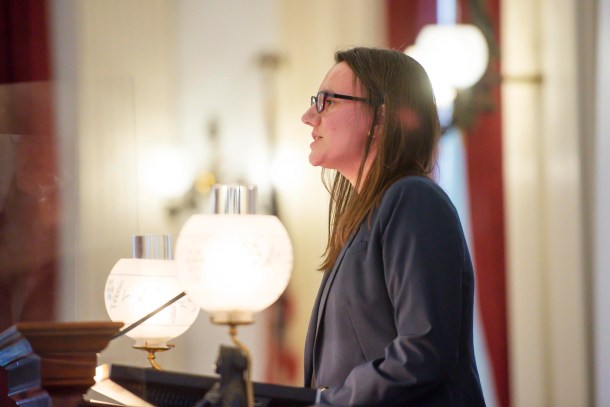
On the morning of Jan. 6, Rep. Jill Krowinski, D-Burlington, was sworn in as speaker of the Vermont House of Representatives and Sen. Becca Balint, D-Windham, became Senate president pro tempore.
It was an historic moment for the state — the first time two women led both chambers of the Legislature.
In their opening addresses, both said they would focus on passing coronavirus relief legislation, working across party lines to reach common goals and restoring the public’s faith in government.
There was a feeling of excitement in the Statehouse that day, the last time that multiple House and Senate members came together in person, with lawmakers happy to see each other again and filled with anticipation about how Balint and Krowinski would lead the Legislature.
But just hours later, after supporters of then-President Donald Trump stormed the U.S. Capitol, Balint and Krowinski’s first day on the job seemed nothing more than a footnote.
“It was this cognitive dissonance that I experienced of feeling such elation and hope, and then seeing what was happening in D.C.,” Balint said.
“When we first gaveled in on day one, we were talking about our shared goals of creating this recovery plan that leaves no Vermonter behind, and then later in the day there was an insurgence of domestic terrorism at the U.S. Capitol,” Krowinski said.
The next day, the Vermont House approved a resolution calling for Trump to be removed from office. The Senate followed suit less than 24 hours later.
“If you would have told me that on the second day of session we would be passing a resolution calling on the president to resign,” Krowinski said, “I had no idea that that’s what we would be doing on day two.”
“In the moment, it shook me, and also refocused my attention on something that I felt like had been brewing for years and had finally sort of burst out into the open, which is this distrust that so many Americans are feeling right now about government,” Balint said.
Krowinski believes that, more than anything else, the Jan. 6 riots reinforced a collaborative approach to legislating.
“I think it has brought us all together to really focus on helping Vermonters through this [pandemic] and showing Vermonters that we’re going to work together across party lines to get things done,” she said.
Two months later, Krowinski and Balint appear to have fostered strong communication between both chambers — and even with Republican Gov. Phil Scott — as the state continues to address the Covid-19 crisis and revitalize an ailing economy.

More collaboration
Some in the Legislature have praised Balint and Krowinski for creating a more collaborative atmosphere than usual. In recent years, the relationship between Democratic leaders in the House and Senate has at times been fraught.
The most visible discord under the most recent leaders — former Senate President Pro Tempore Tim Ashe, D/P-Chittenden, and former Speaker Mitzi Johnson, D-South Hero — came in 2019, when negotiations blew up over two of the Democratic Party’s biggest priorities at the time: raising the minimum wage and providing paid family leave.
That May, legislators walked away without deals on either policy because they couldn’t find agreement.
Sen. Kesha Ram, D-Chittenden, who was elected to the Senate last fall, four years after leaving the House, said that this year there was “a lot of repair needed between the House and the Senate in their relationship.”
“I had felt like I was observing from the outside, and hearing as I was entering back into the legislative space, a lot of mistrust on both sides, a lot of feelings of betrayal about how things had played out and a lot of pitting issues against each other that wasn’t productive for us as Democrats,” Ram said.
Under Balint and Krowinski, she said, both chambers are on “parallel tracks” rather than on “a collision course on a lot of issues.”
Ram noted that both women had previously served as Democratic majority leaders in their respective chambers and often served as “peacemakers,” rallying support for votes and working on interchamber negotiations.
“I just think that Jill and Becca are both really rowing in the same direction and trying to keep people focused on those in need,” Ram said.
Rep. Sarah Copeland Hanzas, D-Bradford, who chairs the House Government Operations Committee, said that because Krowinski and Balint worked opposite each other as majority leaders, they “already have a functional working relationship.”
She said the House speaker and Senate president have called joint meetings of committee chairs to discuss one of this year’s most pressing issues: the state’s growing pension debt. Joint meetings had been rare in recent years, Copeland Hanzas said, though they help improve communication between the chambers.
“I don’t see either Jill or Becca walking away from a meeting or from a negotiation,” Copeland Hanzas said. “I think they would stay to figure it out.”
A stronger partnership
Krowinski and Balint haven’t just stumbled into a better working relationship than their predecessors had.
“We both really made a strong commitment, when we started, to do everything we can to build a stronger partnership between both chambers,” Krowinski said. “We come into this already knowing our leadership styles, and we share a lot of the same goals.”
Balint said the two leaders meet once a week on Zoom. Their respective chambers are different in both “personality” and “function” and may not always approach issues in the same way, Balint said, but it’s important to build a foundation of trust.
“I think Jill and I both know how to throw elbows,” Balint said. “We both are capable of doing that, but we don’t lead from that position each day. We assume of each other the best intentions.”
In the Senate, Balint has also clamped down on criticism of House colleagues — a feature of the upper chamber.
During a Senate Judiciary Committee hearing on Feb. 18, live-streamed on YouTube, Sen. Joe Benning, R-Caledonia, discussed a text exchange he’d had with Ashe, the former pro tem, in which Benning called House members “jackwagons” — a little-used insult similar to calling someone a jerk.
After the incident, Balint called a meeting with the five senators and made it clear that behavior wouldn’t be tolerated, according to Senate Judiciary Committee Chair Dick Sears, D-Bennington.
“I was impressed with the way she handled that,” Sears said. “She very firmly said, ‘You have to be careful about what you say.’”
Sen. Randy Brock, R-Franklin, the minority leader, said Balint has been “inclusive” and “brought her caucus together.”
“They seem to be marching in more or less the same direction,” Brock said. “It’s obviously still very early in her term, and the acid test of how well she does will be really seen at the end of the session in terms of the results that we’ll see at that point.”

Zoom can be frustrating
Rep. Heidi Scheuermann, R-Stowe, said the remote nature of this legislative session has made it difficult to assess Krowinski’s work as House speaker, and limited her ability to track legislation. Meeting on Zoom is not conducive to lawmaking, Scheuermann said.
“That’s what’s frustrating, but that’s not to say that it’s the Democratic leadership’s fault that we’re in this position — it’s not,” Scheuermann said. Still, she added, “I do fear that the public policy being developed as a result is very much weighted towards those who are in leadership, and those of us who are on the outskirts are less involved in that development.”
The bulk of the Legislature’s work this year is still to come, and the chambers have yet to tackle bills that could draw significant opposition from some members or the governor. The first major bill of the year, a $79 million Covid-19 aid package, passed the House last week with tri-partisan support, and awaits action in the Senate.
One of the biggest hurdles facing lawmakers is whether and how to reform the state’s underfunded pension system. In January, state Treasurer Beth Pearce recommended reducing benefits for teachers and state employees, since a new analysis projects the system’s unfunded liability growing by about $600 million.
Lawmakers will have to confront the pension issue and next year’s state budget in the coming weeks.
Looking ahead, Balint and Krowinski say they plan to keep the governor informed of what’s coming — another attempt at making sure everyone is on the same page throughout the session. They’ve already had regular, separate meetings with Scott, discussing everything from the 2021 budget adjustment to clarifications on how the Scott administration is dealing with last month’s Department of Labor data breach.
In a statement, Scott said he has enjoyed the regular conversations with Balint, Krowinski and Democratic Lt. Gov. Molly Gray, who also took office for the first time this year.
“Open communication is important, and our frequent meetings with honest and candid conversation have been helpful, especially because things aren’t as easy with a remote session,” Scott said.
Communication between Scott and Democratic leaders has not always been smooth. During his first term in office, the Republican governor repeatedly butted heads with Democrats over myriad policies. And in Scott’s second term, he decided to stay almost completely out of the fray, refusing to give Democrats an idea of what he would or wouldn’t support.
Now, with new leadership, a pandemic and social distancing, Scott and the Democrats seem to have clear lines of communication.
“Vermonters are depending on us to help them get through this pandemic, and we just have to work together,” Krowinski said. “Or it’ll fail.”


