

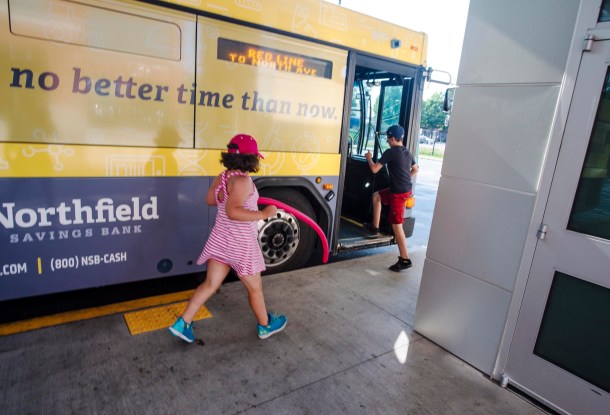
The Vermont Agency of Transportation has received a $26 million federal injection for public transit, Gov. Phil Scott announced on Wednesday, offering a lifeline to a hobbled transportation network.
The money comes from the Coronavirus Response and Relief Supplemental Appropriations Act that Congress passed in December and will offset what would have been millions of dollars in state and local spending.
“Overall, this is very welcomed; it is needed,” said Ross MacDonald, the Agency of Transportation public transit manager. “It will ensure that we’re able to respond to the pandemic with these funds, and directly related costs” such as personal protective equipment, cleaning supplies and additional hours for workers.
MacDonald said about 60% of people on any given bus ride have no other way to make that trip, which highlights the necessity of affordable and reliable public transit for vulnerable Vermonters. This influx of funding will allow public transit to keep running fare-free in all areas outside of Burlington through June of next year.
Like virtually all state agencies, the transportation department has felt a budget pinch during the pandemic.
Bus ridership plummeted by 80% in the spring of 2020, and today is running only 50% to 60% of pre-pandemic totals. Meanwhile, demands for specific transit — such as taking Medicaid patients to doctor’s appointments, getting eligible Vermonters to vaccination sites, or delivering groceries to people in need — have expanded across the board.
“Like so many aspects of daily life, the pandemic has upended transit ridership,” said Sen. Patrick Leahy, Sen. Bernie Sanders and Rep. Peter Welch in a joint statement announcing the grant. “Without congressional action, transit providers in Vermont and across the country would be facing the potential for steep cuts to transit routes and frequency.”
Crucially for Vermont, the $26 million can be used without requiring any state or local matching money. Federal funds for public transit usually require a 50% match.
MacDonald said the lack of match requirement will save about $4 million in state funds and $3 million in local funds. The federal money also frees up about $10 million from the Federal Highway Administration, meaning there’s more money left in the pot to improve Vermont’s bridges and roads.
The $13 million in CARES Act money that public transit received last March also came without any state spending requirements. MacDonald said he expects nearly all of that funding to be spent before the current fiscal year ends June 30.
Vermont’s seven transit providers will soon apply for grants through the Agency of Transportation to tap into the new federal funding, which is for the fiscal year ending June 30, 2022. VTrans indicated the money will be used to address costs related to the pandemic, plus long-term needs that underscore the state’s commitment to sustainable public transit.
As many as 30 buses of the 75 to 80 that have met their “useful life” threshold could be replaced, and VTrans will have the money to conduct overdue energy audits at transit facilities, such as storage garages and administrative offices.
Vermonters will have to keep waiting for electric buses, though. Public transit has just begun to evaluate the costs of developing infrastructure needed for an electric vehicle fleet, and aims to have an analysis ready for the Legislature in 2022.
Public transit was having issues well before the pandemic struck. Green Mountain Transit, the largest of Vermont’s providers, reported about 2.33 million trips between 2017 and 2019, down from the 2.74 million high in 2015.
And in 2019, Green Mountain Transit increased regular fares to $1.50 while dropping the price of a monthly pass from $50 to $40. The transit company debuted its NextGenService Plan that summer, which overhauled Chittenden County bus routes and increased bus frequency, but ridership continued to fall.
With more than $2 million in the pipeline, the new funding could boost a creaking system.
“When the pandemic ends, we’ll be able to rebuild the system to reflect the updated mobility needs, rather than look at rebuilding a reduced program because of lack of funding,” MacDonald said.

