


The House Committee on Government Operations has recommended rejecting Gov. Phil Scott’s executive order establishing a new state agency incorporating all of Vermont’s public safety and law enforcement divisions.
The committee voted 10-1 Wednesday to endorse a resolution to block the state government reorganization. Lawmakers said the subject deserves more discussion, and should be taken up in the legislative process, as opposed to executive action.
“In my mind, it would be most respectful and efficient — if it is the will of the committee — to reject the executive order,” said the committee chair, Rep. Sarah Copeland Hanzas, D-Bradford, during an earlier discussion on Tuesday.
The resolution now moves to the House floor, where it is expected to be taken up Friday.
Copeland Hanzas said rejecting the directive early in the session gives the Scott administration time to introduce legislation to create a new state agency.
Scott’s executive order would create an Agency of Public Safety, with two subdivisions: a Department of Fire Safety & Emergency Management, and a Department of Law Enforcement.
Now, state police, emergency management and the fire division all fall under the Department of Public Safety, with other law enforcement agencies spread across state government.
The executive order stipulates that the new Department of Law Enforcement would at first house only the state police and Motor Vehicle Division, which is now part of the Department of Motor Vehicles.
The order includes a study to see if the Fish & Wildlife Warden Service, the Department of Liquor & Lottery Enforcement, and other state law enforcement groups could be added to the new department.
The agency’s Division of Support Services would also bring together the E911 Board, the Fire Service Training Council and Criminal Justice Training Council.
After taking testimony and hearing from stakeholders and the Scott administration, the committee decided too many questions were left unanswered — specifically around potential costs associated with the consolidation and maintaining the independence of the Criminal Justice Training Council. The council operates the Vermont Police Academy and oversees the training and certification of state law enforcement officials.
“This is by far the largest change in government agencies to be conducted via executive order,” Rep. John Gannon, D-Wilmington, the committee vice chair, said Tuesday.
“We’re talking about taking over multiple agencies with hundreds if not thousands of employees, through an executive order, without any sort of legislation,” he said.
In 2017, Scott used an executive order to establish the Agency of Digital Services. That year, he also tried to merge the Department of Labor and Agency of Commerce and Community Development, but legislators shot down the proposal.
The Legislature also rejected an executive order that would have merged the Vermont Lottery Commission and the Department of Liquor Control. However, in 2018, legislators approved the merger via legislation.
Gannon said voting down the executive order is not the end of the conversation on forming a new law enforcement agency. A bill would be an excellent strategy for giving lawmakers the time needed to deal with the complex proposal, he said.
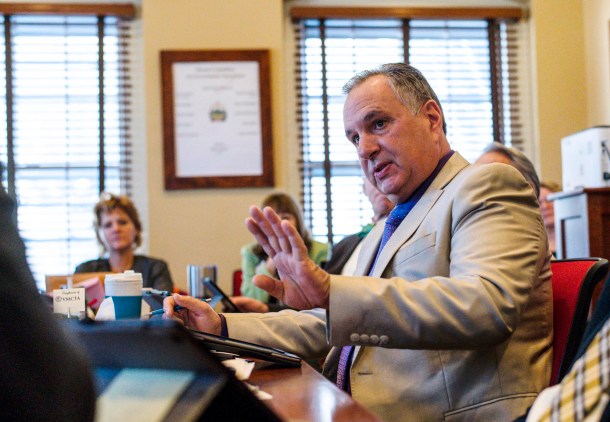
Rep. Rob LaClair, R-Barre Town, assistant minority leader, joined Democrats on the committee in expressing caution about the executive order, while advocating that the panel take more time to dissect the directive issued by the Republican governor.
But LaClair cast the only dissenting vote Wednesday.
“These executive orders are pretty high level, and don’t always have all the details that you’d like to have,” LaClair said. “And the intent has always been to work with the Legislature, and go through and address the areas of concern, and where we have to address it legislatively.”
Two other Republicans on the committee, Mark Higley, R-Lowell, and Samantha Lefebvre, R-Orange, teamed with the Democratic members to oppose the governor’s order.
With the House planning to take up the rejection resolution later this week, Scott is in danger of seeing two of his executive orders shot down by the Legislature. Scott issued both on Jan. 14 — one to form the new law enforcement agency, and the other to restructure the Act 250 land use law.
The Senate took up the Act 250 measure, while the House looked at the law enforcement agency.
“A Senate committee has recommended rejecting the executive order on Act 250. The upper chamber plans on voting on its resolution to dismiss the order on Thursday.”
While current law says an executive order can be rejected by a vote of only the House or the Senate, the Scott administration’s legal position is that it takes both chambers to reject the directives.
As written, the orders go into effect automatically unless both the House and Senate reject them within 90 days of the date it was issued on Jan. 14.
Jaye Pershing Johnson, Scott’s general counsel, has told lawmakers the governor believes that both chambers must vote to reject an executive order.
Legislative leaders have double-checked with the Office of Legislative Counsel and are comfortable with the framework laid out in current law. However, the Scott administration could mount a legal challenge.
Copeland Hanzas said it is likely Scott will look to work with the Legislature and not file a lawsuit.
“I would hope that we would simply move forward with the other avenue of restructuring, which would have the administration put a bill on the table for us to consider,” she said.
Correction: An earlier version of this story misstated when the Senate is expected to vote on a resolution rejecting the Act 250 executive order. It is Thursday.
