


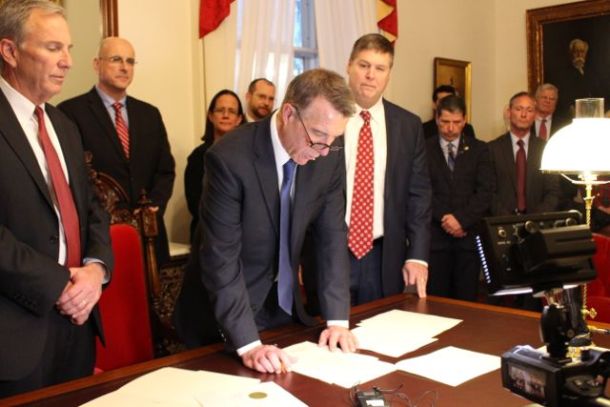
Gov. Phil Scott signed executive orders Thursday that would place Vermont’s public safety and law enforcement divisions under one roof and streamline the Natural Resources Board, the panel that reviews development projects under the state’s land use law.
One order establishes an Agency of Public Safety, which would contain a Department of Fire Safety & Emergency Management and a Department of Law Enforcement. Currently, the state police, emergency management and fire division all fall under the Department of Public Safety, with other law enforcement agencies spread across state government.
“By bringing together our public safety and enforcement functions under one agency, we will see better-coordinated operations, including training and accountability, as well as a consistent culture of fair and impartial policing, so this is the right time to begin this process,” Scott said Thursday.
The other order restructures the Natural Resources Board and its environmental district commissions, which review Act 250 permit applications. The board has operated under the same framework, largely untouched, for 50 years.
“Act 250 has served our state well by protecting the natural resources that Vermonters value, providing a voice for citizens, and ensuring adequate planning within Vermont’s regions,” said Julie Moore, secretary of the Agency of Natural Resources.

“However, the act’s basic administrative structure and governance has not been updated in a half-century and has not kept pace as the complexity of environmental, planning and regulatory issues has increased substantially.”
Under Vermont law, governors have the authority to make structural changes in the executive branch via executive order. The Legislature can reject the orders, but has only 90 days to do so.
In 2017, Scott used an executive order to establish the Agency of Digital Services. That year, he also tried to merge the Department of Labor and Agency of Commerce and Community Development, but legislators shot down the proposal.
They also rejected an executive order from the governor that would have merged the Vermont Lottery Commission and the Department of Liquor Control. However, in 2018, legislators approved the merger via their own legislation.
Neither of the proposals put forth in Thursday’s executive orders are new to the Legislature. The governor pitched both to lawmakers in the last legislative session.
Jason Maulucci, Scott’s press secretary, said the governor opted to make the changes by executive order because legislators are already familiar with the proposals, and it will allow the restructuring to happen rapidly.
When it comes to modernizing Act 250 — a tool that can be used to revitalize downtowns, help address climate change and manage forest fragmentation — he said, “time is of the essence.”
“This is a good way to kick-start the conversations and hopefully implement some of these, we think, important changes quickly,” Maulucci said of the order.
He said the Legislature was interested in both modernization efforts last year, but the changes didn’t end up passing, in part, because of the pandemic.
“These are proposals that were being talked about last year but with Covid, timing, I think, was the biggest barrier,” he said.
‘Some homework to be done’
In a statement, Senate President Pro Tem Becca Balint, D-Windham, said she has “personally connected with the governor around the thinking behind both executive orders” and will work with senators “to do due diligence and consider any possible concerns.”
“We in the Senate know that these executive orders address issues that are not new, and we’ll use our committee process and engagement with the governor’s team to determine if they are the best course of action,” Balint said.

Sen. Chris Bray, D-Addison, who chairs the Senate Committee on Natural Resources and Energy, said most lawmakers agree with making the Act 250 process more efficient and more consistent, but there is still debate to be had about how best to go about it.
“It puts some pressure on the Legislature to respond,” Bray said. “It’s basically rewriting the law and you would have to write some new laws to implement what the governor is proposing.
“There’s some homework to be done,” he said.
With the Natural Resources Board, the governor’s plan is to change it from a five-member panel to a system in which there is a chair and two full-time members. Two district commissioners would join the Natural Resources Board to review major Act 250 project applications from the region where they have jurisdiction. The restructuring gives more authority to the centralized board, over the local commissions.
The Scott administration said this system will ensure a “consistent and predictable permit review process and remains responsive to community concerns.”
The governor had pitched this proposal in 2020 but, after much debate in the Vermont House, it was scrapped from the Act 250 bill that made its way to the Senate.
Under the governor’s plan for the Agency of Public Safety, the newly created Department of Law Enforcement would at first house only the state police and Motor Vehicle DivIsion, which is now part of the Department of Motor Vehicles.
The order also includes a study to see if the Fish & Wildlife Warden Service, the Department of Liquor & Lottery Enforcement, and other state law enforcement groups could be added to the new department.
The agency’s Division of Support Services would also bring together the E911 Board, the Fire Service Training Council and Criminal Justice Training Council.
