


Editor’s note: Mark Bushnell is a Vermont journalist and historian. He is the author of “Hidden History of Vermont” and “It Happened in Vermont.”
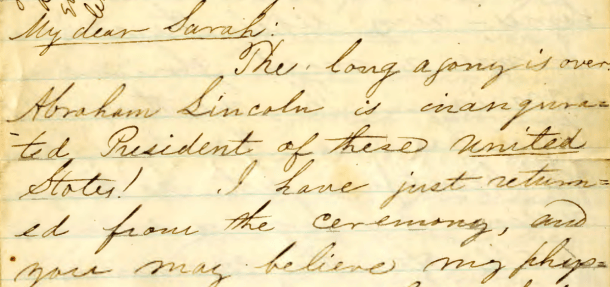
“The long agony is over. Abraham Lincoln is inaugurated President of these United States!” Charles Marshall Stone of St. Johnsbury wrote his wife, Sarah, on March 4, 1861. Stone had just witnessed the ceremony at the U.S. Capitol. He described Washington as tense, with so many soldiers on hand that it felt like a city under siege.

Charles, the 27-year-old owner and editor of the Caledonian newspaper, was excited that the long-awaited day had finally come, and he hoped that the new president would be able to keep the States united. He poured out his observations about that historic day in a six-page letter he mailed home to Sarah. The letter, written in a neat hand in dark brown ink on yellowing paper, is now in the collections of the Vermont Historical Society.
Stone was also relieved the ceremony was over. He was unsure if his “physical system” could have taken any more. “It was a terrible jam,” Stone wrote, “but I went with the Vermont delegation, which was assigned an excellent place. We were quite near the President.” The downside of their position was that it was in a standing section near a group of “roughs” who crowded into them.
Despite the jostling, he told Sarah he hadn’t seen any acts of violence — “no accident or especial disturbance” — though “I presume the telegraph has announced a good many.” He said the day had been a “grand pageant and military display” but he would refrain from describing it because she would probably have read better accounts in newspapers before his letter arrived. She might have also heard details from her father, Erastus Fairbanks, who was Vermont’s governor at the time.
Charles said Gen. Winfield Scott “has done everything to guard against surprise.” The 74-year-old Scott, a hero of both the War of 1812 and the Mexican-American War, had been tasked with keeping the capital safe.
Threats of violence had been numerous and real ever since Lincoln’s election back in November. As the candidate of the new, anti-slavery Republican Party, Lincoln had won the majority of the electoral votes, but only 40% of the popular vote because he had faced three challengers in the general election. In response to his victory, South Carolina announced it was seceding from the Union. Six more states followed suit in the run-up to Inauguration Day.
In mid-February, Congress convened to count the Electoral College votes. The election process gave “the South a chance to turn back the election,” explains historian Ted Widmer in his new book “Lincoln on the Verge: Thirteen Days to Washington.” “… Through parliamentary maneuver, or sleight of hand, it might be possible to declare a miscount and throw Lincoln’s election back into the cloakroom,” where Congress could pick a different winner.
Overseeing the Electoral College certification was Vice President John C. Breckinridge in his role as president of the Senate. Breckinridge also happened to have just finished second to Lincoln in the election.
Rumors circulated that plotters planned to blow up the Capitol or other public buildings to prevent Lincoln being sworn in. Other reports claimed that militias would attack the city and disrupt the count. And in fact, as Congress gathered to certify the electoral vote, an angry mob attempted to force its way into the Capitol, but Gen. Scott had stationed troops around the building. Scott declared that anyone who entered the building attempting to stop the count would be “lashed to the muzzle of a twelve-pounder and fired out the window of the Capitol.” The mob apparently took Scott at his word; the count was allowed to take place.
Despite the tensions and his own political ambitions, Breckinridge chose to fulfill his constitutional duties to assure an accurate count and certify Lincoln’s victory. Lincoln would succeed James Buchanan, a Northerner with Southern sympathies who had completely misread the political moment. In his own inaugural address four years earlier, Buchanan had remarked that slavery was, “happily, a matter of but little practical importance.”
Lincoln’s allies got wind of threats against the president-elect, including a possible plot to assassinate him as he traveled by train to Washington. The most dangerous part of the journey was thought to be Baltimore, where Lincoln would have to switch trains. Private detective Allan Pinkerton arranged to have telegraph lines into the city cut so that conspirators in Pennsylvania and Maryland couldn’t communicate with those in Baltimore. Pinkerton also secretly changed Lincoln’s schedule so he could switch trains earlier than had been announced. The president-elect arrived safely in Washington, but was mocked for years by rivals for sneaking into the capital.
Lincoln’s protection detail was more obvious on Inauguration Day as thousands of federal troops lined the streets. “A very large military escort accompanied the procession and stood guard about the Speaker’s Stand and Capitol,” Stone wrote to his wife. “The carriage containing the President elect + Buchanan was escorted in a hollow square completely surrounded by Cavalry.”
Stone said the “inaugural address was splendid, and delivered in fine style.” He had just heard one of Lincoln’s most famous speeches, in which the new president appealed directly to secessionists:
“We are not enemies, but friends. We must not be enemies. Though passion may have strained it must not break our bonds of affection. The mystic chords of memory, stretching from every battlefield and patriot grave to every living heart and hearthstone all over this broad land, will yet swell the chorus of the Union, when again touched, as surely they will be, by the better angels of our nature.”

While returning to his hotel after the ceremony, Stone saw a light artillery detachment stationed with cannons near City Hall. Each cannon was attached to a team of six horses, with soldiers standing by “ready to spring into the saddle at a moment’s warning. In five minutes after word should be given those cannons could have been placed in the Capitol grounds” and fired.
Stone had witnessed artillery units drilling several days earlier and was amazed by their “rapidity of movement.” “The cannons were taken from one part of the field to another with those horses upon the gallop,” he wrote Sarah, “and it was not half a minute after the horses stopped before they were detached from the carriages and the guns were loaded and fired.”
Anyone wishing to attack the government would face a stiff response. Stone noted: “There were soldiers now in every part of the city, much to the annoyance of the secessionists.”
Stone planned to leave Washington the next day with his traveling companions for the trip home. They had thought of leaving shortly after the ceremony, but learned that the first trains north would be overcrowded. They suspected that many of the passengers would be “Baltimore rowdies,” Southern sympathizers who had recently pelted federal troops with rocks as they traveled through the city. “(F)rom such company deliver us!” Stone wrote.
He’d been away too long, he wrote Sarah: “these eight days seem like eight weeks to me.” He longed to be home.
:

