

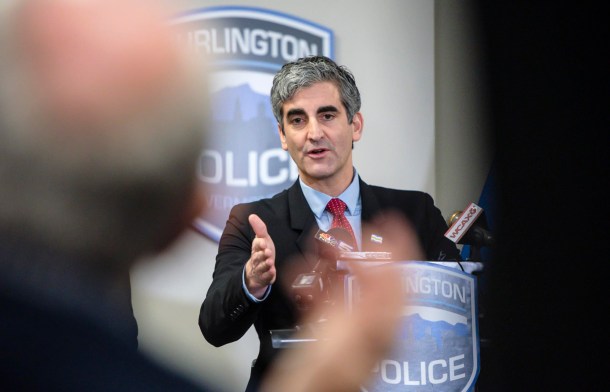
A U.S. District Court judge ruled Monday that Burlington Mayor Miro Weinberger will not be deposed in an excessive force lawsuit brought against the Burlington Police Department.
During an afternoon hearing, Judge William Sessions upheld a protective order and motion to quash the plaintiff’s request to interview Weinberger under oath.
The request was filed after a deposition with former Burlington Police Chief Brandon del Pozo revealed that Weinberger had prior knowledge about the fake Twitter account the chief had used to harass a critic, which led to del Pozo’s resignation.
Attorney Evan Chadwick, representing Albin, Charlie and Jeremie Meli in the excessive force lawsuit, filed the federal lawsuit following a fall 2018 incident during which former officer Jason Bellavance shoved Jeremie into a wall, knocking him unconscious.
Chadwick argued the new information provided by del Pozo — that he had shown Weinberger his fake Twitter account July 3, weeks before Weinberger disciplined him for the action and put him on administrative leave — could point to larger problems in the police department that Weinberger should be questioned about.
“One could argue that if someone is not being punished or disciplined or counseled at least with regards to their inappropriate or unprofessional social media,” Chadwick said, “that could also pass on to whether or not they are handling appropriately allegations of excessive use of force.”
He also wanted to depose Weinberger to clarify a city council resolution authorizing a $300,000 buyout of Bellavance. The resolution states that Bellvance was “exonerated” for excessive use of force, but it also states that he used “more force than necessary,” which Chadwick views as contradictory and in need of clarification by Weinberger.
In a protective order motion filed by the city’s law firm, Lynn, Lynn, Blackman & Manitsky, lawyers argued that legal precedent argued that high-ranking government officials should not be deposed unless there are “exceptional circumstances justifying the deposition.”
An exception could be made if these officials had unique, first-hand knowledge of the claims or if the information cannot be retrieved through “less burdensome or intrusive means.”
Sessions agreed with the defense that the plaintiff did not meet the burden of proof necessary to establish “exceptional circumstances” to dictate the need for Weinberger’s deposition.
“This is a case you brought about excessive force. It’s an incident that is at the heart of your complaint,” Sessions said. “And you know, frankly, when you start talking about the general failure to discipline in regard to social media accounts, that really is of tenuous relevance.”
At a Dec. 18 press conference, Weinberger said his insights wouldn’t advance the case.
“It isn’t clear here what additional information I could offer that has anything to do with this case, which is about officer Sgt. Bellavance’s interaction with Jeremie Meli,” Weinberger said. “It’s not at all clear what the questions that have been asked of Chief del Pozo and regarding his social media account, which is one of the reasons they’re trying to draw me in, has to do with that.”

