

RUTLAND — Richard “Mort” Wasserman had just retired from his faculty position at the Larner College of Medicine at University of Vermont when Covid-19 spread to the United States.
“I retired last November, and when the pandemic hit, I was feeling like I wanted to help out in some way,” he said.
So he reached out to a friend, Mark Levine, Vermont’s health commissioner and a former faculty member at UVMMC. Levine suggested that Wasserman join the Medical Reserve Corps.
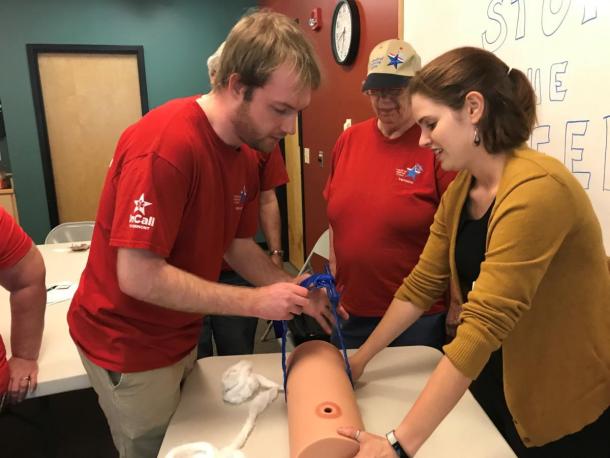
State officials have quietly deployed members of the Medical Reserve Corps, a national volunteer organization made up of health professionals and regular citizens, to help with Covid-19 projects all over Vermont.
In October, corps members assisted Mount Ascutney Hospital and Health Center with 11 clinics — held at schools, food shelves and senior facilities throughout southern Vermont — that distributed flu shots.
Volunteers have been deployed to Covid-19 testing sites across the state, helping to schedule and collect specimens at Southern Vermont Medical Center, for example. They’ve also helped to screen and greet customers at hospitals, and even at the Department of Motor Vehicles in Rutland and South Burlington when the offices reopened.
“It’s anyone with a public health interest,” said Derek Pitts, Vermont’s Medical Reserve Corps coordinator. “We do need nurses and (licensed nursing assistants) and medical assistants, mental health specialists — people with clinical experience. But in order to support those people, we need just as many non-medical people.”
In Rutland, volunteers were deployed to assist Rutland Healthcare and Rehabilitation Center when a Covid-19 outbreak sidelined much of the staff. A local organization, Project VISION, sent an email blast calling the request “urgent.” Medical Reserve Corps volunteers would screen staff as they checked in, help deliver meals, and engage in one-on-one activities with patients who suffered from memory loss, the email said.
Two registered nurses and a few additional volunteers signed up for the high-risk job.
“The program exists for this purpose, to help these facilities,” Pitts said. “Basically, the idea is that people get their credentials and background check, and get pre-cleared before a disaster.”
The Medical Reserve Corps saw a spike in volunteers at the beginning of the pandemic, when Gov. Phil Scott pleaded for Vermonters to consider taking up the work.
“I am asking every Vermonter to dig deep and find a way to give more in this incredibly challenging time,” Scott said then.
Wasserman was part of that surge, signing up in April. He joined a project led by the state health department to distribute pulse oximeters to people who test positive for Covid-19.
A pulse oximeter, used by doctors during routine exams, is a device that clips onto a patient’s finger, detecting the level of oxygen in the blood. Oxygen levels can decrease rapidly in patients with Covid-19 before they experience worrisome symptoms. Levels that stay in the low 90s and high 80s indicate that a person’s condition is deteriorating and they should seek immediate medical help.
Pulse oximeters can be shipped to anyone in Vermont who has Covid-19, Wasserman said, though only about a quarter of Covid-positive people have signed up for the service. He hopes to spread awareness about the availability of pulse oximeters, and to encourage people with Covid-19 to log their symptoms in the state’s online database.
Along with Richard Hopkins, a retired epidemiologist based in Addison County, Wasserman calls people with Covid-19 who are interested in being monitored, but who don’t have access to a computer or internet. The callers collect data about symptoms and make sure patients’ conditions aren’t worsening. In the late spring, that group included a number of new Americans who had the virus.
“We were doing all this with translators,” he said. Through an interpreter, he’d ask how each family member was feeling, and would record symptoms and readings from their pulse oximeters.
He said he’s called around 20 households, many with multiple people who have tested positive for Covid-19, and an additional 20 individuals. He thinks, with Hopkins, they’ve easily reached more than 100 people.
In addition to patients who can’t go online to use the symptom reporting tool, Wasserman contacts people who have agreed to report their symptoms, but haven’t logged any. He also calls if he notices that someone has reported a concerningly low oxygen reading or other troubling symptoms, and advises them to seek medical attention. Wasserman draws the line at acting as their physician, though — that’s not his role, he said.
Wasserman is considered part of the “at-risk” category because he’s over 70 yeas old. His role in the Medical Reserve Corps allows him to keep a distance from Covid patients while offering an opportunity to use his sorely needed skills.
“I mean, I had just stepped away from clinical work, and all of a sudden, we’re hit by a pandemic,” he said. “I had mixed feelings. One was, ‘Wow, this sounds like a really hard situation, I’m glad I’m not there.’ And then the other piece of it was, ‘You better figure out how you can help, because there’s going to be a role for retired people.’”
Wasserman said he hopes to see more people who have tested positive for Covid-19 sign up for the state’s monitoring services.
“We have capacity to do more,” he said. “I’m sure they could draft other members of the Vermont Medical Reserve Corps into doing this. And they may need to, because things are going to get worse before they get better.”

