


Jon Margolis is a political columnist for VTDigger.
The state Senate is poised to complete the work begun by the House and override Gov. Phil Scott’s veto of the Global Warming Solutions Act.
That will make Global Warming Solutions Act law, meaning that global warming, at least in Vermont, has been solved.
Or perhaps not.
Solving global warming requires using less fossil fuel, the burning of which creates the greenhouse gases heating the world.
The new law cuts fossil fuel use by exactly zero. Not one less ounce of coal, gallon of oil, or cubic foot of natural gas will be burned thanks to passage of this bill (H.688).
The law does convert Vermont’s emission reduction “goals” into “requirements.” But establishing requirements is easy, like calling “spirits from the vasty deep,” as a Shakespearean character claimed he could do.
“But will they come?” was the reply. This law requires. It does not accomplish.
That doesn’t make it worthless. The law establishes a mechanism which could cut Vermont greenhouse gas emissions in the future. Johanna Miller, the director of the energy and environment program for the Vermont Natural Resources Council, said the law “forces state government to focus on this issue.”
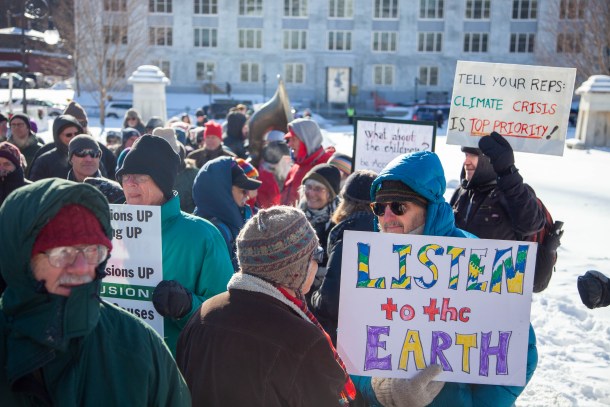
But she also acknowledged that nothing in the GWSA “actually reduces emissions,” raising the question of why the bill created such a hullabaloo. Its supporters warned of the “climate crisis” that awaited should the bill not pass. Scott scorned it as “poorly crafted legislation that would lead to bad government.”
Part of the answer to that question lies in the peculiarities of the climate debate in Vermont, one of the few states where almost nobody – or at least nobody with any political clout – dissents from the scientific consensus that burning fossil fuels is heating up the Earth. That explains why the bill passed both houses so easily (102-45 in the House; 23-5 in the Senate). Climate change denial is a political loser in Vermont.
But while Scott said he shared “the Legislature’s commitment to reducing greenhouse gas emissions,” he and Republican lawmakers don’t like the way this law goes about that task. What the bill should have done, Scott said, was deliver “actual global warming solutions.”
Not a bad idea, and he’s right to point out that the law doesn’t do that.
But with one exception, he hasn’t proposed any actual solutions either, even though he’s the governor, and one job of governors is to propose actual solutions to problems.
In this case, Scott and the Legislature seem to have the same reason for doing just about everything but proposing actual solutions. Those solutions are expensive and/or unpopular.
Most Vermont emissions come from burning gasoline and oil to propel cars and trucks and to heat homes. So there is no way the state can reduce emissions unless Vermonters drive less (or drive more fuel-efficient vehicles) and use less heating fuel.
The real solutions, then, are simple: increase the cost of driving by a new tax on gasoline; subsidize electric cars (Scott’s one initiative), increase public transportation, pay people to put more insulation and better windows in their houses.
Everything in that list costs money except for raising the tax on gasoline. Any legislator who votes to raise the tax on gasoline risks losing the next election. That’s why the Global Warming Solutions Act provides no solutions for global warming. Instead it establishes a 23-member Vermont Climate Council which may or may not be unconstitutional (Scott’s view) but also may or may not be unwieldy.
This council is to identify, evaluate, analyze, update and recommend. It’s hard to see how it could recommend anything that does not include those unpopular and/or expensive items listed above.
From that perspective, both passage of the law and Scott’s veto can be seen as ways to avoid what everyone knows has to be done but no one wants to do, at least not now.
Again, this does not render the law useless. Setting up a mechanism to deal with a problem is arguably better than not setting up a mechanism. The council could come up with some innovative ideas. So might private advocates, encouraged by passage of the law. The VNRC’s Miller said environmental organizations have some “big ideas under discussion” to try to find “different funding and financing strategies” to help people weatherize their homes.
There is one other way in which the global warming debate in Vermont is peculiar, and this is a residue of the years of bitter battles over wind power. Those battles created a rift among environmentalists, with the “establishment” green groups (VNRC, Conservation Law Foundation, etc.) supporting more wind projects while the more off-beat Vermonters for a Clean Environment and Energize Vermont opposed it.
The pro-wind forces won most of the battles – five major wind projects dot (or mar, depending on taste) the state’s ridgelines – but lost the war. As one disappointed wind developer put it earlier this year as he abandoned his project, Vermont has “a current political environment that is hostile to wind energy.”
But the “winners” of that war remain wary, worrying that any global warming plan could serve as a cover for a campaign for more wind projects.
This suspicion is based as much on conspiracy theorizing as on hard evidence, as some of its purveyors acknowledge.
“I know I sound like a QAnon nut,” said Energy Vermont President Mark Whitworth.
But as with most conspiracy theories (no, not QAnon) there is just enough evidence behind this one to render it not completely irrational. The Department of Public Service’s latest (2016) Comprehensive Energy Plan envisions a future in which more Vermonters drive electric cars and heat their homes with electric-powered heat pumps.
So the state would actually use more electricity, but “more of the … electric power supply (would be) generated by solar, wind, and hydro resources.”
On top of that, Whitworth said, is S.267, a bill which ”got derailed but will be back,” which would require that 100% of Vermont’s electricity in 2050 be from renewable sources but limits how much of it could come from Hydro-Quebec, now the source of so much of the state’s power.
Not much more far-fetched than thinking that the Global Warming Solutions Act is a solution for global warming.
