

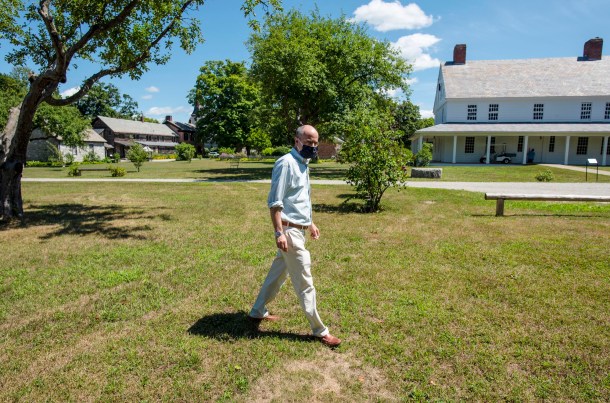
The Lake Champlain Maritime Museum’s day camps usually draw Vermont kids to build fishing rods, work in the blacksmith shop, or study 18th century battles.
The puzzle for Susan McClure, the museum’s executive director, this year has been to bring kids together despite the Covid-19 pandemic. She’s determined to retain the museum’s educational mission despite the shutdown.
“How do you create something that is a different kind of good?” McClure said.
That’s a question a lot of nonprofit organizations have been asking since they closed their doors, and in many cases stopped operating, as the Covid-19 virus started spreading in Vermont in March.
Vermont’s nonprofit sector is large and variable, and the crisis has caused an uneven impact among its estimated 4,500 nonprofit organizations. Nonprofits, especially those that provide direct services to vulnerable populations, “are facing significant financial uncertainty, with limited ability to provide direct services and to support their staff,” said Morgan Webster, director of the Common Good, a Shelburne organization that works closely with Vermont nonprofits.
Like other businesses, nonprofits had to quickly send their employees home to work remotely and to stop offering their services to limit the spread of Covid-19. And, like other businesses, many nonprofits applied for the federal Paycheck Protection Program loans that became available last spring, which a handful were able to use to pay workers’ salaries and which will be converted to grants if the grantees meet all of the criteria.
But unlike businesses, many nonprofits aren’t all well positioned to take advantage of the $150 million state business grants program that became available July 6, one of the first programs providing direct aid to businesses affected by the pandemic.
That’s because when the Legislature designed the Vermont Economic Recovery Grants program, which uses a share of the $1.25 billion that Vermont received from the CARES Act emergency measure passed in March, it said the state must exclude charitable donations when calculating how much money a business had lost. Only earned revenues, such as ticket sales, would be counted.
The grants, of up to $50,000, are based on 10% of the revenues of the business or nonprofit. Under the Legislature’s rules, nonprofits that rely on charitable donations had little revenue to report, so their grant awards don’t reflect their operating budgets.
“If you have, hypothetically, an arts organization that does $200,000 in grant revenues, but they only have $5,000 in earned revenues, then 10% of $5,000 is, great, you’ll get a $500 grant,” said Jody Fried, executive director of Catamount Arts in St. Johnsbury. Fried, who is chair of the Vermont Creative Network, thinks the criteria should be modified. “They’ve done a really good job of getting dollars out quickly, but it has not addressed the need out there.”
Some nonprofits — such as social service contractors — do earn a significant portion of their revenues from their services, and are therefore well-positioned to use the state grants program.
The business grant program also includes a separate $5 million for arts organization, administered by the Vermont Arts Council. There are also grants programs in sectors such as agriculture, which includes its own cadre of nonprofit organizations that can apply. Together, the Vermont Arts Council and the Vermont Humanities Council have awarded nearly $1 million in grants to arts and culture organizations and to individual artists.
The Vermont Community Foundation has a grants program for nonprofits. Even the state Department of Buildings and General Services has a capital improvements grant program that is available to nonprofits. And a multitude of private organizations, such as Grass Roots Fund of New England, have mustered support with small grant programs.
But for Vermont arts organizations supported by grants and donations, there isn’t enough aid, Fried said.

“It’s just a start,” he said. “We estimate thus far that there’s been about $50 million in lost revenues in the creative sector.”
To apply for more assistance, nonprofits are gathering data on the impact of the pandemic. Common Good and allied nonprofit associations are surveying their members now in an effort to find out. In a 2018 study by the Nonprofit Finance Fund, a nonprofit lender, 62% of nonprofits reported that financial sustainability was their top challenge. And that was before the pandemic.
The region’s nonprofits are particularly vulnerable, said Tom Denenberg, director of the Shelburne Museum.
“Northern New England tends to not have cultural institutions with endowments that are scaled to the size of their operation,” he said. “So when times get rough, we don’t have the interest or the endowment income to rely on.”
State officials are aware that the $150 million fund hasn’t met the needs of nonprofits, said Ted Brady, deputy secretary of the Vermont Agency of Commerce and Community Development. Meanwhile, only about $90 million in grants has been distributed since the program opened to applications July 6.
Brady said 100 nonprofits have received $2.7 million through the emergency economic recovery grant portal so far. However, “nonprofits haven’t had access to a lot of the grants other businesses have had,” Brady said. It complicates the grant application process that nonprofits don’t file a state tax return, only a federal return.

“That tricky part is unintentional,” Brady said of the stipulation that only earned revenues be counted as revenue, not charitable donations. But he added that a review of grant applications showed charitable donations and grant revenue hadn’t declined as much as program revenues had.
“You can still donate $100 to your favorite charity in the time of Covid,” Brady said. “I don’t want to pretend it’s perfect, but there is actually good government logic here. While charitable donations may have declined during Covid, they weren’t prohibited the way program revenue may have been.”
Much of the emergency grant program was designed this spring and summer by the Senate Committee on Economic Development, Housing and General Affairs. The group was working fast, over Zoom, to set up rules for administering millions of dollars in federal money to help businesses stay afloat. Its members expect to change some of the details when lawmakers return Aug. 25, said Sen. Alison Clarkson, vice chair of the committee.
“It was all happening very fast, and it’s easy when you’re moving fast to miss some of the things on the sidelines,” Clarkson, D-Woodstock, said this week. “So now we get an opportunity to look at the businesses that were left out in getting relief. We need to figure out how impacted they are and try to help them.”
Correction: An earlier version of this story referred incorrectly to the director of Common Good. She is Morgan Webster.
Get the latest statistics and live updates on our coronavirus page.
Sign up for our coronavirus email list.
Tell us your story or give feedback at coronavirus@vtdigger.org.
Support our nonprofit journalism with a donation.

