




Political newcomer Molly Gray swept past Senate President Pro Tem Tim Ashe and two others Tuesday to capture the Democratic nomination for lieutenant governor. She will face travel executive Scott Milne, who outpolled Meg Hansen and three others for the Republican nomination.
Gray, an assistant attorney general, beat out Ashe, Chittenden Sen. Debbie Ingram and Brenda Siegel, an activist and former gubernatorial candidate.
The Associated Press called both races around 10 p.m.
With more than 90% of precincts reporting, Gray was maintaining a lead of more than 11 percentage points over Ashe, with the others farther back.
In a statement, the 36-year-old Newbury resident thanked her fellow Democratic candidates and said she is “humbled by the support” for her candidacy.
“I entered this race because now is the time for the next generation of Vermont leaders to step forward and to ensure that rural communities have a strong voice in Montpelier,” said Gray, who also is an adjunct professor at Vermont Law School.
“While so much about our future is unclear, I believe in Vermont, in our communities and our people,” she added. “As your neighbor, your fellow Vermonter, and now your Democratic nominee for lieutenant governor, I promise to be by your side every step of the way.”
The Ashe campaign told VTDigger the outgoing Senate leader was not available for comment Tuesday night.
Milne, the president of Milne Travel who narrowly lost a bid for governor in 2014, was gaining just more than half the vote on the GOP side. Hansen, a health care advocate and communications specialist, had about 33% of the vote.
Milne said in an interview just before the race was officially called Tuesday night that he was successful running on his record as a businessman and his hope of working with Gov. Phil Scott to rebuild the state’s economy.
“What the election is about, as is the primary I believe, is who the most qualified candidate to be a trusted partner for Gov. Scott,” Milne said. “I’m going to just keep with our message of I look forward to putting three decades of experience owning a small business and being relatively successful with it.”
Hansen, who said “I put everything on the line” in her first run as a Republican for statewide office, declined to say whether she would support Milne in the general election,
The Manchester resident said she sees Milne’s decision to enter the race as a “personal attack” against her.
“Of course I want Republicans to win, but I see this as a very personal attack and a concerted effort to make sure that our campaign loses,” she said.
The state’s No. 2 position had come open when Lt. Gov. David Zuckerman announced he woud seek the Democratic nomination for governor. He defeated Rebecca Holcombe Tuesday and will face Gov. Phil Scott in November.
The four-way Democratic race to succeed Zuckerman was a competitive affair that continued well into the evening Tuesday.
Early on in the campaign, Gray received support from Vermont’s Democratic establishment, including former Gov. Madeleine Kunin and others. In contrast, her top rival, Ashe, positioned himself as the political outsider — despite his 12 years in the Vermont Senate.
While Ashe and Ingram were busy with the legislative response to Covid-19 until the end of June, Siegel and Gray continued to campaign with the latter setting up a formidable fundraising apparatus.
Between when Gray announced her candidacy in January and the end of July, she had raised $213,680 — more than double Ashe’s total haul.
In Ashe’s own pitches to donors, the outgoing Senate leader criticized Gray for running a campaign funded by “political and donor elites.”
And while he did not receive an endorsement from Sen. Bernie Sanders, I-Vt., he made sure to highlight how his experience working for the congressman in the late 1990s and early 2000s had inspired him to seek higher office.
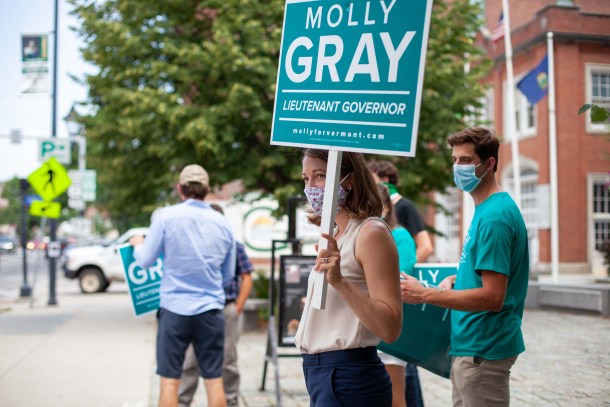
During the campaign, questions were also raised about Gray’s residency status and the constitutional requirement that candidates for governor and lieutenant governor “reside” in Vermont for four years before holding the office.
In a VPR-Vermont PBS debate, Ingram targeted Gray’s eligibility, citing reporting by VTDigger that for 15 months between 2017 to early 2018, Gray had lived in Switzerland working for a human rights nonprofit focused on private military contractors.
Gray has said that during this timeframe she also traveled to the Middle East and back to Vermont — where she retained her legal residency.
“I wouldn’t be running if I wasn’t eligible,” she said. “I am eligible. And it’s a legal question with a legal answer and there is a legal opinion that has been verified by legal experts,” Gray told VTDigger last week.
The first-time political candidate has also been dogged by reports that she had not voted for four election cycles between 2008 to 2018, which has drawn criticism from Democrats and Progressives alike.
While Gray captured the most votes in the Democratic primary, some voters interviewed Tuesday at the polls were not enamored with her.
At the Burlington Electric Department, a polling location in the city’s South End, Lauren Robinson, 26, who voted for former education secretary Rebecca Holcombe for governor — “partially because she’s a woman” — said she decided to vote for Ashe instead of Gray in the lieutenant governor contest.
“She seems like someone I really want to follow but maybe is not quite ready,” she said. “I will be really excited to see where she is in four years.”
Alison Segar, another woman voting in the South End said, “Tim Ashe, no question” when asked whom she was supporting.
“He’s put in the years,” she said. “Never Molly Gray,” she added. “I’m a firm believer that you have to roll up your sleeves and get your hands dirty and she has not done that in any sort of local or state government.”
Gray will now meet Milne, who has run two statewide campaigns in the general election and who has already aligned himself with popular Gov. Phil Scott — who has endorsed him. Milne lost a campaign against former Gov. Peter Shumlin by a narrow margin in 2014 and failed to unseat popular Sen. Patrick Leahy, D-Vt., in 2016.
Milne and Scott will be formidable opponents come November, and the Vermont Democratic Party has already been on the attack, going after Milne — and his connection with the governor.

The party first criticized Milne in June, accusing the Republican of skirting campaign finance law by continuing to run ads for his company. A VTDigger fact check found that claim to be false.
Then on July 24, the Democrats lobbed another salvo, claiming Milne’s business experience is overblown because the firm he heads was founded by his parents. The party also claimed “there is nothing historic about losing a political campaign,” referencing the tight 2014 race with Democratic Gov. Peter Shumlin.
The Democrats went after Milne again on July 27, releasing a statement condemning VTDigger for citing Ingram’s 2017 DUI in a profile of the candidate and not including similar incidents involving Milne’s drunk driving and drug use as a college student.
In 2014, during his challenge to Shumlin, Milne sent a statement to Vermont media outlets disclosing that during his time at college — now 41 years ago — he was arrested twice for driving under the influence and once for possession of a small amount of marijuana and cocaine.
While the Democratic Party has been quick to target Milne, the moderate Republican is already eying potential weaknesses in his Democratic opponent and has not ruled out challenging Gray’s eligibility for the state’s second highest office.
Xander Landen contributed reporting
