

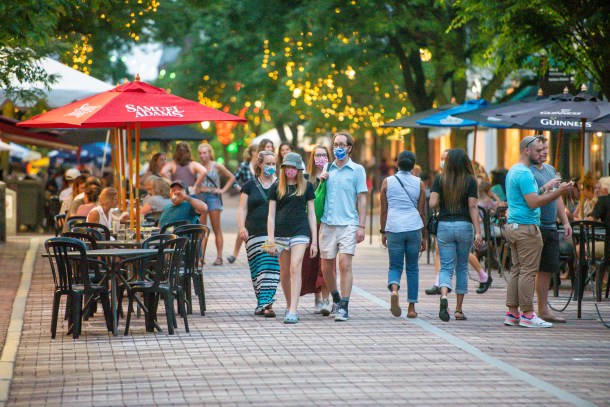
In this column, VTDigger business and economy reporter Anne Wallace Allen looks at the debate over calls for a statewide mask mandate.
When Dan Fraser, the soft-spoken proprietor of Dan and Whit’s general store in Norwich, asked a customer to put on a mask in accordance with store policy July 3, the customer called him a “f—ing douchebag” and stormed outside. A bystander who followed the man into the parking lot to remonstrate got the middle finger.
The episode is just one of many that have erupted recently as Vermont business owners seek to enforce their own mask rules to keep customers and staff safe from Covid-19. Recently, register traffic at the Marshfield store was blocked for several minutes as two customers debated the efficacy of cloth facial coverings.
Many store owners say a statewide mask mandate would make their lives easier. Several municipalities – most recently Woodstock – have enacted them.
“This weekend, there were people here from all over the Eastern Seaboard, and nowhere near all of them were wearing masks,” said Gary Smith, who owns a pharmacy in Woodstock, before the Woodstock mandate was approved. Like many others, Smith thinks the governor should order people to wear masks when in public.
“I would like to see the governor do this. This is so big, this goes to the national level, to the fact that there isn’t science anymore in this country,” said Smith.
Gov. Phil Scott has been hearing pleas for a mask mandate for weeks. The topic erupts regularly on social media and has come up at Scott’s Covid-19 press conferences almost since the crisis began in March.

As he has with other new state guidance – such as business closures and crowd limits – Scott has steadfastly insisted that education works better than a mandate, maintaining that Vermonters will do the right thing when reminded. That said, the state has also sent law enforcement to businesses when education wasn’t enough to keep them in line with social distancing guidelines. But right now, while the state requires masks in many work settings, including for store employees if they’re not behind a screen of some sort, retail stores have to decide for themselves whether customers need to put on a mask indoors.
For this, Scott is getting flak from Democrats who hope to run against him in November. Lt. Gov. David Zuckerman likened Scott’s position on masks to that of a figure who is politically unpopular in Vermont, saying the governor has to decide, “if he’s going to follow the lead of President Trump, listening to a small minority base who believes their inconvenience in wearing a mask is more important than public health, or is he going to stand up to those folks and say everyone wears a mask to support the public good.
“He’s trying to have it both ways but I don’t think that’s acceptable in a pandemic,” Zuckerman said.
“The governor kind of caved,” said Smith, who added that he’s a Democrat who thought Scott was doing a good job in handling the pandemic “until he decided not to go near the mask thing with a 10-foot pole.
“It’s common sense,” Smith said of a mandate. “To suggest people wear a mask doesn’t cut it.”
It’s not just Democrats that want to see everyone required to wear a mask, at least indoors. Coventry Republican Rep. Mike Marcotte, a convenience store owner and chairman of the House Economic Development Committee, said less than half of his customers wear masks into the store. He’d like to see a mandate.
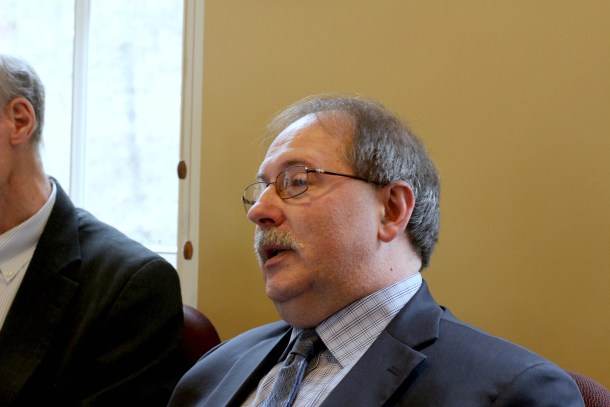
“A lot of them will come in and say, ‘I forgot my mask, sorry,’ he said. “I have other people who are wearing a mask but they have it around their neck. The mask isn’t you doing you any good, or me any good, if it’s around your neck.”
In May, the governor asked the Vermont Retail & Grocers Association to survey its members on the question of a mask mandate. Seventy-one percent of respondents said they did, said Erin Sigrist, the president of the association. Scott asked for a second survey in June. This time, 55% of respondents said they supported a mask mandate.
Sigrist said July 6 that she suspects support for masks might be heading back up again, with the state expanding the areas from which people can visit without quarantines.
“With the border opening up to more visitors, we’re hearing that out-of-staters are not necessarily as open to wearing face masks as maybe Vermonters have been,” said Sigrist, who is considering yet another survey. “There continues to be concern about confrontations between customers and employees.”
The National Federation of Independent Business takes a similarly noncommittal approach, with no position on a mandate, said Shawn Shouldice, NFIB’s Vermont director. “However, we are concerned about the potential liability if a mandate, by either law or executive order, is put in place and a customer refuses to wear one.”
There are also practical concerns.

“A year ago, if somebody came into our store with a mask on, our cashiers would be pretty fearful they were going to get robbed,” said Casey Harrington, who owns Beverage Baron in Barre. Harrington opposes a mandate, saying there’s no proof the mask is effective in stopping the virus. He thinks one of his employees might have gotten pneumonia because she was wearing a mask. “Also, we have a problem with shoplifters,” he said. “It’s pretty hard for the police to identify people when they have masks on.”
On July 1, a team of Goldman Sachs economists released a report saying that a national mask mandate could help the nation scale back the expensive social distancing measures that are slowing the economy and putting millions of people out of work.
The researchers acknowledged that mask mandates are “an inherently political decision,” but in their report, they stuck to the science, finding mask usage significantly cuts back on infection – and that a mandate would increase usage.
There’s no question Scott is experiencing that “inherently political” fallout.
“The governor kind of caved,” said Smith. “It’s common sense,” he added of a mandate. “To suggest people wear a mask doesn’t cut it.”
But Scott’s holding out. Asked about the issue July 7, Scott noted that he wears a mask, and that the state’s creating an educational campaign on the issue.
“I want people to wear a mask when they can’t physically separate themselves from each other,” Scott said. But “the enforcement piece is always the problem, as we’ve seen throughout the country. California has a mandatory mask policy, yet they are one of the top three states at this point in terms of active positive rates.”
Yet the governor also hinted July 7 that he’s open to change.
“I am not saying we’ll never implement it,” he said. Vermont has excelled in suppressing the spread of the virus, he noted. “Our track record is good. So we’ll continue down this path until we see the numbers change or shift in the other direction.”

