


The Vermont Senate approved legislation Thursday that would legally mandate the state meet carbon emission reductions targets in the coming years, and allow individuals to sue the government if it doesn’t.
The bill, H.688, known as the Global Warming Solutions Act, has been a priority this session of the Democratically-controlled Legislature.
The measure, which was approved in a vote of 22-6, would require the state to reduce greenhouse gas pollution to 26% below 2005 levels by 2025. Emissions would need to be 40% below 1990 levels by 2030 and 80% below by 2050.
Emissions have increased in recent years, with the most recent data from 2015 showing emissions 16% higher than 1990 levels.
Like many bills that predated the Covid-19 pandemic, the Global Warming Solutions Act stalled in the Senate for months after it passed the House in February. It moved out of committee earlier this week.
While the legislation sets up new emissions reduction requirements, it does not spell out or dictate how the state will meet them.
Instead, it creates a 22-member council, comprising state government officials, citizen experts and others, to come up with a pollution reduction plan by Dec. 1, 2021.
It would then be up to the Agency of Natural Resources to adopt new rules to regulate greenhouse gas pollutants by the following year. And it would be up to the Legislature enact policies aimed at cutting emissions proposed by the council.
Gov. Phil Scott has not said he would veto the legislation, but he has outlined concerns with the Global Warming Solutions Act.
He and his administration have argued that the bill could lead to costly legal battles and undermine the state’s efforts to address climate change.
“Without delaying the sense of urgency that clearly surrounds our work on climate change we need to approach that urgency prudently,” Julie Moore, the secretary of the Agency of Natural Resources, told the Senate Judiciary Committee on Thursday.
“And I’m concerned that H.688’s urgency may be a bit short sighted and end up causing unwanted delay in the middle term with litigation taking center stage.”

Under the legislation, the state could not be sued for damages — it could only be court-ordered to improve efforts to meet the emissions goals.
Proponents of the bill say that giving Vermonters a way to hold the state accountable for reducing emissions is essential to make sure the government actually meets its targets.
“It’s about time we give citizens a tool, and it’s about time that we set up an actual process, to not just hope that we will get somewhere, but to, in fact, look at how could we possibly redesign our economy in a way that has us not importing fossil fuels,” Sen. Chris Pearson, D/P-Chittenden, the co-chair of the Legislature’s climate caucus, said on the virtual Senate floor.
Democratic Majority Leader Becca Balint, D-Windham, said that the bill “is not enough” but she called it a “great first step that many states have already taken.
In the last 10 years or so, other states including Connecticut, New Jersey, Massachusetts and Maine have enacted similar legislation requiring that they cut emissions in the coming decades.
“We are not leading, we are following,” Balint said. “We have other models to look to, to help us through this important work.”
Most Senate Republicans opposed the legislation.
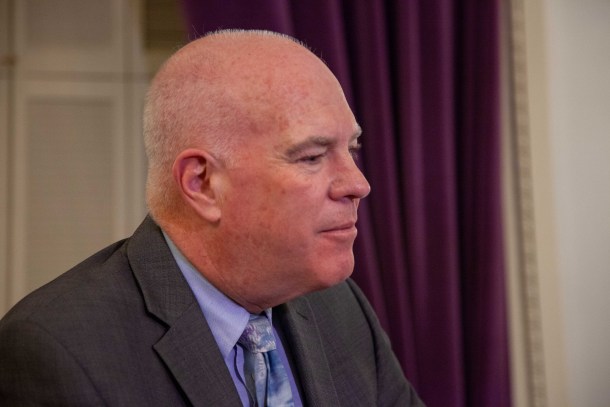
Senate Minority Leader Joe Benning, R-Caledonia, who voted against the measure, said that Vermont would not be able to meet the emissions mandates laid out in the bill unless it took “very draconian measures.”
And he argued that because of Vermont’s small size, reducing the state’s carbon footprint will not have an impact on global climate change.
“We have to be cognizant that we are using a tool that will not achieve global warming reduction, because that 50-foot hole cannot be dug with a toothpick,” he said.
“We are a very small state, and a very small group of people, and if every one of us was to disappear from the planet today, Vermont’s environment might look a little better, but the reality is we will have absolutely no measurable effect on global warming.”
Benning, in addition to three other Republicans and Democratic Sens. John Rodgers and Bobby Starr, of Essex/Orleans, opposed the legislation. Republican Sens. Richard Westman, R-Lamoille, and Jim McNeil, R-Rutland, supported the bill.
Sen. Dick McCormack, D-Windsor, said the bill does not go far enough to fight climate change. McCormack said that the state needs to impose a carbon tax, and expand alternative energy sources and mass transit.
“If this is the best that’s going to come out of the Senate, this Legislature this year, it is a terrible disappointment,” he said. “But it’s not a bad bill, just not enough.”
The Global Warming Solutions Act is expected to pass in a second vote on Friday, and then return to the House.
